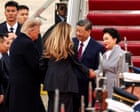
State visits between superpowers are rarely spontaneous. Every gesture, from the altitude of a military flyover to the choice of tarmac versus portico, is calculated to project power, manage domestic optics, and signal strategic intent. When an American president steps onto the tarmac at Joint Base Andrews to greet a visiting Chinese counterpart planeside, standard diplomatic protocol is deliberately upended. This break from tradition offers a diagnostic window into the current state of bilateral mechanics, revealing how transactional diplomacy operates under conditions of extreme structural friction.
The Economics of Protocol Signaling
In international relations, protocol is a currency of statecraft. Traditional state visits adhere to a rigid hierarchy of reception: foreign leaders arrive at military airbases, transit to secure compounds, and receive formal military honors at the executive seat of government. Moving the primary reception point to the airport tarmac bypasses bureaucratic buffers and introduces direct, unmediated visual signaling.
This asymmetry serves a dual function. First, it elevates the status of the visitor, providing an immediate domestic political win for Beijing that can be broadcast across state media to validate China's standing as a co-equal global pillar. Second, it grants the host executive direct control over the narrative frame, bypassing the formal institutional filter of cabinet departments and legislative branch oversight.
When analyzing this interaction through the lens of game theory, planeside greetings represent a costly signal. Because the host leader expends political capital and time—exposing themselves to weather, unpredictable live acoustics, and immediate media scrutiny—the gesture communicates a high valuation of the ongoing negotiation. It signals urgency. Beneath the red carpets and honor guards lies a compressed timeline of economic pressures, specifically the looming expiration of temporary trade truces and the escalating technological competition over artificial intelligence architecture.
Structural Interdependence and the Technology Bottleneck
The substantive agenda underlying high-level summits between Washington and Beijing is anchored by two immutable realities: mutual economic exposure and structural technological divergence. Despite years of rhetorical decoupling and tariff escalations, bilateral trade volumes remain massive, forcing both administrations into managed coexistence.
The primary friction point has shifted from traditional manufacturing and agricultural tariffs to foundational technological infrastructure. Computing power, semiconductor fabrication equipment, and proprietary algorithms form the new strategic high ground. The inclusion of major technology executives—representing artificial intelligence labs, semiconductor designers, cloud providers, and aerospace infrastructure—at state dinner proceedings underscores the convergence of corporate power and geopolitical statecraft.
Under the hood, this dynamic is driven by a zero-sum race for computational dominance. When political principals meet while trade enforcement mechanisms hang in balance, the negotiation space is constrained by domestic security imperatives. Washington views advanced semiconductor restrictions as a national security imperative designed to constrain military modernization. Beijing views the same restrictions as economic containment aimed at arresting national rejuvenation.
The negotiation strategy deployed by both sides relies on functional compartmentalization. Economic officials negotiate trade truce extensions to prevent market shocks, while security apparatuses maintain strict export controls on advanced hardware. This bifurcation allows both governments to project stability to global financial markets while continuing strategic competition below the threshold of open conflict.
Audience Cost and Domestic Political Constraints
Every international summit is played simultaneously on two boards: the international negotiating table and the domestic political arena. Leaders must calibrate their actions to satisfy disparate domestic constituencies whose demands are frequently mutually exclusive.
For an American president facing domestic economic anxiety, high inflation metrics, and skeptical legislative blocs, summit pageantry serves as a mechanism to demonstrate decisive leadership and economic management. However, physical staging carries inherent risks. A visible wince during a military flyover or awkward wardrobe choices on a relatively warm tarmac can instantly hijack media cycles, transforming a designed display of strength into fodder for online mockery and cable news critique. These operational hiccups illustrate the fragility of highly choreographed political theater.
Conversely, Beijing utilizes summit imagery to reinforce an internal narrative of national respect and parity. For domestic audiences in China, footage of an American president greeting their leader at the airplane door validates the official party line that China's rise is recognized and accommodated by the preeminent global power.
This divergence in domestic utility explains why summits often produce high symbolic output alongside narrow substantive agreements. Both leaders derive immediate political utility from the optics of engagement regardless of whether intractable structural disputes over intellectual property rights, territorial claims, or industrial subsidies are resolved.
The Corporate State and Silicon Valley Intermediaries
The integration of private sector tech executives into state-level diplomacy marks a notable evolution in great power competition. Modern geopolitical leverage is no longer monopolized by ministries of foreign affairs and defense departments; it is increasingly wielded by multinational technology conglomerates controlling critical supply chains, artificial intelligence foundation models, and global communications infrastructure.
When executives from semiconductor giants, frontier artificial intelligence developers, and aerospace innovators are seated at state dinners, they occupy a complex position as both instruments of national strategy and commercial entities seeking access to global markets. This creates a regulatory trilemma for state planners:
- Protecting domestic technological advantage against foreign acquisition.
- Maintaining corporate profitability and research capital derived from global sales.
- Preventing competitor nations from establishing technological standards that lock out domestic firms.
The dialogue between state actors and corporate leaders during these summits highlights the limits of government control over advanced technology. While export controls can restrict the physical shipment of advanced lithography machines or graphics processing units, open-source software diffusion and globalized research networks create persistent leakage pathways. Consequently, bilateral discussions frequently focus on establishing informal guardrails and compliance frameworks rather than achieving absolute technological separation.
Navigating the Structural Stalemate
The trajectory of bilateral relations between the United States and China cannot be altered by ceremonial pageantry or tactical trade truce extensions. The underlying structural drivers—demographic shifts, ideological divergence, and the competition for technological hegemony—guarantee a protracted state of strategic rivalry.
To navigate this environment without triggering catastrophic economic fragmentation or military escalation, decision-makers must abandon the illusion of permanent resolution. The objective is not harmonization, but systematic risk mitigation.
Establish bilateral crisis communication channels specifically dedicated to automated systems, artificial intelligence deployment thresholds, and maritime transit lanes. Decouple routine commercial disputes from national security mandates to prevent supply chain shocks from cascading into broader geopolitical crises. Enforce strict transparency metrics on export control exemptions to eliminate market uncertainty for multinational enterprises operating across jurisdictions.