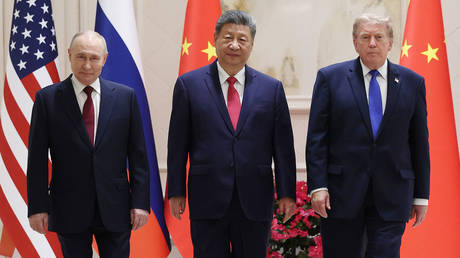
Three distinct fault lines fractured the global order over the past seven days. High-stakes trilateral diplomacy attempted to redraw regional alliances while escalating Russian retribution battered Ukrainian infrastructure and the artificial intelligence industry erupted into open warfare over intellectual property and source attribution. Taken together, these events expose a singular, uncomfortable truth about modern power. Whether on a physical battlefield, inside a closed diplomatic summit, or across the neural networks of Silicon Valley, the rules of engagement are being rewritten by whoever controls the flow of resources and information.
Most observers treat foreign policy, kinetic warfare, and corporate technology disputes as separate beats. That is a mistake. A veteran look at the machinery driving these three stories reveals a shared desperation to secure chokepoints before the window of opportunity slams shut.
The Illusion of Trilateral Breakthroughs
Diplomatic summits rarely fail because of a lack of goodwill. They fail because the underlying math does not work.
Over the past week, intensive trilateral talks brought together rival and aligned powers attempting to stabilize regional security and trade corridors. On paper, joint communiqués always look promising. Delegations shake hands, promise deeper economic integration, and announce working groups to address shared threats. Behind the closed doors of these negotiating rooms, however, the real currency is transactional survival.
When three nations sit at the same table, two are usually trying to contain the third, or all three are hedging against a volatile superpower not in the room. The mechanics of trilateral diplomacy rely heavily on calculated ambiguity. Each leader needs to return home with a domestic political victory, which means the final text of any agreement is deliberately stripped of enforcement mechanisms.
Consider how trade and defense pacts actually operate in practice. If Nation A agrees to share intelligence with Nation B, while Nation C provides the capital for critical infrastructure, the entire arrangement hinges on mutual trust that rarely survives a change in administration. Historical precedent shows that three-way alliances are inherently unstable compared to bilateral treaties. A single domestic election or an unexpected supply chain shock can cause one leg of the stool to buckle, bringing down the entire framework.
Analysts who celebrate the mere occurrence of these summits miss the point. The surge in trilateral posturing is a symptom of global fragmentation, not unity. Nations are scrambling to build redundant safety nets because traditional multilateral institutions have lost their teeth. When the referee stops calling fouls, the players start making side deals on the field.
The Strategic Logic of Retribution in Ukraine
While diplomats traded carefully worded statements, the reality on the ground in Eastern Europe remained brutally kinetic. Russian retaliatory strikes across Ukraine demonstrated once again how modern attrition warfare targets the will of a population rather than just the front lines.
To understand the timing and scale of Russian retribution in Ukraine, you have to look past the immediate tactical headlines and examine the logistics of exhaustion. Every major strike against energy grids, transit hubs, or urban centers serves a dual purpose. First, it degrades the physical capacity of the Ukrainian military to move supplies and repair equipment. Second, and far more insidiously, it forces Kyiv and its Western backers into an asymmetric financial trap.
Air defense is expensive. Intercepting a cheap, mass-produced drone or a legacy ballistic missile often requires firing a sophisticated interceptor that costs millions of dollars and takes months to manufacture. By launching coordinated waves of retaliatory strikes, Moscow is not necessarily trying to capture territory overnight. It is attempting to bankrupt the air defense inventories of its adversaries.
The human toll is catastrophic, and the psychological pressure on civilians living through rolling blackouts during freezing conditions cannot be overstated. Yet from a cold military perspective, this is an industrial math problem. Ukraine has shown remarkable ingenuity in developing domestic strike capabilities, hitting high-value targets deep inside Russian territory and forcing Moscow to stretch its own defensive umbrella. Each successful Ukrainian strike triggers a predictable, disproportionate response designed to re-establish deterrence.
The gray area that Western policymakers struggle to navigate is escalation management. Providing Ukraine with enough weaponry to survive without triggering a direct NATO-Russia confrontation has created a grinding stalemate. Retribution becomes a recurring cycle because neither side believes the other has reached its breaking point. Until the industrial capacity to produce munitions shifts decisively in one direction, diplomatic off-ramps will remain purely theoretical.
Inside the AI Source Wars
Far from the trenches, a different kind of territorial conquest is playing out inside data centers. The escalating AI source wars represent an existential battle over who owns human knowledge and who gets paid when machines remix it.
For years, artificial intelligence developers operated on a simple, unspoken rule. Everything on the open web was fair game. Crawlers scraped billions of articles, academic papers, code repositories, and books to train massive foundation models. Publishers and creators largely ignored the intrusion until those same models began generating direct answers that kept users from ever clicking through to the original websites.
Now, the bill has come due, and the industry is fracturing into two camps. On one side are the legacy media organizations, independent publishers, and digital platforms deploying technical barricades to block automated crawlers. On the other side are the AI giants racing to lock down exclusive licensing deals while quietly scraping whatever remains unguarded.
The mechanics of this conflict are ruthless. To see how the economics break down, look at a hypothetical example of a mid-sized investigative newsroom. Suppose that newsroom spends six months and fifty thousand dollars uncovering a corporate fraud scandal. Within minutes of publication, an AI search engine ingests the reporting, summarizes the core findings, and serves the answer directly to millions of users without sending a single click back to the newsroom's website. The ad revenue vanishes. The subscription funnel dries up. Meanwhile, the AI company captures the user's attention and monetizes the interaction.
Licensing deals are currently being touted as the grand compromise, yet they carry severe structural flaws. When a handful of massive tech companies sign multi-million-dollar agreements with a select few conglomerate publishers, it creates an information oligopoly. Smaller, specialized outlets get frozen out. Worse, the AI models become heavily weighted toward the perspectives and archives of whichever corporations could afford lawyers big enough to force a payout.
The Attribution Mirage
Even when AI companies promise to cite their sources, the technical reality is messy. Large language models do not retrieve facts from a filing cabinet like a traditional search engine. They predict the next most likely token based on statistical weights formed during training.
When a model generates a paragraph and slaps a hyperlink at the end of it, that link is often a post-hoc approximation rather than a true citation. Retrieval-augmented generation helps tether answers to live web results, yet hallucinations and misattributions remain stubbornly common. Publishers are realizing that a tiny footnote link buried beneath a comprehensive AI summary converts into actual web traffic at a fraction of traditional search rates.
The Convergence of Control
Strip away the surface differences between these three stories, and a unified pattern emerges. We are watching the death of frictionless systems.
For decades, the prevailing global consensus favored open borders, interconnected supply chains, and a free, open internet. The assumption was that interdependence guaranteed peace and shared prosperity. That era is over.
In geopolitics, interdependence has been weaponized. Energy pipelines, semiconductor supply chains, and diplomatic alliances are now treated as vulnerabilities to be hardened or exploited. Nations are retreating into smaller, trust-based blocs—hence the frantic pace of trilateral diplomacy—because relying on global consensus has become a liability.
In warfare, the illusion of quick, surgical victories has collapsed into industrial attrition. Whether it is artillery shells in Ukraine or server capacity in Silicon Valley, dominance belongs to whoever controls the raw inputs.
In the digital economy, the open web is rapidly balkanizing into walled gardens. As AI companies exhaust the supply of high-quality human-generated text, data itself is becoming a finite, fiercely guarded natural resource. The companies that survive the source wars will not necessarily be the ones with the cleverest algorithms, but the ones that secure proprietary pipelines of fresh human insight before the well runs dry.
What Comes Next for Information and Power
Navigating this environment requires abandoning comfortable assumptions. Investors, policymakers, and everyday citizens can no longer rely on the institutional guardrails that functioned ten years ago.
If you are watching the diplomatic front, ignore the press conferences and follow the capital flows and defense procurement contracts. Real alliances leave a paper trail of joint manufacturing and shared logistics, not just photo opportunities.
If you are tracking the war in Ukraine, watch the industrial production metrics in Europe, the United States, and Russia rather than daily territorial maps. Territory changes hands based on who runs out of interceptors and shells first.
And if you operate anywhere near the digital economy, recognize that the era of free distribution is dead. Independent creators and publishers must build direct relationships with their audiences—through newsletters, communities, and proprietary data—because relying on algorithmic middlemen to send traffic your way is a slow-motion suicide pact.
Power always consolidates when systems undergo structural shock. Whether it is a diplomat redrawing a security pact, a general targeting a power grid, or an engineer locking down a dataset, the objective is identical: control the chokepoint, and you dictate the terms of survival.