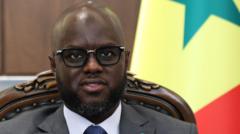
The political marriage that promised to rewrite Senegal's future has officially exploded. Just two days after President Bassirou Diomaye Faye fired his Prime Minister and political mentor, Ousmane Sonko, the crisis swallowed the legislature. National Assembly Speaker El Malick Ndiaye threw in the towel on Sunday, resigning via a social media post that cited "the higher interest of the nation."
Let's drop the polite diplomatic speak. This isn't a routine cabinet reshuffle. It's a full-blown constitutional cage match for control of West Africa's most stable democracy. The resignation of Ndiaye, a fierce Sonko loyalist, isn't a retreat. It's a tactical reset designed to clear the runway for Sonko to seize the leadership of parliament and launch a direct counter-offensive against the presidency.
If you thought Senegal entered a peaceful new era when the African patriots of the Pastef party swept to power in 2024, you miscalculated the mathematics of power. The dual-headed leadership of Faye and Sonko was a ticking time bomb from day one. Now, the timer has run out, and the fallout threatens to wreck crucial international bailout negotiations when the country can least afford it.
The Proxy King Reclaims His Ambition
To understand why the National Assembly is about to become a battlefield, you have to look at how this government was formed. Bassirou Diomaye Faye didn't climb to the presidency on his own brand. He was the backup plan.
When Sonko, the charismatic, fiery opposition leader who galvanized Senegal's unemployed youth, was disqualified from the 2024 election following a defamation conviction, he tapped Faye to run in his stead. Both men were sitting in prison just ten days before the vote. They walked out of jail straight into the presidency, winning 54 percent of the vote on a wave of anti-establishment euphoria. Faye became Africa's youngest elected president, but everyone in Dakar knew who the ideological heavyweight was.
But human nature and political reality don't tolerate proxies for long. Once Faye sat in the presidential palace, the inherent friction of a "two-headed executive" began to chafe. Sonko acted like the de facto head of state, picking fights with Western powers, railing against what he called "homosexual tyranny" from foreign donors, and publicly attacking Donald Trump as an agent of global chaos. Faye, tasked with actually running a state buried under mountains of debt, had to play the sober diplomat.
The rupture became formal on Friday when Faye fired Sonko and dissolved the entire government. By forcing Ndiaye out of the speaker's chair 48 hours later, Sonko's faction is executing a classic parliamentary pivot.
The Battleground Shifts to Parliament
The immediate plan is obvious, though legally messy. Pastef holds a commanding majority in the National Assembly. Lawmakers are scheduled to convene on Tuesday to sort out the mess left by Ndiaye's departure. The goal for Sonko's loyalists is to reinstate their leader as a lawmaker and elect him as the new Speaker of the House.
It's a brilliant, aggressive move. If Sonko secures the speakership, he transforms from a dismissed subordinate into the head of an independent branch of government. He can block Faye’s budgets, choke off legislative reforms, and effectively run a shadow government from the parliamentary chambers.
Critics are already screaming foul, pointing out that Sonko suspended his parliamentary mandate to serve in the cabinet and that local laws complicate a quick return. But in Senegal right now, political momentum is overriding strict legal etiquette. If Sonko pulls this off, Faye will find himself isolated in his own palace, facing a hostile legislature led by the very man who put him there.
The Wreckage of an Economy Mired in Secret Debt
While the politicians play chess in Dakar, the ordinary citizens of Senegal are staring at an economic abyss. This leadership row couldn't come at a worse moment.
The previous administration of Macky Sall left behind a toxic financial legacy. When Faye and Sonko took over, they ordered an audit and discovered billions in hidden, unreported debts. The revelation pushed Senegal’s total debt burden to a staggering 132 percent of its gross economic output by the end of 2024.
Because of that misreporting, the International Monetary Fund froze a critical $1.8 billion lending program. Senegal desperately needs that money to stabilize its finances, pay its bills, and restore investor confidence. Before the government imploded on Friday, Finance Minister Cheikh Diba had confidently told lawmakers that negotiations with the IMF would resume in the second week of June, with a deal locked in by June 30.
That timeline is now total fantasy. International lenders hate instability. When a president fires his prime minister and the head of parliament quits over the weekend, Wall Street notices. Senegal's international bonds have already taken a beating. If Sonko takes over parliament, expect the IMF talks to stall indefinitely. Sonko has already shown deep skepticism toward international financial institutions, recently warning that he wouldn't accept an IMF-mandated debt restructuring. Faye knows a default would be catastrophic, but he no longer has the political leverage to guarantee any reforms he promises to foreign donors.
What Happens on Tuesday
The immediate next step rests entirely on the extraordinary session of parliament this Tuesday. Keep your eyes on two specific indicators to judge which way the wind is blowing.
First, look at the internal cohesion of the Pastef party. Up until now, the ruling party has functioned like a disciplined bloc. If Faye has managed to peel away a moderate faction of lawmakers who prefer stability over Sonko's brand of confrontational politics, Sonko might fail to secure the speakership. If Pastef votes as a unified machine for Sonko, Faye's presidency enters a lame-duck phase three years ahead of schedule.
Second, watch the streets of Dakar. Sonko's primary power base isn't in the air-conditioned halls of parliament; it's among the millions of frustrated, young, unemployed Senegalese who see him as a revolutionary figure. If they feel Faye has betrayed the revolution by sacking Sonko, the civil unrest that plagued the final years of the Sall presidency could easily return.
The illusion of a unified reformist government is dead. Senegal has reverted to the mean of raw power politics. For businesses, investors, and regional neighbors, the priority now shifts from tracking promised governance reforms to basic risk management. Watch the parliamentary vote on Tuesday. It will tell you exactly how messy the next three years are going to be.