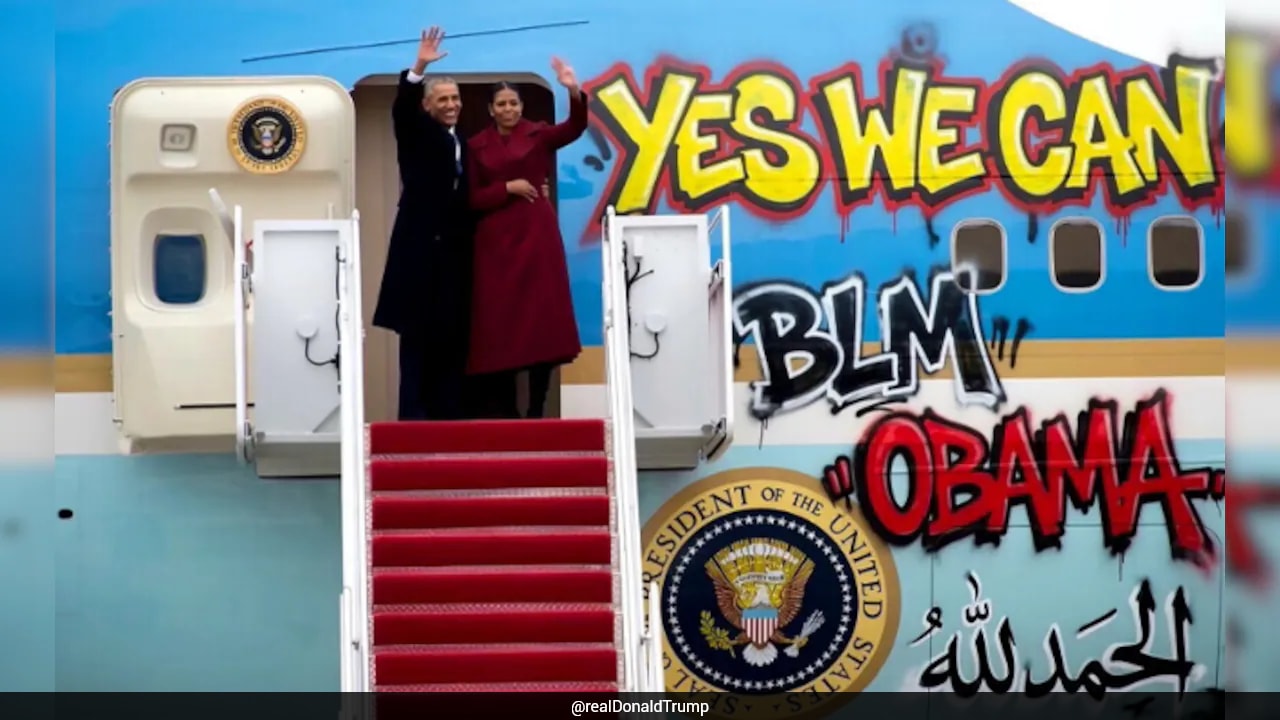
A thumb hovers over a glass screen. It is late, or maybe it is early, the hour where the blue light of a smartphone becomes the only illumination in a quiet room. With a single tap, an image flashes across the world. It is a photograph of a former president, his face altered, framed by graffiti written in Arabic script and the bold letters of a protest movement.
Seconds later, thousands of miles away, a notification pings. Then tens of thousands. Then millions.
We live in an era where the boundary between reality and fabrication has not just blurred—it has been entirely erased. The incident involving Donald Trump sharing a manipulated image of Barack Obama surrounded by "Black Lives Matter" and Arabic graffiti isn’t just a blip in a chaotic news cycle. It is a symptom of a much deeper, more quiet crisis. It is about how easily our perceptions can be hijacked, and what happens to a society when we can no longer trust the evidence of our own eyes.
The Anatomy of a Modern Illusion
The image in question did not emerge from a vacuum. It was a carefully constructed piece of visual disinformation, designed to trigger immediate, visceral reactions. By superimposing symbols heavily weighted with political and cultural anxiety onto the likeness of a political adversary, the image bypassed the logical brain entirely. It aimed straight for the gut.
To understand why this works, we have to look at how human beings process visual information. For millennia, seeing was believing. If you saw a predator in the brush, you ran. If you saw a harvest, you ate. Our brains are hardwired to treat visual inputs as absolute truth.
But the digital world has broken that evolutionary contract.
Consider a hypothetical reader—let’s call him Arthur. Arthur is sitting on his porch, scrolling through his feed. He isn't a media analyst. He is a retired teacher, tired after a long week, looking to stay informed. When an image like the altered Obama photo crosses his screen, Arthur’s brain doesn't instantly launch a forensic investigation. It registers the symbols. It notes the source. If the source is someone he trusts, or someone who commands immense public attention, the brain performs a dangerous shortcut: it accepts the image as context, if not outright fact.
This is the psychological vulnerability that modern political communication exploits. It relies on the speed of the scroll. By the time a fact-checker has dissected the image, traced its origins, and published a correction, the original emotional imprint has already hardened into concrete.
The Invisible Stakes of the Shared Lie
When a public figure shares a fabrication, the immediate debate usually centers on partisan politics. Critics express outrage; supporters offer defenses or dismiss it as a joke. But this superficial back-and-forth masks the real damage being done beneath the surface.
The true cost of pervasive digital falsehoods is the erosion of shared reality.
Think of a community as a house. For the house to stand, the foundation must be solid. In a democracy, that foundation is a basic agreement on what is real. We can argue passionately about what to do about the facts, but we must agree on what the facts are. When manipulated images are elevated to the level of mainstream political discourse, the foundation cracks.
Every time a fake image is validated by a high-profile share, the baseline of truth shifts. It creates a environment of total skepticism. The danger isn't just that people will believe the lie; the deeper danger is that eventually, people will stop believing anything at all. They will look at a genuine piece of photojournalism—a real crisis, a real injustice—and dismiss it as just another manipulation.
The Machinery Behind the Screen
How did we get here? The technology required to alter reality has undergone a quiet revolution. A decade ago, manipulating a photograph convincingly required expensive software and hours of expert labor. Today, algorithms can generate entirely new realities in seconds.
But the technology is only half the problem. The other half is the architecture of the platforms we use to consume information.
Social media algorithms are not programmed to prioritize truth. They are programmed to prioritize engagement. What engages human beings more effectively than anything else? Outrage. Fear. Validation of existing biases. An image that combines a former president, foreign script, and a controversial domestic movement is the ultimate engagement engine. It is designed to be shared, argued over, and amplified.
When a user interacts with a piece of disinformation, they aren't just consuming content; they are training the algorithm to feed them more of the same. It creates a closed loop. Arthur, sitting on his porch, receives a steady diet of increasingly distorted images, each one confirming his worst fears about the world beyond his neighborhood.
Reclaiming the Ground Beneath Our Feet
Fixing this problem is not as simple as implementing better fact-checking or banning specific accounts. Those are temporary patches on a leaking dam. The real solution requires a fundamental shift in how we relate to the digital world.
We have to cultivate a collective skepticism that is healthy, not cynical. This means slowing down. It means resisting the urge to instantly share something just because it aligns with our worldview or sparks a flash of anger. It requires us to look at the screen not as a window into the world, but as a highly curated, often distorted reflection of it.
The next time a bizarre, highly charged image flashes across your device, pause. Look at the edges. Question the motive behind its creation. The future of our shared reality depends on that split-second decision to question the illusion.
The blue light of the smartphone screen fades as the night grows darker. The device is placed on the nightstand. The room returns to shadows, leaving only the quiet weight of the questions we must face when the sun comes up.