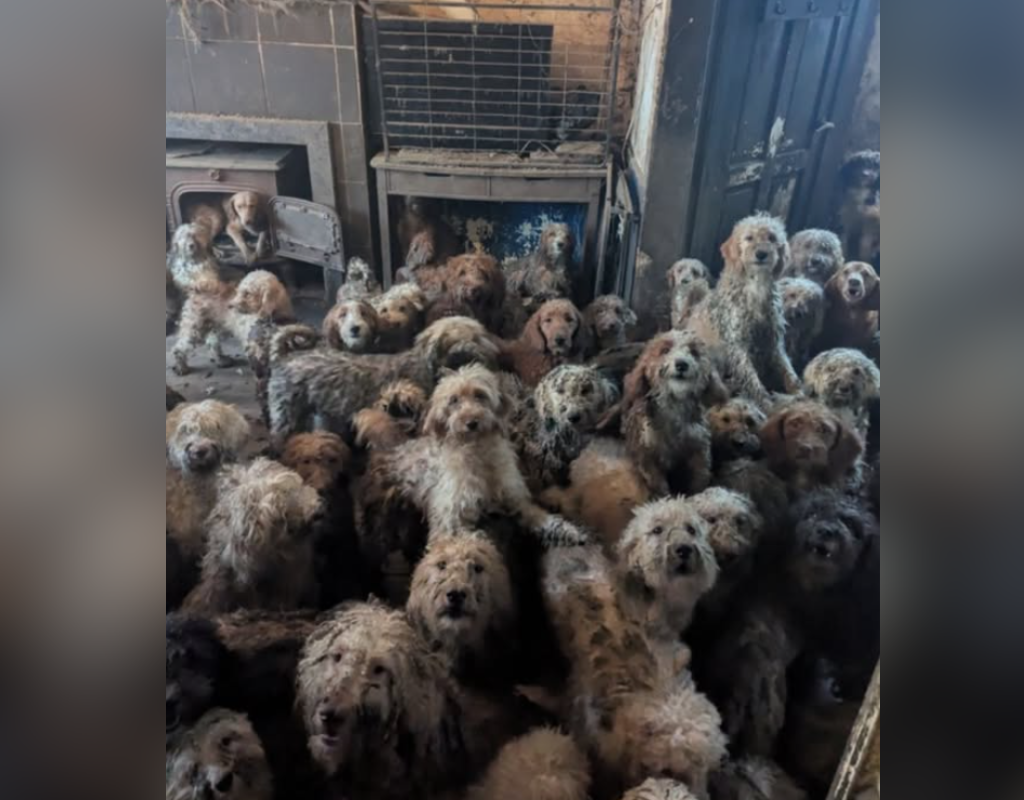
The screen glows with a sea of amber eyes and wagging tails. Row after row of Golden Retrievers, Spaniels, and Terriers sit in perfect, heartbreaking symmetry. To the average scroller, it looks like a glitch in the matrix or a prompt fed into a high-end processor. "Create a photo of 250 abandoned dogs," the machine might have been told. The lighting is a bit too soft. The composition is a little too balanced.
Thousands of people hit the share button, but many did so with a sneer. They pointed to the paws. They looked for sixth toes or melting ears. They commented with the smug certainty of the digitally literate: "Nice try, AI." "Fake." "Stop using bots to pull at our heartstrings."
Then the Hope Rescue charity in Wales had to do the unthinkable. They had to prove the tragedy was real.
The dogs were not pixels. They were skin, bone, matted fur, and fear. They were the physical manifestation of a crisis so large that the human brain, now trained to suspect deception at every turn, simply refused to believe it could exist in the real world.
The Day the Walls Closed In
Picture a small team of rescuers. They are used to the smell of disinfectant and the constant, rhythmic barking that defines their working hours. They are used to the "surrender" calls—the tearful owners who lost a job or the cold-hearted ones who just got bored.
But no one is prepared for a single intake of 250 animals.
This wasn't a hypothetical surge. This was a hoarding situation that had spiraled until the walls of a single property could no longer hold the life inside them. When the rescuers arrived, they didn't find a digital file. They found a logistical nightmare. Every dog needed a health check. Every dog needed a name. Every dog needed a bowl of food and a square inch of floor space that wasn't covered in filth.
The charity took a photograph to show the scale of the burden they had just inherited. They lined the dogs up—a literal army of the abandoned—and snapped a picture. They hoped for help. They hoped for donations to cover the astronomical vet bills.
Instead, they hit the "Uncanny Valley."
The Death of the Witness
We have entered an era where the more horrific a truth is, the more likely we are to dismiss it as a fabrication. This is the hidden tax of the generative age. When we can manufacture any image we desire, the images we need to see lose their bite.
Hypothetically, if a charity wanted to "optimize" engagement, an AI-generated image would be a dream. No barking. No mess. No expensive kibble. Just a perfect, tear-jerking visual delivered in seconds. But Hope Rescue wasn't trying to optimize a brand; they were trying to save lives that eat, breathe, and bleed.
The skepticism they faced wasn't just a social media annoyance. It was a barrier to survival. When a public decides a crisis is "fake," the flow of resources stops. The "Buy Me a Coffee" links go unclicked. The foster applications stay empty. The skepticism that protects us from deepfakes is the same skepticism that is now paralyzing our empathy for the neighbor in need.
Rescuers spent hours of their precious, overstretched time responding to comments, posting "behind the scenes" videos, and showing the shaky, unpolished footage of the dogs moving, breathing, and existing. They had to perform a digital exorcism to prove that the misery was authentic.
A Saturation of Sorrow
The 250 dogs in Wales represent a terrifying trend in the post-pandemic world. During the lockdowns, dogs were the ultimate commodity. They were companions, excuses to walk outside, and status symbols for the home-bound. Prices for puppies soared into the thousands.
Then the world reopened.
The "commodities" started growing. They chewed furniture. They required expensive surgeries. The owners went back to the office, and the dogs—often poorly bred in "puppy farms" to meet the sudden spike in demand—were left behind. The photo that people called "AI" was actually the visual debt of a three-year social frenzy coming due all at once.
We are seeing the collapse of the animal welfare infrastructure. Shelters are at 110% capacity. Staff are burning out. When a single house yields 250 dogs, it doesn't just fill one shelter; it creates a shockwave that cripples every rescue organization within a hundred-mile radius.
The public's refusal to believe the photo was a defense mechanism. It is easier to believe that a computer generated a nightmare than it is to believe that our society is capable of neglecting 250 living beings under one roof.
The Weight of the Real
Think about the sound of 250 collars jingling at once.
Think about the sheer volume of waste. The thousands of pounds of dry food. The silence that falls over a kennel at 3:00 AM when the dogs finally sleep, and the rescuers sit on the floor, heads in their hands, wondering how they will pay for the next week of care.
There is no "undo" button in a physical shelter. You cannot delete a dog that has a broken leg or a skin infection. You cannot "regenerate" a solution with a better prompt.
The volunteers at Hope Rescue didn't have the luxury of debating the ethics of Midjourney or DALL-E. They were too busy scrubbing floors and soothing terrified animals who had never known a kind hand. The irony is bitter: in our rush to guard against the "fake," we have become cynical toward the "too real."
We are losing our ability to be shocked. When the truth is presented to us, we look for the blurred edges of a digital artifact rather than the blurred eyes of a creature that hasn't seen the sun in years.
The Cost of the Click
Every time we dismiss a plea for help as "content," we chip away at the foundation of community action. The Wales incident is a warning. It tells us that the digital noise has become so loud that the actual screams of the world are being filtered out as static.
The 250 dogs didn't care about the algorithm. They didn't care about whether they looked "too perfect" for a Facebook post. They were waiting for a bowl of water and a hand on their head.
The next time you see something that looks too tragic to be true, consider the possibility that it is simply a reflection of a world we’ve spent too long ignoring. Behind the amber eyes and the symmetrical rows was a very human failure—and a very human attempt to fix it.
Truth is often uglier than a prompt. It is messy. It has a smell. It requires more than a double-tap to resolve. It requires us to look at the photo and see, not a digital trick, but 250 heartbeats waiting for us to wake up.
The dogs were real. The question is whether our empathy still is.



