The glow of a laptop screen in a cramped apartment in Cairo or a rural village in West Virginia looks the same. It is a flicker of blue light against the dark, a silent promise that the sum of human knowledge is not locked behind a mahogany door or a $500 paywall. For a student named Omar—a hypothetical composite of the millions who rely on "shadow libraries"—that glow is the only way he can read the medical textbooks required for his degree. He cannot afford the physical copies. His university library hasn't updated its collection since the nineties. For Omar, Anna’s Archive isn't a "piracy site." It is the difference between a future and a dead end.
But to the massive conglomerates that own the rights to the world’s most influential books, that same glow looks like a fire. It looks like the systematic dismantling of a business model that has stood for centuries.
In the early months of 2024, the conflict between these two realities shifted from a quiet digital skirmish to a loud, public execution. A group of major American publishers, led by giants like Penguin Random House and HarperCollins, launched a legal offensive against Anna’s Archive. The lawsuit, filed in a U.S. federal court, doesn't just seek damages. It seeks to erase the site from the face of the internet.
The Quiet Giant in the Cloud
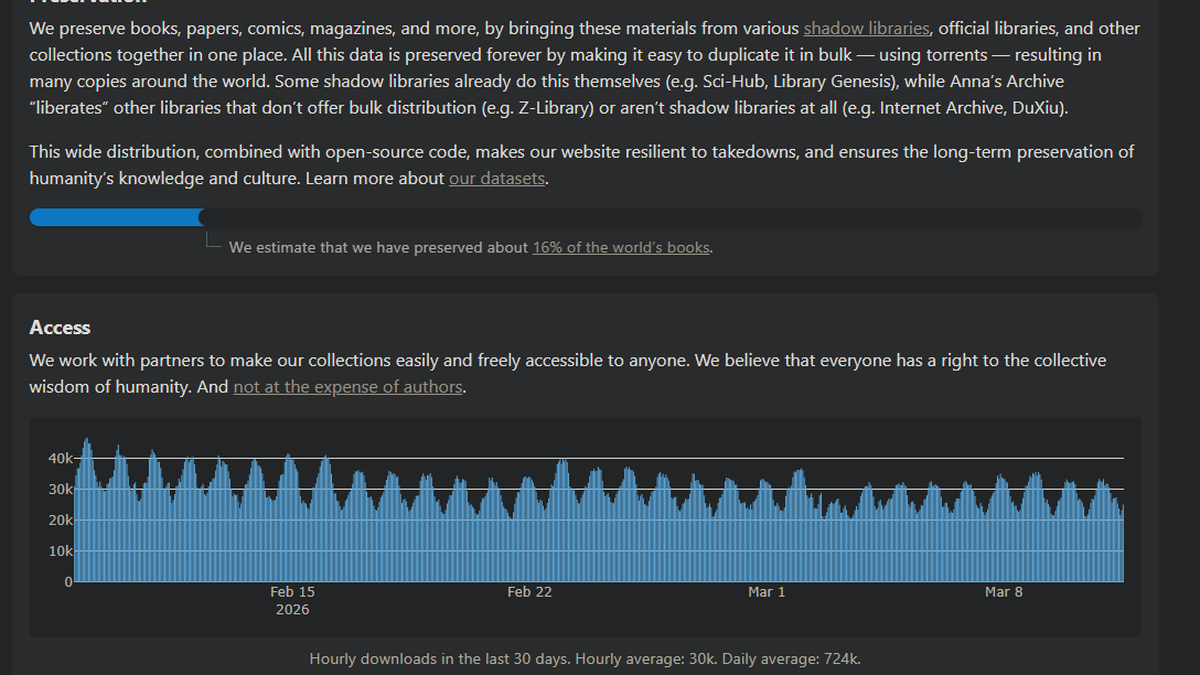
Anna’s Archive is not a typical website. It is an aggregator, a meta-search engine that pulls from several of the world’s largest shadow libraries—shadows of shadows. It indexes millions of books, papers, and journals, many of which are otherwise buried behind subscription models or high-priced academic licenses. To its creators, who remain anonymous and operate from the digital fringes, the site is a preservation project. They see themselves as the modern version of the Library of Alexandria, saving culture from the "rot" of digital decay and the "gatekeeping" of corporate interests.
To the Association of American Publishers (AAP), however, it is a sophisticated theft operation.
The publishers argue that the site facilitates massive copyright infringement on a global scale. They point to the "Anna" behind the archive as a ghost, an entity that profits from the hard work of authors and the financial risk taken by publishing houses. When a student downloads a PDF of a $200 biology textbook for free, the publisher loses a sale. The author loses a royalty. Multiply that by millions of downloads, and you have an existential threat to the industry.
The numbers are staggering. The lawsuit highlights the sheer volume of copyrighted material available on the platform—millions of titles that are being distributed without a cent returning to the creators. This isn't just about pulp fiction or celebrity memoirs. It’s about the foundational texts of medicine, law, engineering, and history.
The Mechanics of a Digital Vanishing Act
How do you sue a ghost?
This is the central problem facing the U.S. publishing group. Anna’s Archive is designed to be resilient. It doesn't host all the files itself; it provides a map. When a user searches for a title, the site points them toward different "mirrors" or sources where the file lives. If one source is taken down, another usually pops up within hours. It is a game of digital Whac-A-Mole played on a global scale.
The lawsuit focuses on several tactical fronts. First, the publishers are going after the domain names. If you can't find the library, it doesn't matter how many books are inside. They are also targeting the infrastructure—the service providers and search engines that allow the site to remain visible to the public. By cutting off the "oxygen" of the site, the publishers hope to starve it out of existence.
Consider the ripple effect of this legal action. If the publishers succeed in securing a broad injunction, it could force search engines like Google or Bing to delist any mention of the archive. It could force internet service providers to block access to the site entirely. In the eyes of the law, this is a necessary step to protect intellectual property. In the eyes of a researcher in a developing nation, it is a digital burning of the books.
The Invisible Stakes of Access
There is a deep, uncomfortable tension at the heart of this story. On one side, we have the principle of intellectual property. Without it, writers cannot make a living. If a novelist spends three years of their life crafting a story only for it to be distributed for free to millions, the incentive to write another book vanishes. The publishing industry employs thousands of people—editors, cover designers, distributors—all of whom depend on the legal protection of the printed word.
On the other side, we have the principle of universal access.
The price of academic journals and textbooks has outpaced inflation for decades. A single research paper can cost $40 to view for 24 hours. A medical textbook can cost more than a month's rent. For the vast majority of the world's population, the legal path to high-level knowledge is blocked by a financial wall.
The shadow library is a symptom of a broken system. If the legal markets were affordable and accessible, the demand for "pirate" sites would plummet. But as long as the cost of knowledge remains high, the shadow libraries will thrive.
The publishers argue that they do provide access through public and university libraries. They claim the system works. But the libraries themselves are under immense pressure. They often have to pay "licensing fees" for digital books that are significantly higher than the price a consumer pays, and those licenses frequently expire, forcing the library to buy the book again and again.
The Human Cost of the Lawsuit
Imagine Sarah. She is a librarian in a small town in the Midwest. Her budget has been slashed three years in a row. She sees her patrons struggling to find reliable information on health issues or legal rights. She knows that some of them are using sites like Anna’s Archive because the library simply cannot afford to license the specialized databases they need.
Sarah is caught in the middle. She believes in the law and the rights of authors, but she also sees the desperation of people who are being priced out of the modern world.
When the U.S. publishing group sues Anna’s Archive, they aren't just suing a website. They are challenging the idea that information should be free at the point of use. They are asserting that the market, not the need, should determine who gets to read.
The legal battle is also about the "preservation" of the digital record. The creators of Anna’s Archive claim that by archiving everything, they are preventing a "digital dark age" where books that are no longer profitable for publishers simply vanish from history. Publishers, conversely, argue that they are the true stewards of culture and that "pirate" archives are often riddled with errors, incomplete files, and potential malware.
A System Under Strain
The lawsuit filed in 2024 is more than a legal document. It is a signal of a massive shift in how we value information.
The publishers have a strong legal case. U.S. copyright law is very clear on the unauthorized distribution of protected works. From a purely legal standpoint, Anna’s Archive is on thin ice. The court is likely to rule in favor of the publishers, granting them the power to seize domains and shutter the site's public-facing operations.
But will it work?
History suggests it won't. When the music industry sued Napster, it didn't stop digital music; it just forced it to evolve into more decentralized, harder-to-track formats like BitTorrent. When the Sci-Hub litigation began, the site simply moved to different domains and continued to grow.
The real question isn't whether the publishers can win a court case. They probably will. The question is whether they can win the war of relevance.
As the world becomes more digital, the tension between "ownership" and "access" will only tighten. The lawsuit against Anna’s Archive is a flashpoint, a moment where the old world of physical copyright crashes into the new world of infinite digital reproduction.
The Ghost in the Machine
The people behind Anna’s Archive know they are being hunted. They have built their system to be a hydra. You cut off one head, and two more appear. They use decentralized storage, encrypted communications, and anonymous funding. They are prepared for a long, drawn-out conflict.
The publishing group knows this, too. Their strategy isn't just about this one site. It is about setting a precedent. It is about showing that they will fight for every inch of their intellectual property, no matter how elusive the target.
We are watching a high-stakes game of chess where the board is the entire internet. On one side are the protectors of the traditional order—the publishers who have curated the world’s stories for centuries. On the other side are the digital insurgents—the archivists who believe that a paywall is a crime against humanity.
Neither side is entirely right, and neither side is entirely wrong.
The author who can't pay their mortgage because their book was pirated is a victim. The student who can't finish their degree because they can't afford a $300 textbook is also a victim. The lawsuit is a collision of these two victimhoods.
The Horizon of the Archive
The legal proceedings will likely drag on for months, if not years. We will see domain seizures, frantic "mirror" site announcements, and perhaps even the unmasking of the individuals behind the archive. The headlines will focus on the billions of dollars at stake and the "theft" of intellectual property.
But the real story is happening in the quiet moments.
It is happening when a doctor in a remote clinic downloads a life-saving protocol they couldn't otherwise afford. It is happening when a researcher in a poorly funded lab finds the one piece of data they need to make a breakthrough. And it is happening when an author receives a royalty check that is smaller than it used to be.
The lawsuit against Anna’s Archive is not just a footnote in technology news. It is a chapter in the history of how we, as a species, choose to share—or hoard—the things we know.
The blue light of the laptop continues to flicker. Somewhere, a file is being uploaded. Somewhere else, a lawyer is drafting a motion to stop it. The archive remains, for now, a ghost in the machine, haunted by the very laws that seek to protect the beauty of the written word.
The screen stays lit, the cursor blinks, and the world waits to see if the library will burn or if it will simply move to another part of the dark.


