Three miles down, the Pacific forgets what daylight looks like.
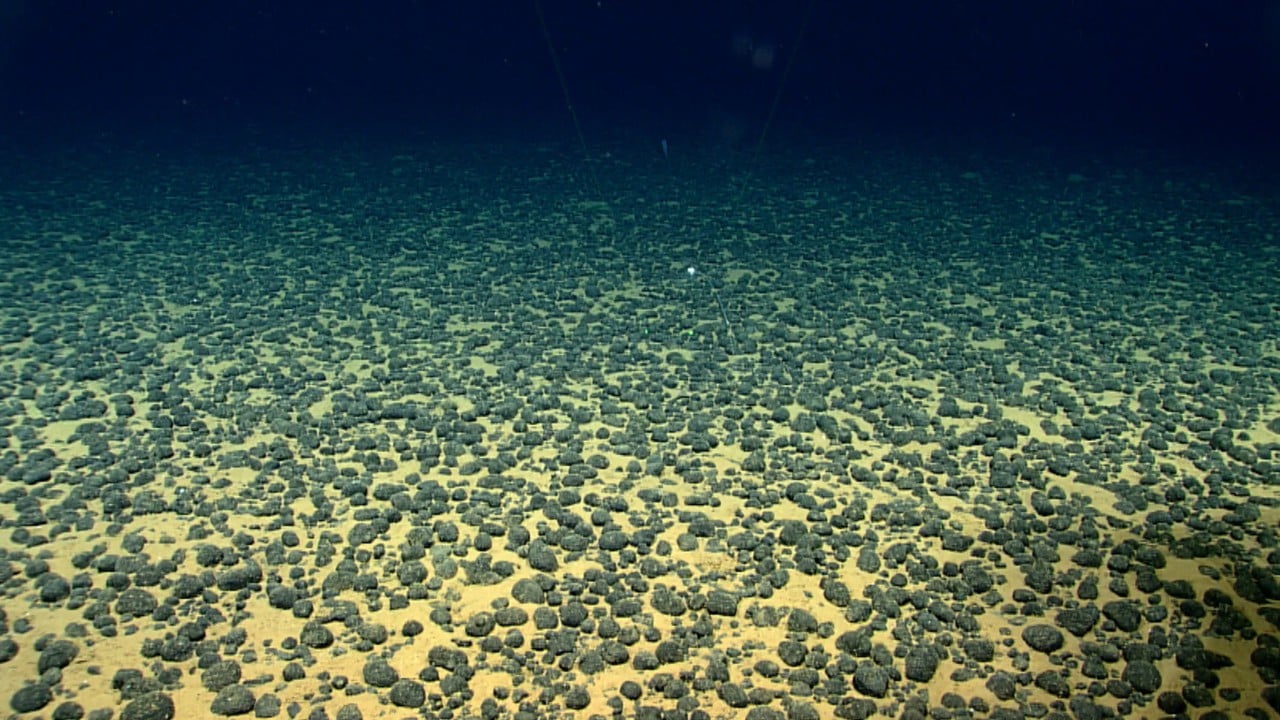
There is no blue gradient here, no shimmering refraction from waves overhead, no pale green twilight filtering through kelp. Only crushing hydrostatic pressure—hundreds of times what squeezes your chest at sea level—freezing water, and a vast, silent plain of mud and rock stretching between Mexico and Hawaii. Out there, in the Clarion-Clipperton Zone, dark potato-sized lumps lie scattered across the abyssal floor like fallen meteorites.
Engineers look at those polymetallic nodules and see salvation for a warming planet. Inside those heavy, metallic crusts sit nickel, cobalt, and manganese—the exact raw ingredients needed to build lighter, longer-lasting electric vehicle batteries and grid storage without tearing open another mountain range on land. To a supply-chain planner staring at projections for 2035, those rocks aren't just geology. They are clean energy waiting to be scooped up.
In a study published in Nature Communications, researchers from Chongqing University analyzed sediment samples from this deep-sea metal treasure trove, reaching depths as great as 6,000 meters. They cataloged 11,742 distinct viruses.
Out of those 11,742, 11,662 had never been seen before. More than 99 percent were ghosts in our genetic reference books.
Read that headline again if your pulse doesn't jump a little. Thousands of unknown viruses in the deep ocean. Our modern instincts—trained by years of pandemics, news alerts, and quarantine memories—immediately flash red. Virus equals threat. Virus equals contagion.
I remember the quiet, heavy stillness of early 2020 in my own kitchen, watching the counter tick upward while holding a cold mug of coffee, feeling how small human plans look when something microscopic decides to rewrite the rules. That memory lives in my bones. When someone says "11,662 new viruses," even a person who reads science for a living feels that tiny, involuntary flinch.
Here is the truth that settles the flinch: almost all of these deep-sea viruses are not coming for us. Most belong to groups like Caudoviricetes, including bacteriophages that hunt single-celled microbes—bacteria and archaea—living in the dark sediments. They evolved over millions of years to infect deep-sea hosts under crushing pressure and heavy-metal stress, not human lungs or cells.
Fear.
That is the wrong emotion to bring to this story.
The real emotion—the one that ought to keep policymakers, engineers, and everyday drivers awake at night—is humility mixed with urgency. Because we are standing at the edge of an industrial rush into one of Earth's oldest biological vaults, holding a flashlight that barely illuminates the doorway.
Why Nobody Talks About the Invisible Engines Under Our Feet
Most of us live in a world of things we can point to. A car. A lithium-ion pack. A seafloor crawler dragging a collector head across black mud. We measure progress by weight, voltage, and tonnage.
Microbes and the viruses that infect them do not fit neatly onto a balance sheet. Yet they run the quiet plumbing of the planet.
To picture what happens down there without getting lost in biochemistry, let's use a simple metaphor. Think of the deep seabed sediment as a vast, slow-moving city where microscopic workers—bacteria and archaea—process waste, break down drifting organic matter, and cycle carbon, nitrogen, phosphorus, sulfur, and trace metals. In that city, viruses aren't just vandals burning down buildings. Many act like traffic controllers, population regulators, and genetic couriers, carrying auxiliary metabolic genes that help their microbial hosts survive harsh conditions and keep nutrient cycles turning.
When a virus infects a deep-sea microbe, it can alter how that cell uses energy or survives lean times. Multiply that across billions upon billions of microscopic interactions across a zone larger than many countries, and you begin to see a hidden web keeping the abyssal floor alive.
Consider what happens next: commercial deep-sea mining machines arrive to harvest those polymetallic nodules.
Even if you have never stepped aboard a research vessel, you know what heavy machinery does to dirt. Now imagine scaling that up three miles underwater, where sediment plumes can drift for miles in slow currents, smothering creatures that grow at geological speeds and disturbing layers of mud that took millennia to settle.
Let's sketch a hypothetical scenario—clearly labeled as one—to see how blind we currently are. Suppose an operator begins dredging a stretch of the Clarion-Clipperton Zone before baseline microbial and viral networks are mapped across the region. Heavy sediment clouds blanket surrounding nodule fields. Key bacterial groups that help cycle nutrients and metals drop sharply or shift composition. Because 99 percent of the viral diversity in the Chongqing University study had no match in existing databases, scientists watching from afar wouldn't even know which viral-host partnerships were breaking down, which metabolic genes were disappearing, or whether the local nutrient web could recover on its own.
That scenario is hypothetical in its exact sequence, yet it rests squarely on what the researchers actually warn: we do not yet know how commercial mining will alter these viral communities, and establishing a pre-mining baseline is essential before large-scale extraction begins.
Look at those layered crusts in the illustration above. Those nodules don't form overnight. They accrete metal upon metal over vast stretches of time, sitting right on top of the sediment where microbial and viral life thrives. A rock that looks like inert scrap metal from a distance is actually part of a living neighborhood.
The Green Dilemma Nobody Wants to Admit
Here is where the story gets uncomfortable—and where I have to be honest about my own conflicting feelings.
I want clean energy. I want cleaner air in cities choked by tailpipe exhaust, fewer fossil fuels burned into the sky, and batteries that don't force children or vulnerable communities into dangerous artisanal mines on land. When people talk about the urgent need for nickel, cobalt, and manganese to power electric vehicles and renewable storage, they aren't villains. They are trying to solve one massive crisis: climate change.
But trading one blind spot for another is how humans repeatedly get tripped up.
History is full of moments when we treated a frontier as empty, simple, or infinitely resilient because we hadn't bothered to look closely. Early industrial whalers thought the oceans were too big to empty. Early farmers in North America thought thick prairie sod could never blow away until the Dust Bowl proved otherwise. We don't repeat those mistakes out of cartoon malice. We repeat them because urgency makes us impatient with nuance.
We want a clean villain and a clean hero. Deep-sea mining isn't that simple.
If we never touch seabed nodules, we have to reckon honestly with where else tens of millions of tons of battery metals will come from—and what terrestrial mining, deforestation, water depletion, and carbon emissions cost. If we rush into deep-sea mining before understanding the biology of the abyss, we risk tearing apart ecosystems whose chemical and ecological roles we haven't even decoded.
Both paths carry real weight. Pretending either choice is painless is dishonest.
That is why the Chongqing University finding—identifying 11,742 viruses in Clarion-Clipperton Zone sediments, with 11,662 previously unknown—matters far beyond a neat trivia number. It is a mirror held up to our timing. We are racing toward extraction at a depth of up to 6,000 meters while our biological map of that very place is less than one percent complete on the viral side.
What a Baseline Actually Buys Us
Scientists call this kind of work a "pre-mining baseline".
To a casual reader, "baseline" sounds like bureaucratic throat-clearing—another report on a shelf delaying action. In practice, a baseline is the difference between flying blind in fog and reading instruments on a cockpit panel.
Meet Dr. Lin, a hypothetical marine ecologist—again, purely a composite character to ground the human side of the lab bench—staring at sequencing output late on a Tuesday night. Her screen is filled with unfamiliar viral sequences pulled from dark Pacific mud. Each code represents a tiny packet of genetic instructions shaped by cold, darkness, and immense pressure. Without a baseline catalog recorded before industrial machines churn the seabed, nobody five years later can prove whether a shift in microbial activity came from natural ocean cycles or from a mining collector passing three miles overhead.
With a baseline, science has a "before" photograph.
It allows researchers to ask sharp, testable questions:
- Which microbial hosts do these newly identified viruses infect?
- How do auxiliary metabolic genes carried by these viruses shape nutrient and metal cycling in nodule fields?
- How far do disturbances spread across the sediment column, and how long does recovery take?
Notice how grounded that is. The researchers themselves emphasize that more observation and experimentation are needed to pin down exact host interactions, viral activity, and ecosystem impacts. Good science doesn't pretend to have all the answers on day one. It starts by naming what is actually there.
And there is another angle worth sitting with: biotechnology and basic discovery. Every time humanity explores an extreme environment—hot springs, polar ice, deep ocean trenches—we stumble onto biological mechanisms we never could have invented from scratch. While these deep-sea viruses are studied primarily for their ecological roles in marine sediments rather than as human pathogens, understanding how life adapts to heavy metals, high pressure, and scarce food deepens our grasp of how Earth's living systems hold together.
A Question of Pace, Not Panic
If you are wondering whether this discovery means we should slam the brakes on clean technology forever, pause and breathe. That isn't the argument here.
The argument is about sequence.
First comes knowledge. Then comes rules backed by evidence. Only then should irreversible industrial scale follow—if the evidence shows it can be done responsibly.
Think about how we treat almost every other high-stakes engineering leap when lives or complex systems are on the line. You don't send passengers into a brand-new tunnel before checking whether the rock walls hold or how air circulates deep inside. You map. You test. You measure what is invisible until you can see it clearly.
Down in the Clarion-Clipperton Zone, the nodules have sat there quietly gathering trace metals from seawater and sediment for ages. They aren't going anywhere next week. The 11,662 newly identified viruses aren't going anywhere either—unless we disturb their world before we understand how it works.
I still feel that old pull toward speed whenever I read about climate targets and battery supply chains. We are tired of waiting for solutions. We want answers fast, clean, and decisive.
Yet the ocean has a way of reminding us that deep time moves on its own clock. Three miles down, in pitch blackness where no eye has ever seen a sunrise, eleven thousand unknown viruses are already quietly doing their work in the dark.
Before we lift the first rock toward the light, we owe it to the planet—and to our own future—to finish reading the page in front of us.