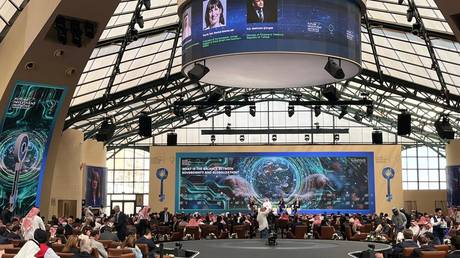
Silence. That is the first thing you notice when a thousand-person conference room stops talking at the exact same second.
No clinking of espresso cups. No rustle of tailored linen jackets or tapping of glass screens. Just the low, persistent hum of air conditioning fighting off the heat outside, and four hundred pairs of eyes fixed on a single notification lighting up on a dozen phones at once.
I have stood in rooms like that before—not always in Riyadh, and not always during a summit, yet always at the moment when the market’s tidy spreadsheet meets a messy, physical reality that no algorithm priced in. You smell the cold air of over-cooled marble. You feel the sudden stiffness in your shoulders as everyone around you calculates the same unspoken equation: Is it safe to stay? Is it smart to leave? What does this do to my deal?
When Saudi Arabia postpones the Future Investment Initiative—the gathering the financial press has long nicknamed “Davos in the Desert”—because of Houthi strikes, the headlines usually read like a weather forecast for capital. A date moves on a calendar. A press release goes out. Analysts type out brisk notes about regional risk premiums, oil market jitters, and diplomatic signaling.
Cold. Clean. Distant.
The truth is messier. Behind every postponed summit is a chain reaction of human nerves, canceled flights, paused careers, and quiet recalibrations across boardrooms and living rooms alike. A conference is not just a stage where sovereign wealth funds flex their muscle and billionaires trade talking points under spotlights; it is a physical meeting point where trust is forged eye-to-eye over three days of handshakes and side conversations. When missiles or drones cross borders and air defenses light up the night sky, trust doesn’t merely dip. It fractures.
Consider a hypothetical character to see how this plays out on the ground. Let’s call her Nadia—a composite figure representing dozens of mid-career dealmakers, policy analysts, and logistics managers I have watched navigate Gulf summits over the years. Nadia isn’t flying in on a private jet with a security detail and a guaranteed seat on a main-stage panel. She is a thirty-eight-year-old infrastructure advisor flying commercial out of London, carrying a briefcase packed with renewable grid proposals she spent six months modeling. For her, Riyadh isn’t a glamour stop. It’s the one week of the year when decision-makers from utilities, sovereign funds, and engineering firms are all under one roof, where a ten-minute hallway chat can save three months of cold emails.
When word breaks that Houthi strikes have forced a postponement of the gathering, Nadia’s phone starts buzzing before her boarding pass even loads. Her flight status flickers. Her hotel booking feels suddenly provisional. More importantly, the calendar invites she spent weeks begging for begin to evaporate or shift into vague “TBD” placeholders.
You don’t need a degree in geopolitics to understand what happens next in her stomach. It’s that hollow drop you feel when a high-stakes presentation gets pushed back indefinitely—except layered with the sharp edge of physical danger. Even if the strike happens hundreds of miles away, even if interception systems do their job, risk is an emotional tax. It drains focus. It makes people ask whether pushing forward with a major commitment in the region is bold or reckless.
The Architecture of Confidence
Money is shy. People say that so often it sounds like a cliché, yet it remains one of the most reliable truths in economics.
Think of investor confidence like glass blown thin at the end of a long rod. Heat makes it pliable; a steady breath shapes it into something clear and useful. One sudden draft of cold air, though—one sharp shock to physical security—and the whole thing can crack along an invisible line.
For years, Saudi Arabia worked tirelessly to turn Riyadh into a global magnet for capital, technology, and diplomatic weight. The Future Investment Initiative became the centerpiece of that effort: a showcase designed to project momentum, modern ambition, and stability to an audience that often viewed the Middle East strictly through the lens of conflict and oil cycles. By bringing together global executives, policymakers, and founders, the event aimed to prove that the kingdom’s economic transformation wasn’t just a slide deck—it was happening in real time.
Postponing it under the pressure of Houthi attacks cuts directly against that narrative.
Why does a delay matter so much when the event isn’t canceled forever, just pushed back? Because momentum has a half-life. In high-stakes finance and diplomacy, timing isn’t a minor detail; it is half the value of the room. Deals have windows. Political cycles turn. Boards meet on quarterly schedules. When an anchor event slips, the surrounding ecosystem—side summits, bilateral meetings, media briefings, supplier pitches—loses its gravitational pull.
Still, I want to be honest about where my own certainty ends. Geopolitical crises are notoriously opaque from the outside. Unless you are sitting inside a security briefing or a royal court, you rarely see the full calculus behind a postponement. Was the decision driven primarily by immediate physical safety concerns for thousands of international guests? Was it a deliberate signal of restraint or resolve? Was it logistical caution amid airspace uncertainty and regional escalation?
Often, the answer isn’t one neat motive. It’s all of them braided together.
And honestly, that uncertainty is part of what makes moments like this unsettling for ordinary observers and seasoned professionals alike. We like clean cause-and-effect stories: X happened, so Y followed. Real crises rarely oblige. They arrive with conflicting rumors, shifting flight advisories, and sudden silences from contacts who were chatting cheerfully two hours earlier.
Beyond the Headlines
If you only read standard news coverage of a postponed summit, you might walk away thinking the stakes are purely macro: oil prices, sovereign balance sheets, regional security posture. Those matter enormously. A sustained threat from Houthi strikes—whether targeting shipping lanes, energy infrastructure, or territory—carries real economic weight far beyond the Arabian Peninsula. Global trade routes depend on calm waters and predictable skies. When conflict flares, insurance premiums rise, shipping detours add days and dollars to supply chains, and inflation pressures ripple outward in ways that eventually show up at a supermarket checkout thousands of miles away.
Yet macro numbers can numb us. Billions of dollars sound weightless until you trace them back to people whose livelihoods depend on things moving on schedule.
Return to Nadia for a moment—still a hypothetical stand-in, still grounded in real-world patterns. If the summit is postponed, her firm doesn’t collapse overnight. Life goes on. She might reschedule calls on Zoom, trade emails with colleagues in Riyadh and Dubai, and wait for new dates. But deal momentum cools. A project that might have moved from feasibility study to pilot funding in the fourth quarter slips into next year. Younger analysts on her team lose a chance to build relationships in person. A small engineering contractor hoping to win a subcontract sees cash flow tighten while everyone waits to see what happens next.
That is the hidden cost of geopolitical disruption: not just dramatic explosions on a screen, but slowdowns, hesitations, and deferred plans.
Historically, major hubs across the Middle East have shown remarkable resilience in the face of shocks. Markets reopen. Airports rebuild schedules. Conferences return once the dust settles and security assessments allow. Over decades, leaders and businesses in the region have repeatedly demonstrated that adaptation is survival—whether navigating oil gluts, regional wars, or global downturns.
Resilience, however, is not the same thing as immunity. Every shock tests how much strain the system can absorb before habits change permanently. When a flagship gathering like “Davos in the Desert” has to step back because of external strikes, it reminds everyone in the room—and everyone watching from afar—that economic vision never exists in a vacuum. Vision still has to share a map with geography, politics, and armed conflict.
What Stays in the Room
Imagine—purely as a metaphor—a grand banquet hall set for a thousand guests. The linen is crisp, the microphones are tested, the schedule is printed down to the minute. Then word comes that a storm is sweeping across the approach roads, lightning is striking near the power lines, and it isn’t clear whether the roads will hold. You don’t serve soup while the roof leaks. You close the doors, send word ahead, and wait for clearer skies.
A postponement is a pause button pressed under pressure.
For the people who spent months preparing—event staff, security teams, translators, junior researchers, founders flying in with a single pitch deck—a sudden delay brings a strange mix of relief and deflation. Relief, perhaps, that no one is being asked to walk into an avoidable hazard. Deflation, because so much energy went into building toward a specific moment that suddenly isn’t happening on cue.
And for the broader public reading about Saudi Arabia postponing its signature investment forum due to Houthi strikes, the story invites a sharper question than Who blinked? or What happens to the stock index tomorrow? It asks us to notice how fragile our assumptions of normalcy can be. Modern global business runs on timetables, flights, and confidence—all three of which depend on a quiet baseline of security that we usually take for granted until it flickers.
When the lights dim in a hall that was meant to roar with deals and speeches, the silence doesn’t feel empty. It feels heavy with everything left unsaid, everything postponed, and everything still to be decided once the sky clears.


