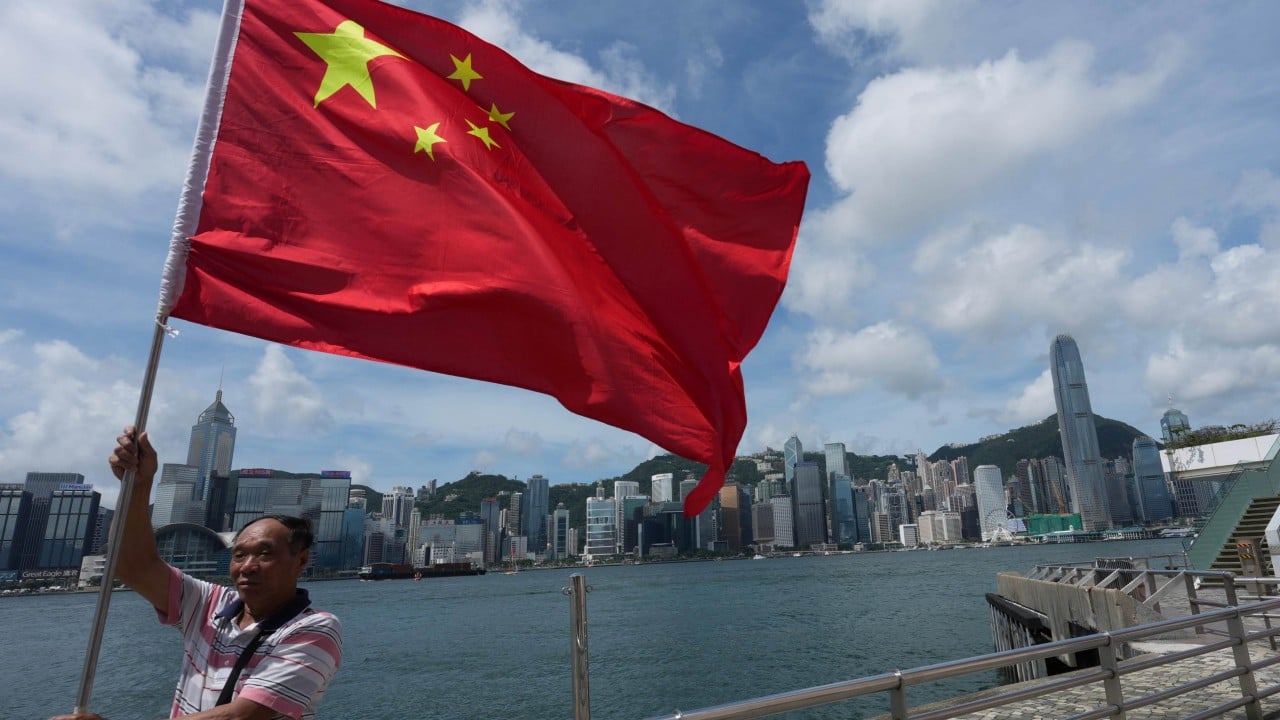
John Lee stood at the podium for the city’s handover anniversary and declared the leadership of the Communist Party of China a fundamental safeguard of Hong Kong’s prosperity. Across the ocean, Western analysts immediately fired back their standard, predictable rebuttal: Hong Kong is dead, its autonomy is crushed, and its economic engine has been permanently derailed by political overreach.
Both sides are completely wrong.
They are trapped in a lazy, binary consensus that confuses the survival of old systems with the arrival of a entirely new economic species. Beijing claims it is preserving Hong Kong’s capitalist way of life. The West claims that life has been extinguished. The reality is far more cold-blooded. The Communist Party is not safeguarding the legacy version of Hong Kong’s prosperity, nor has it accidentally destroyed it. It is deliberately liquidating Hong Kong’s historical identity as an open, Western-facing global hub to engineer a highly specialized, hyper-controlled offshore conduit for a parallel financial ecosystem.
The old Hong Kong is not coming back, but the city isn't dying either. It is being repurposed. Anyone managing capital based on the rhetoric of political stability or the doom-mongering of total collapse will find themselves wiped out by the structural mechanics of this transition.
The Flawed Premise of Security Driving Growth
The official narrative peddled by the current administration relies heavily on a neat, linear equation: high-level security equals high-quality development. We are told that the transition from stability to prosperity is a natural progression now that political friction has been legally erased.
This is an economic fiction. Security does not generate growth; it merely establishes a perimeter.
I have watched institutional allocators shift billions of dollars out of the territory over the past five years. They did not leave because they were afraid of street protests or because they lacked faith in the legal framework of national security. They left because the enforcement of absolute political compliance fundamentally alters the risk premium of doing business.
True financial centers thrive on friction, unpredictability, and the unchecked flow of information. When you prioritize a risk-free political environment above all else, you inadvertently create an environment that is too sterile for raw, speculative capital. The administration touts a result-oriented governance culture, citing shortened public housing wait times and tunnel toll restructurings as proof of economic vitality. These are municipal management victories, not macro-economic growth drivers. They mistake administrative efficiency for global competitiveness.
To understand why the official cheerleading misses the mark, consider a thought experiment. Imagine a secure vault built inside a burning building. The vault is perfectly safe, structural integrity intact, and completely impervious to the flames outside. But if the building around it burns down, the utility of the vault drops to zero because no one can access it. By focusing entirely on building the legal and political vault, the city’s managers are ignoring the fact that the international networks connecting the vault to the global financial architecture are fraying.
The Re-Engineering of the Capital Conduit
To see where the real money is moving, you have to stop looking at traditional metrics like the number of Wall Street investment bankers residing in Mid-Levels or the volume of classic American funds trading on the Hang Seng Index. Those legacy indicators are structural relics.
The new economic architecture of Hong Kong is designed around three distinct, sovereign realities:
- The Offshore Renminbi Sandbox: Hong Kong is no longer a neutral meeting ground for global capital. It is the primary offshore liquidity valve for a superpower that refuses to open its capital account. Its main purpose is to facilitate the internationalization of the Renminbi on Beijing's terms, ensuring that capital flight can be monitored, regulated, and choked off instantly if necessary.
- The Sovereign Debt Fortress: While Western IPO issuance has cratered, the issuance of mainland state-backed bonds and provincial green bonds in Hong Kong has accelerated. The city’s financial plumbing is being rewritten to serve the refinancing needs of the mainland’s local government financial vehicles rather than funding global tech startups.
- The Parallel Banking Node: As geopolitical decoupling accelerates between Washington and Beijing, China requires a financial jurisdiction that possesses a separate currency peg (the HKD) and separate membership in global trade bodies, yet remains politically ironclad. Hong Kong is being transformed into a sovereign firewall.
This is not a safeguard of prosperity in the classical sense. It is the tactical transformation of a free market into an insular utility. The Western critique fails to see this because it measures Hong Kong against London or New York. Beijing does not want another London or New York. It wants a financial version of Shenzhen with a convertibility loophole.
The Northern Metropolis Is an Anchor Not a Startup Hub
Much has been made of the Northern Metropolis, the 30,000-hectare project pushed by John Lee’s administration as a breakthrough for the city’s technology and innovation goals. The official line frames it as a future silicon valley clone designed to integrate with the Greater Bay Area.
This is a complete misunderstanding of urban and economic geography. High-tech hubs cannot be willed into existence by administrative decree or by clearing land near a border. Silicon Valley, Tel Aviv, and even Shenzhen grew out of unique cultural, military, or regulatory vacuums where founders could break things without asking for permission.
The Northern Metropolis is not designed to create disruptive technology. It is designed as a physical, structural anchor to permanently tie Hong Kong's economic elite to the mainland supply chain. It is real estate alchemy masquerading as industrial policy. By shifting the economic weight of the city away from Central and the harbor toward the Shenzhen border, the government is physically locked into a structural integration plan that leaves no room for independent economic course correction.
For businesses operating in this zone, the trade-off is stark. You gain direct access to mainland manufacturing pipelines and state-backed research grants, but you lose the regulatory insulation that historically protected Hong Kong enterprises from mainland policy shifts. It is an environment built for state-owned enterprises and compliant conglomerates, not independent founders.
Dismantling the People Also Ask Premise
When casual observers look at the current state of the city, they tend to ask the wrong questions because they are relying on an outdated playbook. Let us dismantle the most common structural misunderstandings.
Has Hong Kong lost its status as an international financial center?
The answer depends entirely on how you define international. If your definition requires the free-flowing participation of North American pension funds, European asset managers, and global venture capital, then yes, that status has severely decayed. Cross-border capital flows from traditional Western sources have dropped significantly, replaced by capital that originates from or is destined for the mainland.
However, if you define an international financial center as a hub that processes massive volumes of cross-border transactions for a diverse array of non-Western actors—including Middle Eastern sovereign wealth funds, Southeast Asian conglomerates, and Russian capital pools looking for alternatives to the SWIFT-dominated system—then Hong Kong is actually expanding its footprint. It is transitioning from a global financial center into a non-aligned financial sanctuary.
Does the common law system still protect foreign businesses?
The administration frequently points to the preservation of the common law system as a guarantee of commercial safety. This is technically true for standard commercial disputes, maritime arbitration, and bankruptcy proceedings. If two logistics firms are suing each other over a broken contract, the courts function with high predictability.
The blind spot lies in the definition of a commercial dispute. In the modern economic era, the line between data security, corporate due diligence, macroeconomic research, and national security has completely dissolved. If a foreign consultancy conducts a routine investigative report on a mainland state-owned enterprise and uncovers financial irregularities, that research can now be reclassified as a violation of state secrets or national security laws. The common law system will not protect you if the state decides your business activities cross an invisible, shifting political line.
The Hidden Costs of the Sovereign Umbrella
Every contrarian thesis has a downside, and the downside of Hong Kong’s new economic model is its absolute vulnerability to the macroeconomic health of a single sovereign entity.
In the old days, Hong Kong acted as a life raft. When the mainland economy suffered from structural inefficiencies or political campaigns, capital fled to Hong Kong, preserved its value, and waited for the storm to pass. The city’s independence allowed it to hedge against mainland systemic risk.
Today, that hedge is gone. By tightly integrating the city’s financial, corporate, and physical infrastructure into national strategies like the 15th Five-Year Plan, the administration has ensured that Hong Kong will sink or swim entirely with the mainland economy.
If Beijing successfully navigates its property crisis, manages its demographic decline, and achieves a soft landing for its debt-laden local governments, Hong Kong’s specialized capital conduit will remain incredibly lucrative for those who know how to navigate it. But if the mainland faces a prolonged period of economic stagnation, Hong Kong has no secondary engine to fall back on. It has traded its diversification for a spot under the sovereign umbrella.
The Operational Reality for Global Capital
Stop listening to the political speeches delivered at official receptions, and stop reading the nostalgic elegies written by departed expatriates. Both are irrelevant to the actual movement of money.
The strategy for surviving and profiting in this environment requires a cold assessment of utility. If you are an asset manager trying to play the old game of picking high-growth Chinese internet stocks for Western retail investors, your business model is obsolete. The valuation premiums that Hong Kong once enjoyed over Shanghai or Shenzhen due to its regulatory insulation have permanently compressed.
Instead, the actionable playbook belongs to those who view the city as a specialized toll booth. The money will be made in structuring cross-border wealth management corridors for the mainland’s affluent class, facilitating commodity trades that bypass Western sanctions networks, and clearing offshore Renminbi transactions for global trade partners.
The Communist Party did not safeguard Hong Kong's prosperity; it changed the definition of what prosperity means. It stripped away the messy, unpredictable freedoms that built the old free-market miracle and replaced them with the heavy, structured predictability of a state-directed infrastructure asset. It is an economic landscape built for institutional compliance officers, state-backed capital allocators, and sovereign wealth managers. The freewheeling merchants who built the city have been replaced by bureaucrats managing a vital, locked-down gateway. Accept the transition, or get out of the way.