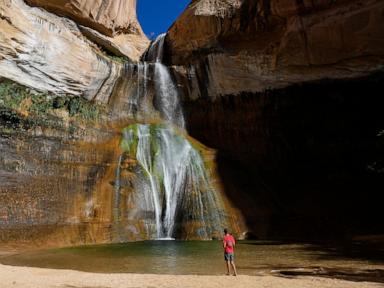
The executive action executed on July 13, 2026, which reduced the acreage of the Bears Ears and Grand Staircase-Escalante national monuments by approximately 90% each, represents a structural realignment of federal land tenure, resource valuation, and executive power. By utilizing presidential proclamations to shrink these protected zones to a fraction of their prior sizes, the administration has reopened a fundamental debate regarding the limits of statutory delegation and the economic prioritization of public lands.
Rather than viewing this decision as a simple partisan shift, a rigorous analysis must evaluate the structural legal mechanisms, the quantifiable spatial reconfigurations, and the competing economic cost functions that will dictate the region's operational future. Don't forget to check out our recent article on this related article.
The Quantitative Reconfiguration of Space
The physical scale of these reductions alters the land-management matrix of southern Utah. To understand the operational impact, we must analyze the precise spatial delta between the restored 2021 boundaries and the newly mandated 2026 limits.
Bears Ears National Monument
- Pre-July 2026 Footprint: Approximately 1,360,000 acres.
- Post-July 2026 Footprint: 121,096 acres.
- Total Land Subtracted: ~1,238,904 acres (a 91.1% reduction).
- Structural Modification: The remaining acreage is divided into two noncontiguous units, fundamentally altering the ecological and administrative continuity of the area.
Grand Staircase-Escalante National Monument
- Pre-July 2026 Footprint: Approximately 1,890,000 acres.
- Post-July 2026 Footprint: 181,541 acres.
- Total Land Subtracted: ~1,708,459 acres (a 90.4% reduction).
- Structural Modification: Similar to Bears Ears, the monument has been fragmented into isolated, noncontiguous parcels.
The total geographic withdrawal exceeds 2.9 million acres—an area larger than the state of Delaware. The spatial reduction is more aggressive than the 2017 modifications, which left Grand Staircase-Escalante at roughly 1 million acres and Bears Ears at 213,000 acres. By reducing both reserves to less than 10% of their previous sizes, the administration has effectively shifted the default management status of these millions of acres back to multiple-use frameworks overseen by the Bureau of Land Management (BLM) and the U.S. Forest Service. If you want more about the background of this, TIME provides an informative summary.
The Statutory Mechanics of the Antiquities Act of 1906
The core legal vector driving this action is the Antiquities Act of 1906. The statute grants the President unilateral authority to declare historic landmarks, historic and prehistoric structures, and other objects of historic or scientific interest as national monuments. However, the law contains a critical limiting clause:
$$A_{\text{monument}} \le A_{\text{smallest compatible}}$$
The statute dictates that monument reserves "shall be confined to the smallest area compatible with the proper care and management of the objects to be protected."
The structural legal conflict centers on two competing interpretations of this clause:
- The Landscape-Scale Protection Theory: Proponents of expansive monuments argue that entire ecosystems, watersheds, and cultural pathways constitute a singular "object of scientific or historic interest". Under this model, large geographic footprints are required to preserve the integrity of the individual artifacts contained within them.
- The Parcel-Specific Restriction Theory: Opponents argue that the act was intended exclusively for localized archaeological sites, such as specific ruins or geological formations. This theory holds that designating millions of acres is an ultra vires expansion of executive power that violates the "smallest area compatible" mandate.
The administration's 2026 executive orders heavily rely on the second interpretation, echoing concerns raised by Supreme Court Chief Justice John Roberts in 2021. Roberts noted that the Antiquities Act had been transformed from its original preservationist intent into a mechanism used to set aside vast, amorphous expanses of terrain.
A critical unresolved constitutional question is whether the power to establish a monument implies the power to diminish or abolish one. The Antiquities Act explicitly details the mechanism for creation but is silent on modification or revocation. Opponents assert that under the Property Clause of the U.S. Congress retains the sole authority to dispose of and make all needful rules respecting federal territory, meaning any contraction of monument boundaries requires legislative approval.
The Resource-Extraction vs. Amenity-Driven Economic Frontier
The reduction of monument boundaries directly shifts the economic utility functions of these public lands. When lands are designated as national monuments, they are typically closed to mineral entry, oil and gas leasing, and new utility corridors. Removing these designations reintroduces a market-driven resource allocation model.
The Extraction Utility Function
The lands removed from the monuments contain proven geological deposits of several high-value commodities:
- Uranium and Copper: Bears Ears sits on significant deposits of uranium, a critical fuel source for domestic nuclear energy, alongside valuable copper reserves.
- Coal: The Kaiparowits Plateau within the original Grand Staircase-Escalante boundaries contains massive, high-Btu, low-sulfur coal reserves.
- Oil and Gas: Portions of the extracted land overlap with potential hydrocarbon basins.
By opening these lands to leasing, the federal government enables capital-intensive extractive industries to bid on mineral rights. The economic benefit of this model is characterized by high, concentrated, short-to-medium-term capital investments, direct high-wage employment, and royalty payments to state and federal treasuries.
The Amenity-Driven Utility Function
Conversely, conservationists and local outdoor recreation businesses operate under an amenity-driven economic model. This system relies on keeping public lands intact to attract tourism, outdoor recreation, and retirees, which support long-term, distributed service economies.
The economic trade-off can be conceptualized as:
$$\text{Net Economic Value} = f(\text{Extractive Yield}) - g(\text{Amenity Degradation}) - \sigma(\text{Regulatory Instability})$$
Where:
- $f(\text{Extractive Yield})$ is the direct revenue and energy security value generated from mining and drilling.
- $g(\text{Amenity Degradation})$ is the loss of tourism revenue, ecological services, and cultural capital resulting from landscape disruption.
- $\sigma(\text{Regulatory Instability})$ represents the deadweight economic loss born by both extractive and tourism industries due to policy volatility.
The primary economic headwind created by the 2026 orders is the amplification of $\sigma$ (Regulatory Instability). Because these boundaries change every four to eight years based on presidential administrations, long-term capital deployment in both sectors is chilled. Extractive firms are hesitant to invest hundreds of millions of dollars in infrastructure when a future administration might attempt to re-establish the monument boundaries and tie up projects in litigation. Simultaneously, local hospitality and recreation businesses face planning horizons clouded by the threat of visual and environmental degradation of the surrounding areas.
The Co-Stewardship and Tribal Sovereignty Deficit
The 2026 proclamations revoke the collaborative management agreements established between federal agencies and Native American tribes. Bears Ears was the first national monument created at the explicit request of a coalition of tribal nations, including the Navajo, Hopi, Zuni, Ute Mountain Ute, and Uintah-Ouray Ute.
The original co-stewardship framework had practical operational implications:
- Integration of Traditional Ecological Knowledge: Tribal representatives actively participated in formulating fire management, grazing, and visitor-impact mitigation strategies.
- Access Protections: The framework guaranteed access for ceremonial, medicinal, and wood-gathering practices.
- Site Security: Joint management improved the monitoring of thousands of archaeological sites susceptible to looting and vandalism.
The dissolution of this framework without prior consultation violates the federal government's trust and treaty obligations. By shifting management back to standard BLM and Forest Service guidelines, the administration prioritizes centralized federal authority and local state preferences over sovereign tribal partnerships. This creates an immediate operational bottleneck, as tribal coalitions have already aligned with conservation groups to launch multi-pronged legal challenges in federal courts.
Judicial Arbitrage and Legal Pathways
Because the boundaries have now been radically altered twice in under ten years, the ultimate resolution of this conflict will not occur in the executive branch, but rather in the federal judiciary. The legal strategy of both proponents and opponents of the reductions will pivot on a critical procedural shift.
Recently, the State of Utah won an appellate ruling establishing that federal courts have the explicit authority to review presidential land designations under the Antiquities Act. This ruling removes a major jurisdictional barrier, allowing courts to look past the executive's broad assertions and examine whether the designated or excluded lands actually match the statutory criteria of "objects of scientific or historic interest."
The upcoming litigation will likely progress along two parallel tracks:
The Ultra Vires Track
Plaintiff coalitions (tribes, environmental NGOs, and outdoor businesses) will argue that the President acted ultra vires (beyond his legal power) because the Antiquities Act contains no text authorizing a reduction of boundaries. They will rely on the Federal Land Policy and Management Act (FLPMA) of 1976, which reserved the power to modify or terminate national monuments exclusively to Congress.
The Smallest Area Track
Defense teams (the federal government and the State of Utah) will argue that even if the President has the power to modify, the previous expansions under Democratic administrations violated the "smallest area compatible" requirement. They will attempt to use the newly established judicial review standard to force a narrow, object-by-object accounting of the monuments, challenging the legal validity of protecting millions of contiguous acres of surrounding desert.
The strategic objective of the state of Utah and its allies is to fast-track these cases to the Supreme Court. Given the current conservative majority on the high court and Chief Justice Roberts’ previous skepticism regarding monument sizes, the state believes it has a strong chance of securing a landmark ruling that permanently limits the scope of the Antiquities Act.
The immediate tactical move for stakeholders is to prepare for a prolonged period of regulatory suspension. While the court battles proceed, the Bureau of Land Management will be forced to draft interim resource management plans. Extractive companies should expect any permit requests or leases issued within the excised boundaries to face immediate injunctions from federal judges. Consequently, the most viable path forward for commercial and conservation interests alike is not immediate exploitation or despair, but the rigorous documentation of site-specific resources to build defensible positions for the eventual judicial showdown.
For direct coverage of the executive orders and immediate regional reporting, view this news report on the shrinking of the national monuments. This video provides direct footage of the signing ceremony and captures the immediate public statements made by federal and Utah state officials regarding the executive action.