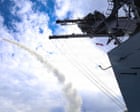
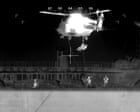
The removal of Supreme Leader Ayatollah Ali Khamenei on February 28, 2026, represents the most significant disruption to the Iranian state apparatus since the 1979 Revolution. This was not a localized strike but the opening salvo of Operation Epic Fury, a joint U.S.-Israeli campaign designed to force a rapid collapse of the clerical administration through kinetic decapitation and the systematic dismantling of its command-and-control (C2) nodes.
While initial reporting focused on the spectacle of the strikes, the true shift lies in the intentional creation of a power vacuum designed to overwhelm the regime’s internal stabilization mechanisms. By targeting the Supreme Leader and concurrently eliminating high-ranking officials—including Armed Forces Chief of Staff Abdolrahim Mousavi and IRGC Commander-in-Chief Mohammad Pakpour—the coalition has forced the Islamic Republic into a state of "strategic blindness," where the traditional hierarchy for decision-making has been physically erased. You might also find this connected article useful: The $2 Billion Pause and the High Stakes of Silence.
The Tri-Node Collapse: Mapping the Decapitation Strategy
The effectiveness of Operation Epic Fury is best understood through the collapse of three critical nodes that historically maintained the regime's longevity.
1. The Theological Legitimacy Gap
The sudden death of the 86-year-old Khamenei without a formally designated successor has triggered an immediate crisis within the Assembly of Experts. Under Article 111 of the Iranian Constitution, a temporary leadership council has been formed, comprising President Masoud Pezeshkian, Judiciary Chief Gholamhossein Mohseni Ejei, and Ayatollah Alireza Arafi. This council is a structural stopgap, not a source of charismatic authority. The loss of the "Marja" (source of emulation) creates an ideological deficit that the interim council cannot bridge, particularly as the coalition continues to strike symbols of clerical power. As reported in detailed coverage by The Guardian, the results are worth noting.
2. The Operational Paralysis of the IRGC
The Islamic Revolutionary Guard Corps (IRGC) functions as a state-within-a-state, yet its efficacy relies on a centralized "Office of the Supreme Leader." With the death of the Commander-in-Chief and top security advisors like Ali Shamkhani, the IRGC is currently operating in a fragmented, reactionary mode. While the IRGC announced a "sixth wave" of retaliatory strikes against 27 U.S. bases and Israeli assets, these actions lack the coordination of a sustained campaign. They are "revenge strikes"—tactically significant but strategically hollow—designed to project strength to a domestic audience rather than to achieve a specific military end-state.
3. The Socio-Economic Tipping Point
The strikes hit an economy already degraded by "Maximum Pressure" sanctions and the aftermath of the January 2026 protests. By targeting the headquarters of the IRGC and the naval infrastructure in the Persian Gulf, the coalition is effectively severed the regime's ability to subsidize its security apparatus. The Trump administration’s explicit call for the Iranian public to "take over your government" leverages this economic desperation, aiming to convert kinetic military success into a popular uprising.
Tactical Dynamics: The Multi-Front Response
The conflict has rapidly expanded beyond the borders of Iran, following a predictable but dangerous escalatory ladder.
- Asymmetric Retaliation: Iran’s retaliatory strikes have hit the Israeli town of Beit Shemesh, resulting in at least nine civilian casualties, and targeted U.S. assets in Bahrain and Qatar.
- Proxy Activation: Hezbollah has initiated rocket and drone salvos from Lebanon, prompting Israeli counter-strikes in Beirut’s southern suburbs.
- Maritime Chokepoints: The threat to the Strait of Hormuz remains the primary global economic risk. While the U.S. claims to have sunk Iranian naval vessels and destroyed naval headquarters, the presence of Iranian mines or "swarm" drone capabilities could still paralyze 20% of the world’s oil supply.
The Trump administration’s warning that operations will continue "uninterrupted throughout the week" signals a departure from the "proportional response" doctrine of previous decades. This is an attrition-based decapitation model. The goal is to ensure that by the time the Assembly of Experts meets to elect a new leader, there is no viable state structure left for that leader to command.
Structural Risks of the Power Vacuum
The primary risk of this strategy is the "Entropy Problem." When a highly centralized authoritarian system is decapitated, the result is rarely a clean transition to democracy. Instead, the most likely outcomes involve:
- Warlordism: Regional IRGC commanders may begin operating independently to secure their own local power bases and resources.
- Ethnic Fragmentation: As suggested by the presidential rhetoric targeting Persians, Kurds, Azeris, and Balochis, the collapse of the center could lead to secessionist movements along Iran’s periphery.
- The "Succession Trap": If the interim council attempts to install a hardline figure like Mojtaba Khamenei (the late leader’s son), it may trigger an internal civil war within the security forces between those loyal to the "Khamenei brand" and those seeking a pragmatic deal with the West to ensure their own survival.
Strategic Forecast: The Four-Week Window
The Trump administration has provided a timeframe of approximately four weeks for the primary combat phase. During this window, the objective is the total degradation of Iran’s nuclear and ballistic missile infrastructure.
The success of this operation does not depend on the death of a single man, but on the speed at which the Iranian people or dissident elements within the regular military (the Artesh) move to fill the void. If the Iranian security apparatus—the 600,000 Basij and 250,000 internal security forces—remains cohesive, the conflict will evolve into a prolonged, bloody stalemate. If, however, the "immunity" offered by the U.S. to defecting soldiers gains traction, the Islamic Republic as a political entity will cease to exist before the end of the month.
Monitor the movement of the Artesh (regular army) versus the IRGC over the next 72 hours; a divergence in their response patterns will be the definitive signal that the regime’s internal structure has fractured beyond repair.
Would you like me to analyze the specific impact of the Strait of Hormuz closure on Brent Crude pricing models for the second quarter of 2026?