The era of the "sanctions tax" has flipped. For three years, China’s independent refiners—the scrappy "teapots" of Shandong province—built an empire on the back of cut-rate crude from international pariahs. They didn’t just survive; they thrived by processing barrels that the rest of the world was too afraid to touch. But as of March 2026, the floor is falling out. Russia and Iran are no longer just competing with the global market; they are cannibalizing each other in a desperate race to the bottom to secure a dwindling slice of Chinese demand.
The math for Tehran and Moscow has turned mid-winter bleak. Recent data from Kpler and Vortexa confirms a brutal shift: Iranian Light is currently being offered at discounts of $11 to $12 per barrel against Brent benchmarks, a massive leap from the $3 to $4 discounts seen just a year ago. Russia’s Urals grade has followed suit, hitting a $12 discount in a frantic attempt to claw back market share after India—once Moscow’s most reliable post-invasion customer—began retreating under the threat of secondary U.S. sanctions. This isn't a strategic pricing move. It is a liquidation sale.
The Teapot Bottleneck
To understand why these discounts are deepening, you have to look at the gatekeepers. China’s "teapot" refineries are effectively the only clearinghouse left for sanctioned oil. These private firms account for roughly 20% of China’s total crude imports, but they operate under a rigid ceiling of government-issued import quotas. They cannot simply buy more just because it is cheap.
In early 2026, the Chinese Ministry of Commerce released its first batches of import quotas, and the signals are clear: Beijing is tightening the leash. With roughly 132 million tonnes allocated so far—about 70% of the annual expectation—the teapots are being forced to choose between Russian, Iranian, and whatever remains of the Venezuelan supply chain following the recent U.S. intervention in Caracas.
Russia has the upper hand here because it offers something Iran cannot: relative stability. While Iranian tankers are currently loitering in Southeast Asian waters, afraid to offload as U.S. carrier groups move into the region, Russian barrels continue to flow with slightly less friction. In February 2026, Russian exports to China surged to 2.07 million barrels per day (bpd), a 370,000 bpd jump from the previous month. They didn't just find new buyers; they effectively evicted 220,000 bpd of Iranian crude from the Chinese docks.
The Shadow Fleet Under Siege
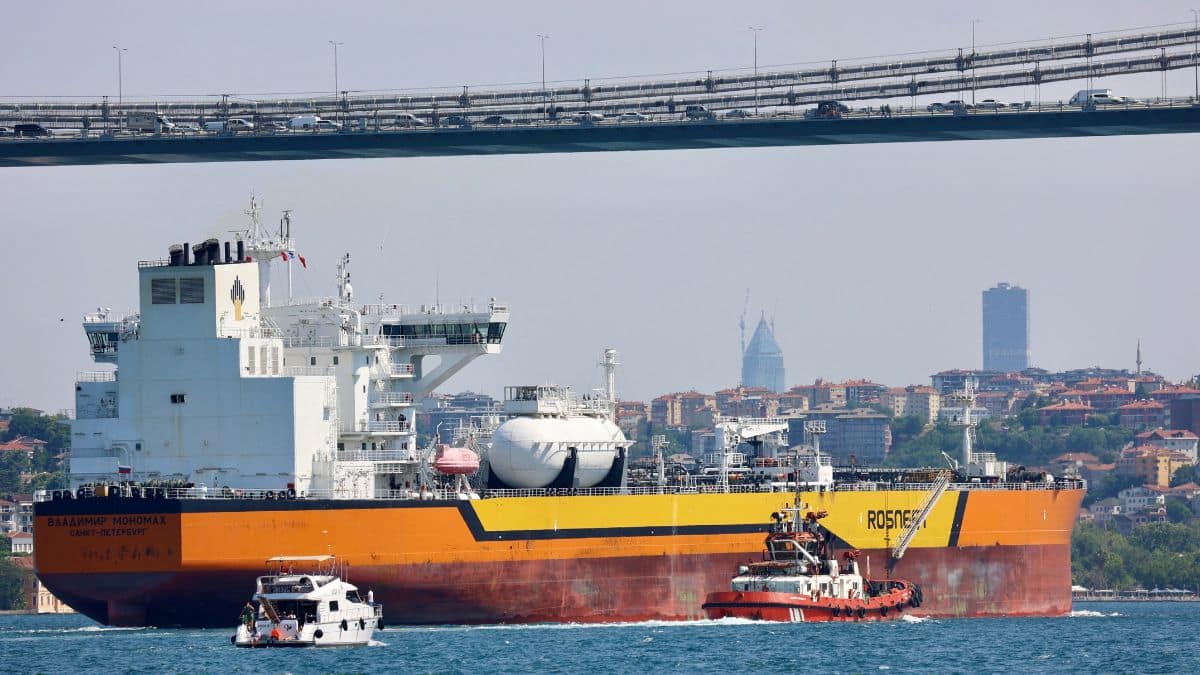
The infrastructure of evasion is finally fraying. For years, the "shadow fleet"—a ghost navy of aging tankers with opaque ownership and disabled transponders—was the indestructible link in the axis of sanctioned trade. That invincibility ended when the U.S. Treasury’s Office of Foreign Assets Control (OFAC) shifted from sanctioning entities to targeting the hulls themselves with surgical precision.
In 2025 alone, OFAC designated over 875 vessels and individuals. In February 2026, another 30 entities and 12 specific shadow fleet tankers were blacklisted. When a ship is named, its value as a logistical tool evaporates. It can no longer secure insurance, it is denied entry to most ports, and even the "dark" ship-to-ship transfers in the Malacca Strait become too hot for mid-level brokers to handle.
Iran is currently feeling this squeeze the hardest. Approximately one-third of its dedicated tanker fleet is currently acting as floating storage, unable to find a buyer willing to risk the 25% tariff recently threatened by the Trump administration against any trading partner of Tehran. For a teapot refinery in Shandong, a $12 discount looks a lot less attractive when it carries the risk of being permanently cut off from the global financial system or facing a retaliatory tariff on the refined products it hopes to export.
The Strategic Silence of Beijing
While Moscow and Tehran bleed margins, Beijing is playing a calculated game of strategic patience. The Chinese leadership has long viewed the flow of discounted oil as a "security dividend"—a way to fuel its massive manufacturing engine while keeping its geopolitical rivals occupied. But that dividend is reaching the point of diminishing returns.
The 25-year, $400 billion cooperation agreement signed between China and Iran in 2021 has largely remained a paper tiger. Investment has not materialized at the scale Tehran expected. Instead, China has used the agreement as leverage to keep prices low. If Iran wants to keep its economy from total collapse, it must sell to China. If it sells to China, it must accept whatever price Beijing’s middle-men dictate.
This isn't a partnership; it's a distressed debt workout.
Russia finds itself in a similar, if slightly more dignified, position. By pivoting its entire energy architecture toward the East, Moscow has traded its European "energy weapon" for a Chinese "energy leash." The more Russia competes with Iran for the same limited pool of Chinese buyers, the more power it cedes to the Chinese state-owned enterprises that ultimately regulate the flow of quotas to the teapots.
The Cost of the Conflict Premium
The volatility isn't just about sanctions; it's about the physical threat of kinetic action. With U.S. and Israeli strikes on Iranian nuclear and military infrastructure in mid-2025 still fresh, and the threat of new "kinetic attacks" looming in early 2026, the risk premium is being baked into the freight and insurance costs of every barrel.
Consider the logistics of a "dark" shipment. A tanker must:
- Load at Kharg Island under the threat of aerial surveillance.
- Steam toward Southeast Asia while spoofing its AIS (Automatic Identification System) coordinates.
- Conduct a ship-to-ship transfer in international waters to a "cleaner" vessel.
- Re-label the crude as "Malaysian" or "Oman" blend.
- Discharge at a Chinese port that is increasingly under the microscope of Western intelligence.
Each of these steps has become more expensive. Middlemen who used to take a $2 cut are now demanding $5 or $6 to cover the increased risk of asset seizure. When you subtract these "evasion costs" and the $12 market discount from the price of a barrel, the net revenue returning to the Iranian or Russian treasury is a fraction of the global Brent price.
Beyond the Barrel
The real story isn't just about oil prices; it's about the collapse of a parallel economy. The "Maximum Pressure" campaign 2.0 is designed to do more than just stop tankers; it is intended to make the cost of evasion higher than the value of the commodity.
We are seeing the results in real-time. Iran’s nominal oil export value fell 10% to $30.7 billion in the first half of the current fiscal year, and that doesn't even account for the ballooning costs of the shadow fleet operations. Meanwhile, Russia is finding that its "fortress economy" has a glaring weakness: it only has one major customer left with the infrastructure to take its volume, and that customer knows it.
The price war between Russia and Iran is a symptom of a closing trap. As the U.S. moves to seize more tankers—modeled after the January 2026 capture of the Bella 1—and China balances its need for cheap energy against the risk of massive trade tariffs, the "discount" will eventually reach a point where it is no longer worth the risk for anyone involved.
Would you like me to investigate the specific Chinese "teapot" refineries that have recently been blacklisted by the U.S. Treasury to see how they are restructuring their ownership?