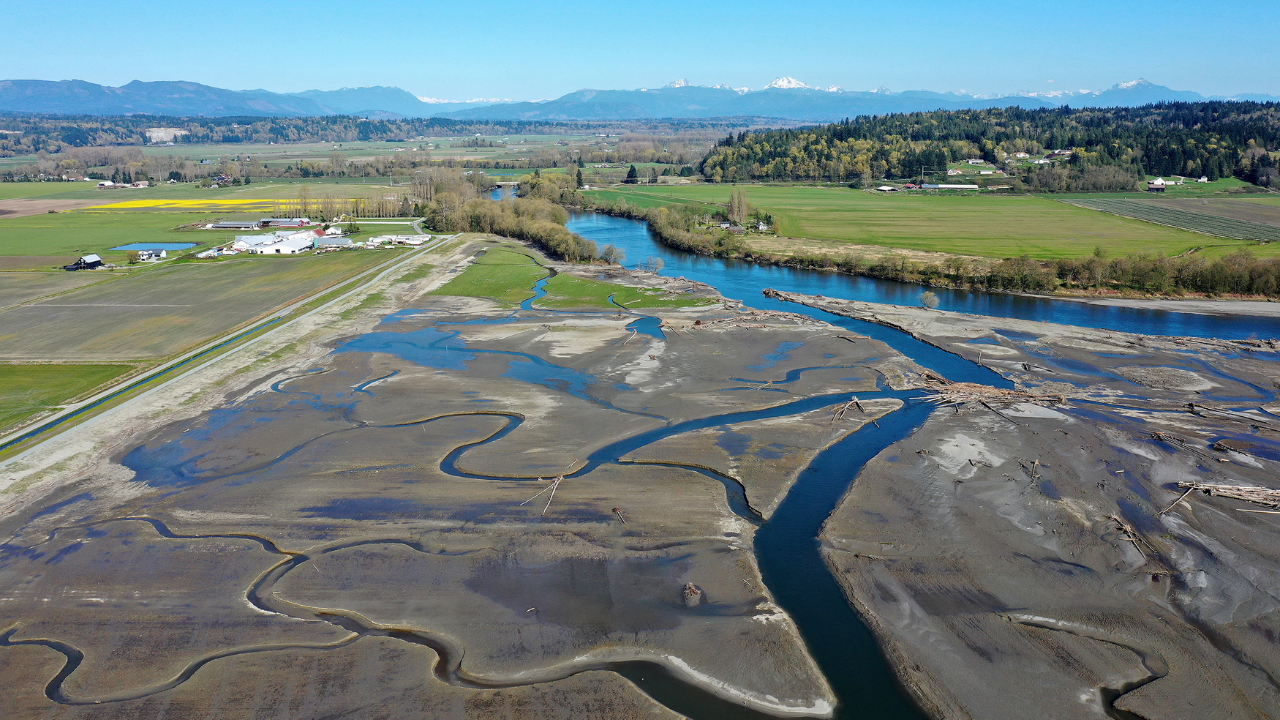
For a hundred years, we thought we could negotiate with water by building walls.
We drove cedar pilings deep into the muck of the Skagit River delta. We stacked gray basalt. We threw up earthen levees like stubborn shoulders, turning our backs to the salt and the tide, convinced that if we just drew a hard enough line in the mud, the Pacific Ocean would stay on its side of the fence.
It was a quiet war. A daily, grinding attrition.
I remember standing on the edge of the Fir Island farm fields back when the dirt still smelled exclusively of dry manure and chemical fertilizer. The wind off the bay tasted of nothing except dust and distance. You could stand right there, a few feet from the massive barrier holding back the Samish and Skagit tides, and feel a strange, hollow sense of human cleverness. Look at us, we seemed to say. We turned a swamp into a grocery store. We traded mud for corn.
Except rivers have long memories. And tides do not negotiate.
By the turn of the twenty-first century, the math had broken. The dikes were sinking. The maintenance bills were climbing like creeping ivy. Worst of all, the juvenile Chinook salmon—the very heartbeat of the Puget Sound ecosystem, the creature upon which killer whales and coastal economies alike depend—were dying. They were exhausting themselves trying to swim past miles of stone riprap, looking for a shallow, quiet place to rest, feed, and grow before facing the open ocean. There was no resting place left. Just stone. Just gravity. Just a straight, cold chute designed by engineers who thought nature was an engineering problem to be fixed.
So, in 2009, someone finally blinked.
Washington State did something radical. They surrendered.
Crews moved heavy machinery onto the historic Jensen-Olsen property. They didn't patch the leak. They didn't build a bigger wall. They tore a massive, deliberate hole in a century-old dike and walked away, letting the saltwater rush inland over seven hundred sixty-two acres of former farmland.
(To be clear, this wasn't an abandonment of stewardship; it was a calculated ecological unpaving, returning privately owned agricultural plots back to their original tidal marsh state through managed restoration.)
Imagine standing there on the first day the breach opened.
The silence of the pasture broke. The water didn't just flood; it exhaled. It poured through the jagged gap in the earthen wall with a low, hungry hiss, flooding ditches that had been dry since the Taft administration. It swallowed fence posts. It drowned old tractor ruts. It rushed into the low spots with an urgent, foaming joy, as if remembering a song it hadn't sung in generations.
The local farmers had watched with folded arms. You can't blame them. To a person whose grandfather cleared that land with a crosscut saw and a team of oxen, letting the ocean back in looks like vandalism. It looks like defeat. Why surrender good dirt to the crabs?
The answer took years to crawl out of the mud.
Within months of the breach, the ecosystem began a violent, beautiful reorganization. The stubborn agricultural weeds died off, choked by salt. In their place, pickleweed and Lyngbye's sedge sprouted, painting the mudflats in bruised purples and electric greens.
Then came the residents who actually owned the place before we arrived.
The salmon returned. Not in a trickle, but in thousands. Tiny, fragile Chinook fry found the newly formed maze of tidal channels. They didn't have to fight a concrete current anymore. They ducked into the flooded marsh grasses, feasted on amphipods and insect larvae, and fattened up in the warm, protected shallows. The marsh acted like a biological incubator, supercharging their survival rates before they headed out to the deep blue.
Birds followed the fish. Great blue herons stalked the newly formed creeks with prehistoric patience. Flocks of dunlin wheeled through the coastal fog in synchronized clouds, feeding on the bounty of a revived food web. Bald eagles perched on drowned snags, watching the silver flash of smolts in water that hadn't seen a wild fish in a century.
We spent a hundred years trying to make the landscape efficient. We learned, too late, that efficiency is often just another word for fragility.
When you trap a river between concrete walls, you starve the land of sediment. The delta subsides. The ground sinks below sea level. Every storm surge becomes a threat because the sponge—the natural marsh that absorbs the punch of the storm—has been paved over, drained, and farmed. By giving those seven hundred sixty-two acres back to the tides, Washington didn't just save fish. They built a shock absorber. When winter gales push storm surges against the coast now, that vast, spongy marsh spreads the blow out, protecting inland properties far better than any aging pile of rocks ever could.
History is heavy. It accumulates in the sediment of our choices.
We love straight lines because they make us feel safe. A straight drainage ditch. A square field. A concrete levee that says human on one side and nature on the other. But the earth is curved, and water is patient, and eventually, gravity collects what we borrowed.
The breached dike on Fir Island is a scar that healed into something better than what was there before. It stands as proof that sometimes the bravest, most forward-thinking thing a civilization can do is to undo its own arrogance.
Drive past it today on Highway 530, just as the morning fog begins to peel back from the Skagit flats. Look out toward Port Susan. You won't see a neat, tidy grid of crops anymore. You will see water shifting with the moon. You will see light skipping off a wild expanse of marsh grass, breathing, expanding, and contracting with a rhythm older than any state constitution.
The ocean came home. And for once, we got out of the way.