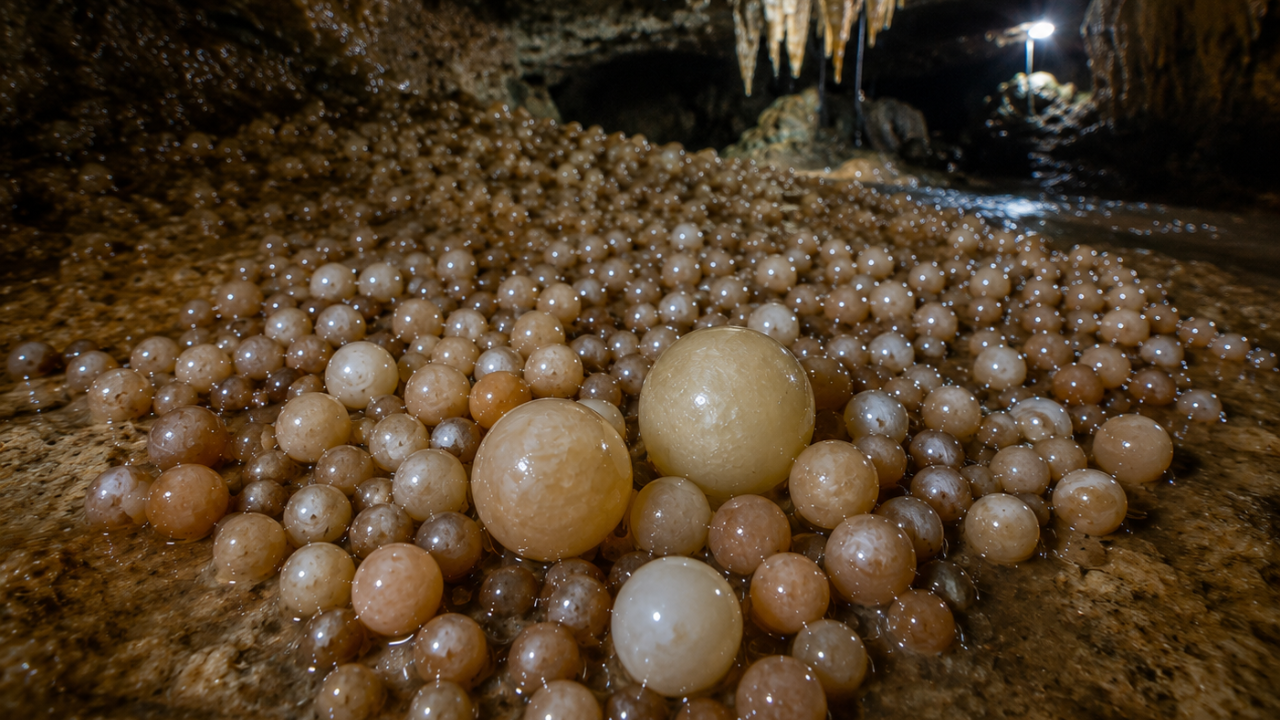
Deep inside the core zone of Phong Nha-Ke Bang National Park, a local resident named Thanh noticed a concealed fissure framed by limestone cliffs in the Ma Da Valley. That brief observation led expedition teams from local tour company Jungle Boss and national park authorities down a 20-meter rope drop into what is now called Thang Cave, or Victory Cave. Spanning three kilometers with cavernous chambers over 100 meters wide, the cavern contains a massive underground geological collection. What made international headlines was not just the 50-meter-tall limestone pillars or towering stone curtains, but the extraordinary discovery of thousands of bright, spherical cave pearls nestled in shallow rock pools across the cavern floor.
To mainstream media, this discovery represents another dazzling win for Vietnamese tourism. Pictures of smooth, porcelain-like spheres resting in ancient stone nests quickly flooded travel feeds. Beyond the glossy photography lies a far more complex reality regarding cave preservation, delicate karst hydrology, and the high-stakes economics of adventure tourism in Southeast Asia.
The Physics Behind the Stone Spheres
Understanding why these formations trigger such intense excitement requires stripping away the marketing hyperbole and examining the physical processes at play. Cave pearls are not precious gems. They carry zero monetary value on the open jewelry market and are composed almost entirely of calcium carbonate.
When mineral-saturated water trickles through ceiling fractures and drips into shallow basin pools, carbon dioxide escapes into the subterranean atmosphere. This chemical shift causes calcite to precipitate around a tiny core fragment, such as a speck of sand, a broken piece of stalactite, or an ancient animal bone fragment.
[Mineral-Rich Dripping Water]
           │
           ▼
[Shallow Rock Pool] ──► CO2 Released ──► Calcite Coating
           │
  [Agitation & Rolling Action]
           │
           ▼
[Polished Concentric Spheres (Cave Pearls)]
What transforms a standard mineral deposit into a round, lustrous sphere is physical movement. Water droplets falling from high ceilings create gentle, continuous currents inside the basin pools. This subtle motion keeps the nucleus rolling endlessly along the bottom of the depression. As thin layers of calcite build up in concentric circles around the core, constant friction against neighboring stones and the smooth basin wall grinds away any sharp edges. Over thousands of years, this continuous tumbling action creates smooth, spherical, or oval forms.
In most cave systems worldwide, these conditions exist only in microscopic isolated pockets. Finding a handful of crude cave pearls is noteworthy for speleologists; discovering thousands of uniform, brightly polished spheres inside broad stone basins across multiple chambers is an extraordinary rarity.
The Hidden Climate Record Written in Calcite
Beyond their aesthetic appeal, these mineral spheres function as ultra-precise environmental chronometers. Scientists view each pearl as a subterranean tree ring, capable of reconstructing ancient climatic shifts with remarkable detail.
When sliced open under laboratory conditions, a cave pearl reveals hundreds of distinct concentric growth bands. Thin, pure white layers indicate periods of stable, low-intensity rainfall where slow mineral precipitation occurred without contamination. Broader, darker bands correspond to prehistoric periods of heavy monsoons, surface soil erosion, or sudden hydrological surges that introduced foreign minerals and organic sediments into the cave system.
"A single cluster of cave pearls contains tens of thousands of years of local climate data," explains Dr. Marcus Vance, a subterranean hydrologist specializing in Southeast Asian karst systems. "They record long-term drought cycles, historic monsoon fluctuations, and changes in surface vegetation canopy above the park. Disrupting the ambient hydrochemistry of these pools effectively destroys an unread archive of Earth's history."
💡 You might also like: The Illusion of the Cool Rim and the Canyon Traps Below
This scientific value creates an immediate conflict with commercial ambitions. The moment a human boot treads near these fragile basins, the micro-environment begins to alter.
The Flawed Logic of Commercializing Pristine Karsts
Shortly after the survey team completed its initial mapping of Thang Cave, commercial proposals were submitted to incorporate the site into a two-day, one-night trekking route through the Ha Ma Da Valley. The economic motivation is clear. Phong Nha-Ke Bang has transformed from an obscure rural region into the cave-touring capital of the world, anchored by famous sites like Son Doong, Hang En, and Pygmy Cave. Local operators are constantly hunting for the next major feature to sell to high-paying international adventurers.
The structural reality of Thang Cave makes mass or even moderate trekking inherently destructive. The main entrance covers barely five square meters, with several internal passages squeezing down to narrow choke points that accommodate only one adult at a time. The interior environment is tightly sealed, maintaining near 100 percent humidity and an invariant ambient temperature.
+------------------------------------------------------------------+
|                   THANG CAVE PHYSICAL METRICS                    |
+------------------------------------------------------------------+
| Total Mapped Length  | ~3,000 meters                             |
| Average Width        | ~70 meters                                |
| Entrance Dimensions  | ~5 square meters (Vertical rope descent)  |
| Primary Feature      | Dense nests of calcium carbonate pearls  |
| Vulnerability Level  | Extremely High (Inclosed microclimate)    |
+------------------------------------------------------------------+
When human groups enter an enclosed cavern system, they introduce immediate physical disturbances:
- Thermal Pollution: Body heat raises ambient air temperatures in stagnant chambers, disrupting the delicate evaporation rates required for calcite precipitation.
- Carbon Dioxide Accumulation: Exhaled breath alters atmospheric carbon ratios, changing the chemical pH of pool waters and potentially dissolving the outer layers of cave pearls over time.
- Foreign Microbes and Fluff: Lint, hair, footwear dirt, and fungal spores carried on clothing settle onto sticky mineral surfaces, feeding invasive mold colonies that permanently stain pristine white calcite.
- Physical Micro-Fractures: Even small vibrations from foot traffic can crack delicate basin rims, allowing trapped water to drain away and ending the pearl-forming process permanently.
Cave pearls remain stable only while immersed in their native subterranean ecosystem. Once removed or exposed to shifting humidity and dry air, they lose their luster, dry out, and crumble into ordinary, brittle limestone fragments.
Lessons from Past Preservation Failures
The enthusiasm to open Thang Cave overlooks painful lessons learned elsewhere in Southeast Asia. Across the region, rapid tourism development without strict capacity limits has repeatedly ruined delicate subterranean resources.
Consider the history of early cave tourism in Southeast Asia during the late 1990s and early 2000s. When show caves were illuminated with high-intensity floodlights to accommodate large walking groups, the light triggered extensive "lampenflora" outbreaks—green algae and moss growth fueled by heat and artificial light that consumed ancient stalactites and permanently etched delicate rock faces.
In other unguided or poorly regulated karst sites in neighboring provinces, visitors touched formations with bare hands. Oils left by human skin created hydrophobic barriers on calcite surfaces, repelling water and permanently halting centuries of natural mineral growth. Many accessible cave pearl deposits throughout Asia were looted within months of public disclosure, picked clean by visitors seeking souvenirs that turned into dull, crumbling rocks within weeks of leaving the humid caves.
Operators in Phong Nha point to strict conservation protocols used in Son Doong as proof that eco-tourism can work. Expedition sizes are capped, waste is hauled out entirely, and trekking paths are defined by strict ropes.
Son Doong boasts massive, open collapse dolines that allow natural air exchange and sunlight penetration. Thang Cave is an enclosed, highly sensitive subterranean cavity. Applying the same operational logic to a completely different geological structure is a dangerous miscalculation.
The False Narrative of Local Economic Reliance
Proponents of rapid cave commercialization frequently argue that opening new routes is essential for lifting local communities out of poverty. They frame any attempt to restrict access as an attack on rural economic development in Quang Binh.
That argument ignores how modern high-end adventure tourism operates. While local residents work as porters, camp cooks, and field guides, the vast majority of profits generated by multi-hundred-dollar expedition permits flow directly to established tour management companies, gear suppliers, and regional administrative bodies.
Porters carry heavy 30-kilogram packs through dense jungle terrain, wading through underground rivers for modest daily wages while bearing the physical wear and tear of the job. Meanwhile, the delicate natural assets that justify those expensive permits face gradual degradation.
True sustainable regional development requires diversifying the local economy beyond simply funneling human traffic through pristine natural sanctuaries. Investing in sustainable agriculture, buffer-zone eco-lodges that do not rely on core-zone intrusion, and cultural heritage initiatives offers long-term stability without risking permanent damage to UNESCO-protected karst systems.
A Strict Blueprint for Scientific First Management
If Vietnam intends to protect the geological treasures inside Thang Cave, it must abandon the rush to turn every new discovery into an active trekking corridor. Protection must take precedence over profit.
A responsible approach requires an immediate, total moratorium on commercial tour development inside Thang Cave for at least five years. During this period, access should be restricted exclusively to credentialed speleologists, geochemists, and hydrological researchers tasked with establishing baseline environmental data.
Scientists need to map the exact water sources feeding the pearl basins, monitor seasonal microclimate shifts, and measure atmospheric equilibrium within the sealed chambers. Digital twin modeling—using high-resolution 3D LiDAR scanning to capture every millimeter of the cave floor—should be completed before any human group is allowed inside for non-scientific purposes.
If limited public access is ever permitted in the future, it must be strictly controlled through non-invasive virtual viewing hubs established outside the core national park zone, or restricted to ultra-exclusive, low-impact scientific observation permits.
The value of Thang Cave lies in its pristine condition, unmarred by human presence over hundreds of thousands of years. Turning a rare geological miracle into another check-mark on an adventure travel itinerary represents a profound failure of environmental stewardship. Some natural wonders are far more valuable left completely untouched in the dark.