The radiator in a winter apartment in Kyiv clicks and hisses, promising warmth it cannot always deliver when the substation down the street takes another hit. Outside, frost coats the windshields of parked cars. Inside, a mother holds a mug of lukewarm tea and listens to her phone buzz with a power-grid alert while her eight-year-old tries to finish a math worksheet by the glow of a battery lantern.
To anyone sitting in a café in Lyon, Nantes, or Lille on a crisp November afternoon, that radiator click can feel two thousand kilometers away. Distant. Abstract. Easy to reduce to a line item on a budget spreadsheet or a talking point on a Sunday television panel.
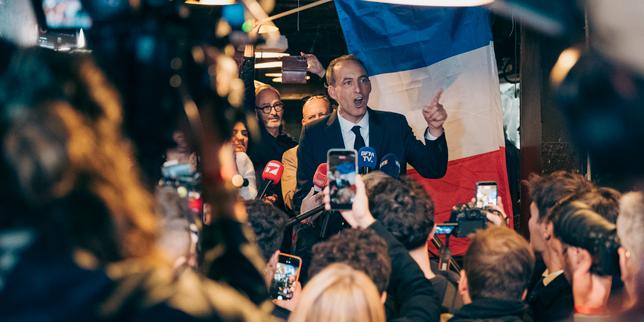
Yet as France inches closer to the 2027 presidential race, that distance is shrinking in the rhetoric of its leading political voices. Raphaël Glucksmann, carrying the banner of the Socialist Party and Place publique into the presidential contest, has turned aid to Ukraine into a defining moral fault line—accusing Rassemblement national leader Marine Le Pen of "capitulation" over her pledge to cut off French financial subsidies to Kyiv within six months of taking office, citing the strain on France's public finances.
Words like "capitulation" hit hard. They sound theatrical on a campaign trail. They also carry a heavy weight when real artillery shells, air-defense interceptors, and winter generators are waiting at the other end of a policy decision.
Two Visions of a Fractured Continent
On paper, the disagreement looks like a familiar clash between fiscal restraint and geopolitical solidarity. Look closer, and it becomes a test of what France believes it owes its neighbors—and itself.
Since Russia launched its full-scale invasion in February 2022 through August 2026, France has provided 7.91 billion euros in bilateral aid to Ukraine, according to calculations by the Kiel Institute for the World Economy. That number is large enough to spark real arguments at the checkout counter and in town halls across France, especially when households feel squeezed by cost-of-living pressures and public debt weighs on every ministry.
Le Pen argues that French taxpayers cannot keep underwriting open-ended financial support while the state's own accounts are stretched thin. Her camp has paired that six-month cutoff on financial subsidies with assurances that France would honor existing commitments—such as its share tied to the European Union's 90-billion-euro loan framework—continue material and humanitarian support, pursue more active diplomacy, and leave the door open to meeting Ukrainian President Volodymyr Zelenskyy in Paris or Brussels rather than traveling to Kyiv.
Glucksmann sees something far more stark behind that restraint. For him, pulling back financial lifelines while Russian forces press their advantage is not prudence; it is surrender disguised as bookkeeping. He has framed Ukraine's resistance as Europe's front line, argued for seizing roughly 210 billion euros in frozen Russian sovereign assets held in Europe so the burden does not fall on European taxpayers, and called for stronger air protection over Ukrainian skies. Even outgoing President Emmanuel Macron has stepped into the fray, warning that pushing Kyiv toward an "unjust peace" or cutting support only plants the seeds of a future war closer to home.
Let's pause and be honest about how confusing all of this can feel. When a politician says "no more financial subsidies" in one breath and "humanitarian aid and diplomacy" in the next, ordinary citizens are left wondering what actually changes on the ground. Does cutting financial aid mean hospitals run out of medicine? Does it mean fewer air-defense batteries? Or is it mostly political positioning aimed at voters tired of foreign crises?
I don't pretend to have a crystal ball that resolves every campaign promise in advance. What I do know—from watching how war grinds down everyday life—is that modern conflict rarely breaks all at once. It erodes slowly. A delayed shipment here. A budget freeze there. A moment of hesitation in a distant capital that convinces an aggressor to wait out the West's patience.
The Invisible Arithmetic of a Six-Month Clock
(Note: The following household in northern France is a hypothetical composite created to illustrate real economic trade-offs discussed during the campaign, not a real family.)
Picture Claire, a high school history teacher in Amiens who grades essays late into the evening while her husband works shifts at a regional logistics depot. Claire is not an ideologue. She worries about her property taxes, her aging parents' care, and whether her son will find steady work after university.
When Claire hears a candidate promise to turn off financial aid to Ukraine six months after taking office, part of her listens with relief. Billions of euros sound like money that could fix a leaky school roof or ease pressure on the national deficit. Who wouldn't want relief when their own belt already feels tight?
Now imagine a second scene—this one grounded in the documented reality of a country fighting for survival. In Kharkiv or Dnipro, a municipal engineer looks at a map of damaged transformers. Keeping a city of hundreds of thousands of people supplied with heat, water, and emergency services during winter isn't an abstract geopolitical exercise. It requires cash, spare parts, fuel, and steady international backing that doesn't vanish mid-season because an election calendar turned a page.
Think of a house fire down the street. (This is a metaphor comparing collective security to neighborhood firefighting.) If your neighbor's roof is ablaze and sparks are blowing toward your own eaves, handing the firefighters a bucket of water for six months and then telling them you're closing your wallet because you need to repaint your living room doesn't put out the fire. It just gives the flames time to reach your fence.
That is the core of Glucksmann's accusation of "capitulation". Critics of cutting aid argue that halting financial support weakens Ukraine's hand at the exact moment diplomacy needs strength behind it. If Moscow believes European capitals will lose nerve or run out of money, why would the Kremlin compromise on terms acceptable to Kyiv or its European neighbors?
On the other hand, supporters of Le Pen's approach contend that a financially strained France cannot lead or sustain anything if its own economy falters. They argue that diplomacy—including face-to-face talks with Zelenskyy—and targeted non-cash assistance offer a way to stay engaged without signing blank checks.
History Doesn't Repeat in Neat Chapters, But It Rhymes in Warnings
European politics has wrestled with the temptation of distance before. Throughout the twentieth century, leaders repeatedly told anxious publics that conflicts on the edges of the continent—or driven by authoritarian regimes testing borders—could be contained through caution, accommodation, or looking inward.
Sometimes caution looked like wisdom in the moment. Often, it merely postponed a much steeper bill.
Zelenskyy himself put the stakes plainly in late October interviews, warning that if Ukraine falls, Russia moves closer to the European Union—and therefore closer to France. Whether you agree with every detail of Kyiv's strategy or every proposal put forward by Glucksmann, Macron, or Le Pen, that geographic reality cannot be wished away by a slogan.
And yet, dismissing voters who worry about French public finances is a mistake, too. Democracies don't sustain long commitments by lecturing citizens into silence; they sustain them by showing why security at home and solidarity abroad are tied together, and by finding smarter ways to fund defense—such as debating the use of frozen Russian assets—rather than pretending the problem doesn't exist.
What's Really at Stake Before 2027
By the time ballots are cast in 2027, voters will hear dozens of speeches about sovereignty, budgets, peace, and strength. Campaign language loves sharp edges: heroes and villains, patriots and capitulators.
Real life is messier.
A mother in Kyiv still has to watch the battery indicator on her lantern when night falls early in November. A teacher in Amiens still has to balance her household budget while wondering what kind of Europe her children will inherit. Between those two lives runs a thread made of choices—choices about courage, cost, and whether promises made in peacetime hold up under pressure.
When the sirens sound over a Ukrainian city, nobody asks how a debate polled in Paris. They only know whether the lights stay on.
Lights.
Flickering in a frost-bitten window while a continent decides whether it still has the nerve to stand by its word.