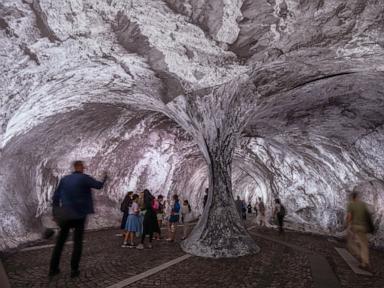
The oldest standing bridge in Paris has disappeared beneath an eighteen-meter mountain of printed fabric and compressed air, forcing thousands of daily commuters to trade their view of the Seine for an artificial cavern that smells of wet rock and animal smoke.
Running through June 28, La Caverne du Pont Neuf—the latest public installation by the monumental street artist JR—aims to shock citizens out of their urban blindness by encasing the 1607 stone bridge in a massive, fabric-and-air facsimile of a prehistoric cave. While the global press lines up to praise the sensory magic of the experience, a sharper look at the project reveals a deeper irony. The installation, explicitly designed to critique our collective addiction to digital screens and corporate algorithms, is financed heavily by private tech capital and relies on Silicon Valley augmented reality to achieve its climax. It is an extraordinary artistic achievement, but it operates within the exact corporate matrix it claims to expose.
Reimagining the Parisian Limestone
For centuries, the Pont Neuf has served as a primary artery of Parisian life. Built from Lutetian limestone—the foundational stone quarried from the very bowels of the city—it was the first bridge in Paris built entirely without wood. JR’s installation deliberately strips away this classical elegance, replacing the familiar open-air crossing with a dark, claustrophobic tunnel that stretches across the river.
The primary mechanism of the illusion is not visual, but olfactory and auditory. The sensory details include:
- The Scent Profile: Created by olfactory expert Sarah Bouasse, the air inside shifts dynamically. It utilizes chemical compounds like geosmin and isoborneol to mimic the smell of petrichor—rain striking dry earth—before transitioning into warmer, smoky, and distinctly animal notes.
- The Acoustic Environment: A low-frequency, monolithic electroacoustic soundtrack composed by Thomas Bangalter, formerly of Daft Punk, reverberates through the fabric walls, simulating the heavy, oppressive breathing of an underground chamber.
- The Ground Underfoot: Stripped of the surrounding cityscape, visitors are forced to focus strictly on the physical sensation of the ancient, uneven cobblestones beneath their feet.
The immediate result is undeniable. The installation effectively strips away the automated numbness of the daily commute, forcing passersby to walk slowly, listen closely, and look at their surroundings like children.
The Shadow of Christo and the Reality of Private Funding
The project explicitly frames itself as a direct tribute to the 40th anniversary of Christo and Jeanne-Claude’s legendary 1985 installation, The Pont Neuf Wrapped. That historical connection, however, highlights a fundamental shift in how monumental public art is produced and funded in the modern era.
When Christo and Jeanne-Claude wrapped the bridge in pale golden fabric four decades ago, they maintained absolute financial sovereignty. They famously refused all grants, corporate sponsorships, and donations, funding the millions of dollars required for their projects entirely through the independent sale of preparatory drawings, collages, and scale models. This financial isolationism was central to their philosophy, ensuring that no corporate logo or political agenda could dilute the purity of the public intervention.
In contrast, La Caverne du Pont Neuf operates on an entirely different economic model. While JR’s team emphasizes that no government funds or taxpayer money were used, the endowment fund responsible for the project relies heavily on private, multinational corporate backing. The exhibition is explicitly supported by Snap Inc., Bloomberg Philanthropies, and Salesforce.
The Silicon Valley Illusion
This corporate overlap becomes highly evident in the physical experience of the artwork itself. JR has publically linked the installation to Plato's allegory of the cave, arguing that modern smartphone screens and corporate algorithms are the contemporary equivalent of the shadows on the wall, keeping humanity blind to true reality.
Yet, to experience the full scope of La Caverne du Pont Neuf, visitors are instructed to pull out their smartphones and open the Snapchat application. Through an augmented reality lens developed in partnership with Snap Inc., the physical fabric walls give way to digital illusions. Digital bats trail trails of light through the cavern, passing human bodies leave ghostly digital traces on the screen, and a virtual dancer materializes out of thin air.
This creates a striking paradox. To fully appreciate an artwork designed to liberate the public from the tyranny of the digital screen, the viewer must view the physical world through a proprietary camera filter owned by a multi-billion-dollar social media corporation. The critique of the algorithm is delivered via the algorithm itself.
The Ephemeral Illusion
When the installation closes at the end of June, the printed fabric will be deflated, dismantled, and sent away for recycling. The artificial mountain will vanish from the Parisian skyline, vehicle traffic will reclaim the cobblestones, and the 17th-century bridge will return to its familiar, classical state.
The temporary nature of the project ensures that its critique remains safe, digestible, and temporary. It provides a thrilling, highly photogenic shock to the sensory system of Paris, but it ultimately leaves the deeper structures of urban life—and digital consumption—completely untouched. The public steps inside, sniffs the simulated earth, views the corporate-sponsored shadows on the wall, and steps back out into the bright, unexamined reality of the modern city.