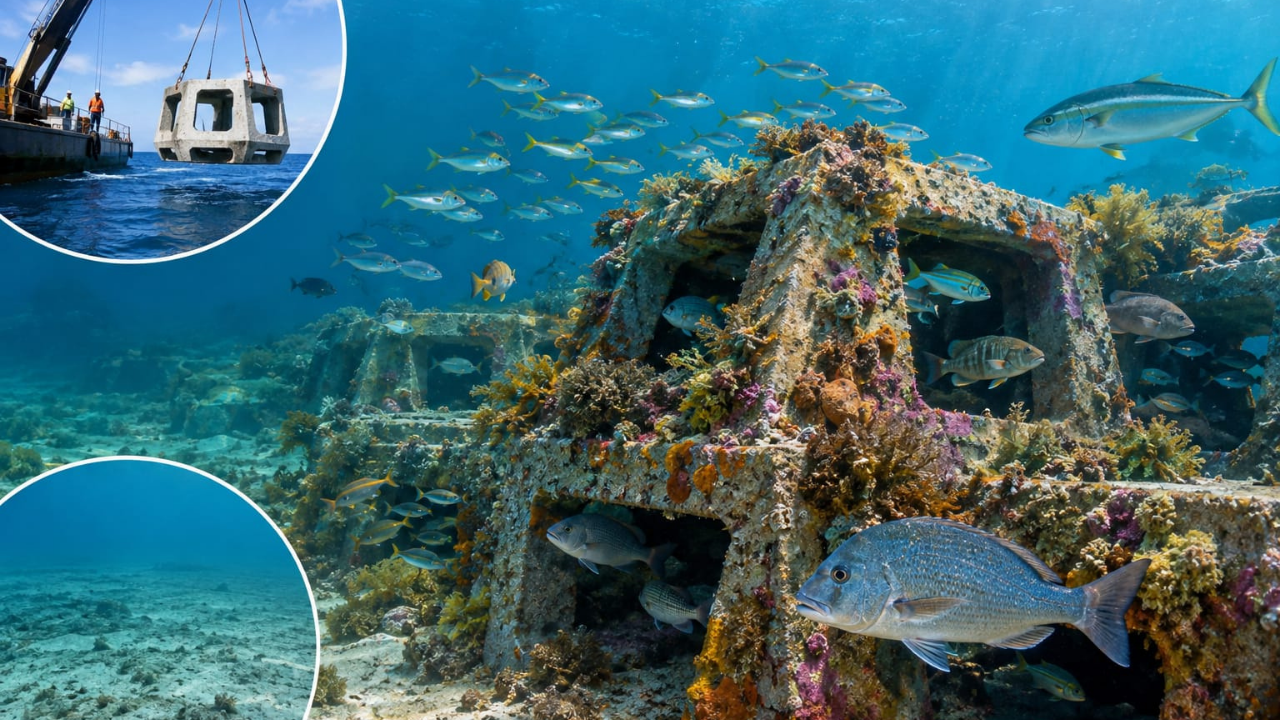
When marine biologists and state fisheries managers dropped sixty ten-tonne concrete boxes onto the barren, sandy seafloor off the coast of Western Australia, skeptics called it an expensive disposal exercise. Positioned in the shallow waters of Geographe Bay near Bunbury and Dunsborough, these massive blocks of steel-reinforced concrete were designed with internal voids and curved cross-braces. Their stated purpose was simple: engineer an upwelling effect that could force nutrient-rich bottom water toward the surface and spark local biological productivity.
Within three years, the transformation rendered the skepticism obsolete. Surveys coordinated by researchers and local fishing organizations documented that fish species counts at the sites surged from roughly twelve baseline residents to over sixty distinct varieties. Yet, looking past the headline-grabbing metrics reveals a complex ecological narrative. Dumping heavy aggregates onto a flat seabed does not automatically repair an ocean; it redistributes biomass, alters local predator-prey dynamics, and forces a hard look at how humans manage coastal ecosystems.
The Physics of the Artificial Drop
To understand why a concrete box attracts life, one must look at the mechanics of an underwater desert. Much of the nearshore continental shelf consists of featureless sand flats. These plains offer zero shelter from currents, minimal hiding spots from apex predators, and almost no structural attachment points for sessile invertebrates like algae, sponges, and bryozoans.
When engineers sank the thirty-tonne blocks in clusters across the Bunbury and Dunsborough zones, they introduced vertical relief. Ocean currents hitting these monolithic structures are forced upward, creating localized water column mixing. This physical disturbance brings dormant nutrients up from the benthic zone, feeding microscopic phytoplankton and zooplankton.
Almost immediately, the food chain ignited. Within weeks, pelagic species such as Samson fish and yellowtail kingfish appeared, utilizing the shadow of the structures to ambush prey. Within months, encrusting organisms began to paint the raw concrete, turning industrial grey surfaces into living biological substrates.
Attraction Versus Production
A persistent debate plagues marine spatial engineering. Do artificial reefs like the Western Australian project actually increase regional fish populations, or do they simply act as underwater magnets, drawing fish away from natural reefs and concentrating them where humans can easily catch them?
Fisheries scientists distinguish carefully between net production and aggregation. If a structure merely gathers existing fish from miles around, it risks making populations more vulnerable to overfishing by centralizing the stock. However, long-term monitoring programs—including citizen science initiatives where local boaters drop underwater cameras to record fauna—suggest a more nuanced reality.
The structural complexity of the hollow boxes provides crucial juvenile nursery habitat that was previously absent in those sandy stretches. Species that require shelter during their vulnerable early life stages can survive and grow in numbers that the open sand could never support. As a result, the reefs do more than draw in adult nomads; they complete life cycles, effectively expanding the biological carrying capacity of the coastal strip.
The Human Element and Management Pressures
Placing multi-tonne concrete modules just a few kilometers from major boat ramps was an intentional socioeconomic decision. Recreational fishing is a cornerstone of coastal culture in Western Australia, putting immense pressure on fragile inshore natural reefs. By creating alternative fishing destinations close to ports, authorities hoped to disperse the angling pressure.
The strategy worked, but it introduced new management challenges. Concentrating high volumes of predatory fish like pink snapper and dhufish around predictable GPS coordinates creates hotspots that modern fish finders and global positioning technology can target with surgical precision. Without strict bag limits and adaptive fisheries management, these successful oases could easily become overexploited fish traps.
The success of the South West reefs prompted the state government to replicate the blueprint across other regions, deploying larger and more complex arrays from Exmouth to Esperance. Each new deployment serves as a massive, open-air laboratory where marine architects fine-tune module porosity, weight, and spatial arrangement to optimize specific species recruitment.
Ultimately, dropping concrete boxes onto the seabed does not reverse decades of broader environmental stress, nor does it replace pristine natural marine parks. But as a masterclass in kickstarting biological activity where virtually none existed, the Western Australian experiment demonstrates that human engineering, when aligned with ecological fundamentals, can write a very different chapter for a barren seafloor.