The sea does not care about borders. It rolls in with a heavy, indifferent gray, crashing against the double row of razor wire that fringes the Spanish enclave of Ceuta like rusted iron thorns. For months, the water has been a graveyard of quiet desperate decisions. People stand on the shore of North Africa looking across a strip of blue water at Europe, seeing not a continent, but an escape hatch from hunger, state collapse, and futures ground down to dust.
Then the boots arrive.
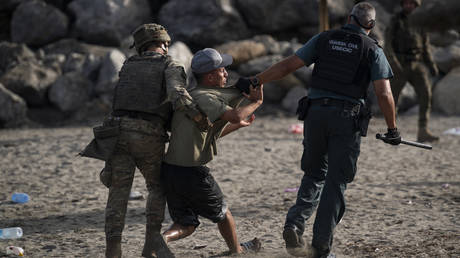
To understand what happened on that stretch of beach, you have to look past the bureaucratic language of security protocols and international jurisdiction. You have to look at the geometry of desperation meeting an immovable wall of state-sanctioned force. Video footage leaked from the border fence captured something raw and disturbing: Spanish Guardia Civil officers striking migrants who had managed to claw their way past the barriers, beating them back into the surf with batons while they lay motionless or scrambled like crabs in the wet sand.
It is easy to watch a video on a glowing screen, sip coffee, and scroll away. It is harder to sit with what those images actually mean.
Imagine, for a moment, that your entire life has been reduced to a single waterproof plastic bag holding your birth certificate, fifty crumpled Euros, and a photograph of your mother. Imagine walking thousands of miles across deserts where the wind scours your skin raw, sleeping under highway overpasses, dodging extortionists and militias, only to find yourself pinned beneath the heavy wool uniform and riot gear of a European border guard.
Ceuta and its sister enclave Melilla are strange anomalies of geography. They are tiny shards of Spain—and by extension, the European Union—physically grafted onto the northern coast of Morocco. They are Europe’s back door. For decades, they have served as magnet points for sub-Saharan Africans and impoverished Moroccans willing to risk broken limbs or drowning to cross the fence lines.
The physical barriers here are engineering marvels of exclusion. They are twenty feet high, laced with high-tension cables, thermal cameras, motion sensors, and loops of concertina wire designed to shred flesh on contact. Yet people still climb. Why? Because the alternative at home is worse. When starvation is a certainty and a shattered pelvis from a fall is merely a risk, the math changes. The fence stops being a barrier and becomes a gamble.
When those videos of the beatings surfaced, they triggered more than just outrage. They laid bare a deep moral contradiction at the heart of modern border management. Western democracies spend billions of euros preaching human rights, rule of law, and asylum protections across the globe. Yet at the physical margins of those same democracies, the velvet glove comes off entirely. The iron fist takes over.
Witnesses and human rights organizations have long whispered about what happens in the gray zones between Spanish and Moroccan authority. Pushbacks—known legally as devoluciones en caliente—are designed to bypass the due process required by international law. Under the Geneva Conventions and European human rights frameworks, anyone who sets foot on European soil has the right to claim asylum, to have their individual case heard, to be treated as a human being rather than a stray animal.
Instead, what the cameras caught was a summary execution of rights on the wet sand.
Let us be entirely honest about the pressure points facing border nations. Spain is tasked with guarding the southern frontier of an entire continent. When hundreds of people rush a fence simultaneously—a tactic known locally as a salto—the officers on the ground are overwhelmed, anxious, and operating under immense adrenaline. Fear breeds aggression. It is a predictable psychological reaction when systems are strained beyond their breaking point.
However, explanation is not absolution.
When a man is curled into a fetal position on the ground, shielding his head with his forearms while multiple uniformed officers strike him with batons, the boundary between defense and brutality has been crossed. At that moment, the state ceases to be a protector of law and order and becomes an instrument of raw, unchecked dominance. It sends a chilling message to anyone watching: You are invisible, and your pain is the price of our security.
The aftermath of such incidents follows a predictable script. Officials issue statements expressing concern. Investigations are promised. Internal reviews are launched to determine whether proportionality was maintained. But the systemic pressure remains unchanged. The sea is still there. The fence is still there. And millions of young people across the African continent are still calculating that the risk of a Spanish baton is worth the distant, fragile promise of a safe bed in Madrid or Paris.
We live in an age obsessed with walls. Everywhere, nations are retreating behind nationalistic barricades, sealing their perimeters, and treating human migration as an invasion rather than a permanent, historical reality driven by climate change, economic inequality, and political violence. We build higher fences because we lack the imagination to build humane, functional systems.
When you strip away the politics, the legal briefs, and the tactical analyses, migration is fundamentally about human endurance. It is about the refusal to accept the lottery of birth as a death sentence.
On the beach at Ceuta, the tide eventually washed away the footprints in the sand. The salt air rusted the iron wire just a little bit more. But the questions raised by those heavy blows do not wash away so easily. They linger in the quiet spaces between one news cycle and the next, asking us to decide what kind of world we actually want to inhabit—one defined by the brutal crack of a baton against the dark, or one courageous enough to look a human being in the eye and recognize our shared reflection.


