The air in Niagara Falls carries a permanent mist, a damp chill that clings to the skin and smells faintly of concession stand popcorn and old water. For decades, tourists flocked to this strip of concrete and neon, drawn by the thunder of the falls and the promise of seeing wild things up close. They paid their admission, walked through the turnstiles of Marineland, and looked into the pits.
Down there, beneath the level of the sidewalk, were the bears.
To a child holding a plastic cup of corn, a bear is a massive, slow-moving cartoon. It sits on its haunches. It waves a heavy, clawed paw. It begs. The crowd laughs, tosses the food, and moves on to the next exhibit, leaving the animal in its bowl of painted rock.
But if you stand there long enough, past the point where the crowd thins, the spectacle fractures. You notice the rhythmic, mind-numbing pacing. The heavy paws clicking against the concrete, tracing the exact same radius, hour after hour, year after year. It is a stillness masquerading as movement. It is the sound of a wild instinct trapped inside a sensory vacuum.
For the last remaining black bears of Marineland, that concrete reality just shattered.
The logistics of moving a single large predator are dizzying. Moving an entire group of them across an international border is an exercise in high-stakes bureaucracy, veterinary precision, and raw physical labor. The destination is the Wild Animal Sanctuary in Keenesburg, Colorado—a sprawling, prairie refuge that looks nothing like Ontario.
To understand why this matters, you have to look past the press releases and the clean, clinical language of animal transfers. You have to understand what happens to a creature built for the horizon when its world is fifty feet wide.
The Geography of a Cage
A wild black bear is an explorer of the highest order. Its life is governed by an intricate internal map of smells, seasons, and vast distances. In the wild, a single bear might claim a home range of up to eighty square miles. They climb. They dig. They forage for berries, strip bark from decaying logs, and submerge themselves in cold, rushing rivers to escape the summer heat. Their minds are constantly processing a massive influx of environmental data.
When you place that same animal on flat, featureless concrete, its world shrinks to a geometric point.
The psychological toll of this restriction manifests in ways that are painful to watch. Biologists call it stereotypic behavior. It is the repetitive rocking, the swaying, the biting of iron bars. It is the brain’s desperate attempt to stimulate itself when the environment offers nothing but a blank wall. The animal is alive, but its world has been completely extinguished.
The transition from this static existence to a life of freedom is not as simple as opening a gate. You cannot take a creature that has known only walls and suddenly drop it into the wilderness. The shock alone can be fatal.
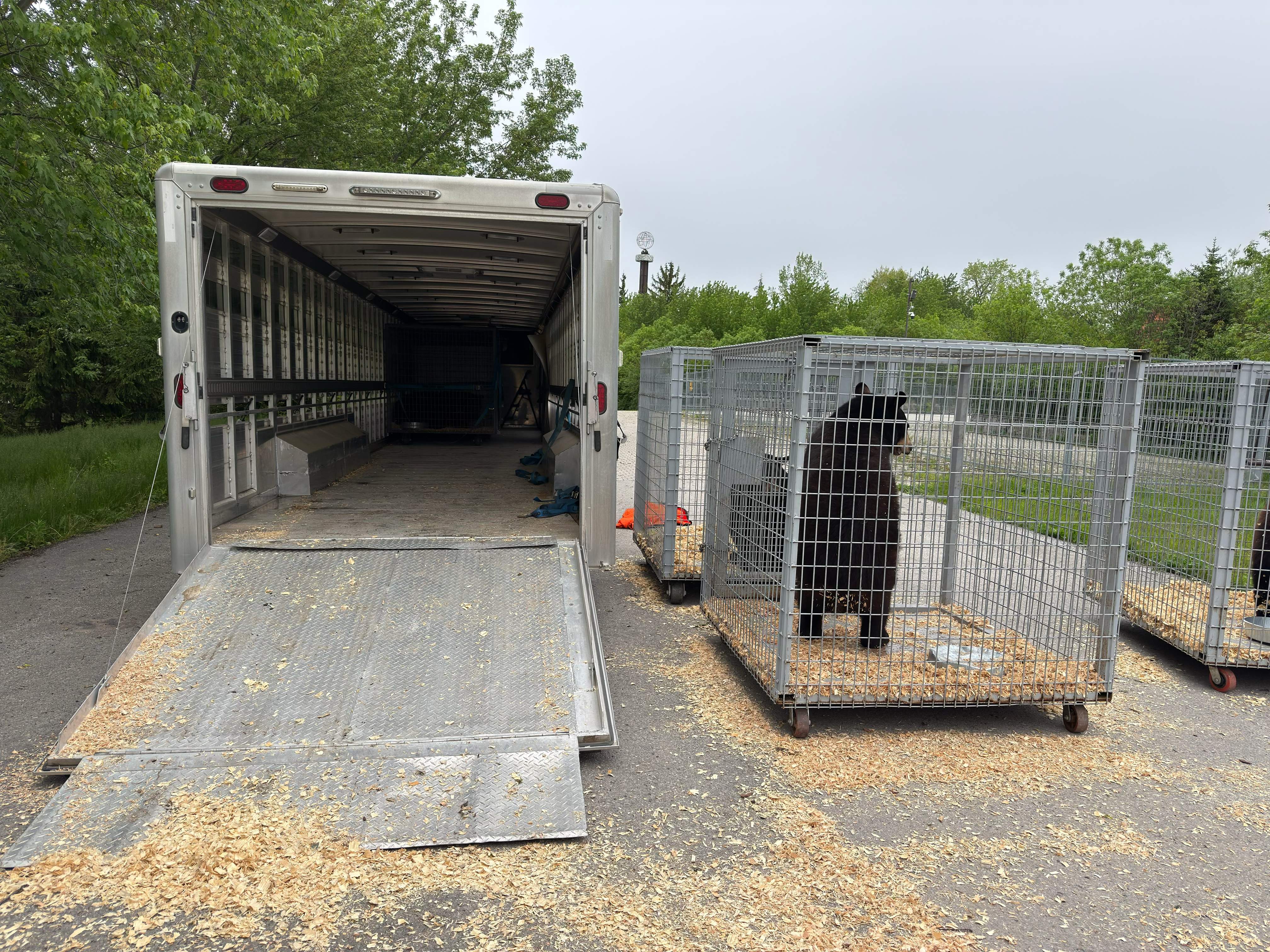
The people tasked with managing this transition operate in a space of quiet, intense pressure. The physical preparation begins months before the actual journey. Crate training is the first hurdle. The bears cannot be heavily sedated for the entire duration of a cross-continental trek; long-term sedation carries severe respiratory risks for animals of that size. Instead, they must be coaxed into viewing their transport crates not as traps, but as safe spaces.
Day after day, keepers place food inside the heavy containers. The bears hesitate. They sniff the metal. Eventually, hunger or curiosity wins, and they step inside. The doors remain open at first, then close for a few seconds, then minutes. It is a slow, methodical dance of building trust where little reason for trust exists.
The Border and the Blueprint
The journey from Ontario to Colorado is roughly fifteen hundred miles. It spans multiple states, customs checkpoints, and climate zones. Every mile introduces a variable that can go wrong. A tire blowout, a spike in humidity, a delay at the border—any of these can escalate from a minor inconvenience into a life-threatening crisis for the cargo.
Consider the paperwork alone. Under the Convention on International Trade in Endangered Species, moving animals across the US-Canada border requires a mountain of permits, health certificates, and legal clearances. Each bear must have a documented medical history, proof of vaccination, and a clean bill of health from government veterinarians. The bureaucracy is thick, rigid, and completely indifferent to the emotional urgency of the rescue.
While the lawyers argue over signatures, the team at the Wild Animal Sanctuary in Colorado prepares for the arrival.
The sanctuary does not use cages. It operates on a scale that is difficult to comprehend until you see it. Thousands of acres of open grassland, dotted with hills, ponds, and specialized structures designed to mimic natural habitats. Here, the bears will eventually be introduced to large, multi-acre enclosures.
But that freedom must be rationed.
When a bear arrives from a lifetime of confinement, its initial reaction to an open field is rarely joy. More often, it is terror. An animal used to walls relies on those walls for a sense of security. Without them, the vastness of the sky can feel like a vacuum, causing the bear to panic, run blindly, or injure itself against the perimeter fencing.
The sanctuary staff utilizes a process of gradual acclimatization. The new arrivals are placed in smaller, secure transition areas. They can smell the earth beneath their feet, feel the wind coming off the Rocky Mountains, and hear the distant sounds of other bears, but they still have the physical boundaries they require to feel safe. Only when their stress hormones level out and their behavior stabilizes are they allowed to step into the larger world.
The Weight of What We Leave Behind
There is a distinct vulnerability in looking at these animals and realizing how long we got it wrong. For over half a century, facilities like Marineland existed because we believed that the value of seeing an animal justified the cost of its captivity. We convinced ourselves that as long as they were fed and sheltered, they were content.
The shift in public consciousness did not happen overnight. It was driven by decades of legal battles, undercover investigations, and a growing body of scientific evidence detailing the complex emotional lives of large mammals. We began to understand that a bear is not a prop. It is a sentient being with a profound capacity for frustration, boredom, and grief.
Marineland’s decision to transition its remaining bears is part of a larger, systemic collapse of the old-world amusement park model. It is an admission that some things are simply too big to be kept in a souvenir shop.
But the departure of these bears leaves behind an empty space that is heavy with history. The concrete pits remain, stained with decades of use, serving as a monument to an era of entertainment that is finally running out of time. The victory is real, but it is tempered by the knowledge of the years that were lost to the concrete.
The First Step on the Dirt
Imagine the moment the transport vehicle finally pulls into the Colorado sanctuary. The engine cuts out. The dust settles. The air here is thin, dry, and smells of sagebrush and pine. It is a radical departure from the humid, chlorinated atmosphere of the Niagara tourist strip.
A keeper approaches the rear of the vehicle, unlatching the heavy steel doors of the crate.
Inside, a black bear shifts its weight. It does not rush out. It has spent its entire life understanding that the world ends at a vertical surface. It sniffs the air. It catches the scent of deep soil, of living grass, of things that have never been scrubbed down with bleach.
Slowly, a heavy, calloused paw extends past the edge of the metal.
The pad of the foot presses down. For the first time in the animal's life, the ground yields. The earth shifts under its weight. It is not the hard, unyielding shock of concrete, but the soft, damp embrace of the living world. The bear pauses, absorbing the sensation through nerves that have been dormant for years, before stepping completely out into the sun.