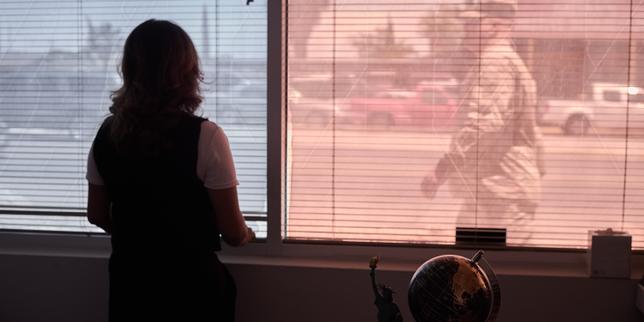
The air inside the processing center doesn't move. It sits heavy, smelling of industrial-grade bleach and the salt of unwashed skin. When the metal door clangs shut, the sound doesn't just ring through the room; it vibrates in your marrow. It is a sterile, fluorescent-lit purgatory where time dissolves into a sequence of shivering and waiting.
Most people see these facilities as data points on a map of the Texas scrubland. They see numbers, migration surges, and political talking points. But the reality is found in the crinkle of a Mylar blanket. It’s the silver, foil-like sheet given to men, women, and children to ward off the "hieleras"—the iceboxes. That is what the detainees call these rooms. The air conditioning is cranked so low that lips turn a faint shade of blue, a tactical cold designed to keep a crowded room passive.
Consider a man we will call Elias. He is a hypothetical composite of the dozens of testimonies emerging from the Texas border, but his fear is documented and real. Elias didn't cross the Rio Grande looking for a fight. He crossed because the alternative back home was a certain kind of grave. Now, he sits on a concrete floor so cold it feels like it’s drinking the heat directly out of his bones. He hasn't seen the sun in four days. He hasn't been able to brush his teeth. He is told to stand, then told to sit, then told nothing at all.
"They treat us like animals," is the refrain that leaks out of these walls. But that’s not quite right. In many jurisdictions, there are laws governing the space and caloric intake required for a kenneled dog. Here, the rules feel more like suggestions weighed against the crushing volume of human bodies.
The Architecture of Erasure
The logic of the detention center is built on the idea of the "temporary." It is meant to be a waystation, a brief holding pattern before someone is processed and moved. However, the system is backed up like a blocked artery. "Temporary" stretches into a week. A week becomes two.
When you strip a human being of their shoelaces, their belt, and their name—replacing it with a numbered plastic wristband—you aren't just processing them. You are practicing a form of erasure. The guards often stop using names entirely. It is easier to manage a "unit" than a father who is wondering if his daughter in the next room has been given enough water.
The water is another thing. Reports from the interior frequently describe a yellow tint to the liquid coming from the taps, or a heavy scent of chlorine that makes the throat itch. When you are thirsty enough, you drink it. When you are hungry enough, you eat the frozen sandwich that hasn't fully thawed in the middle. This is the grit of the American Dream for those currently caught in the gears of the Texas detention machine.
The Sound of Two Thousand People Whispering
If you stand in the center of a large holding cell, the noise is a constant, low-frequency hum. It’s the sound of a thousand different prayers and anxieties being whispered at once. There is no privacy. Not for sleeping, not for weeping, and certainly not for the toilet, which often sits in the middle of a crowded pen, shielded by nothing but a low concrete wall or sometimes nothing at all.
This isn't an accident of logistics. It is the result of a philosophy that views the migrant not as a seeker of asylum, but as a logistical burden to be managed with the least possible friction.
Human rights observers who have managed to gain access or speak to those recently released describe a profound psychological "breaking." It starts with the lights. They never go out. 24 hours a day, the LED strips hum overhead, erasing the circadian rhythm. You lose track of whether it is Tuesday or Thursday. You lose the ability to dream. You simply exist in a perpetual, brightly lit "now."
The Invisible Stakes of the Texas Scrub
Why does the temperature matter? Why does the taste of the water or the lack of a toothbrush signify something larger?
It’s because these are the small, daily ways we acknowledge someone’s humanity. When we stop providing a way for a mother to wash her child’s face, we are making a statement about that child’s value. The "hieleras" of Texas are not just cooling units; they are a physical manifestation of a cold-blooded policy.
The statistics tell us that tens of thousands pass through these gates. We see the overhead drone footage of lines of people snaking through the dust. It looks like a column of ants. But when you zoom in—past the metal fences and the tactical gear of the Border Patrol—you see the trembling hands. You see the man holding a scrap of paper with a relative's phone number written in ink that is fading from the sweat of his palms.
That scrap of paper is his only tether to a world where he is a person. Inside the center, that paper is often confiscated.
The Weight of the Silence
There is a specific kind of silence that follows a person after they leave detention. It’s a haunted look, a flinch at loud noises, a strange obsession with keeping the lights on at night because the darkness has become unfamiliar and terrifying.
The "competitor" reports often focus on the budget or the political sparring between state and federal governments. They argue about who pays for the bus or who signs the executive order. But while the adults in suits argue in Austin and D.C., the man on the concrete floor is wondering if he will ever feel warm again.
He is not a statistic. He is a memory of a home he can never return to, trapped in a room that refuses to acknowledge his presence.
The real cost of these centers isn't measured in dollars. It’s measured in the slow, steady erosion of the moral high ground. We tell ourselves we are a nation of laws, but when those laws produce a system where a child shivers under a foil blanket while a guard looks on with indifference, the law has lost its soul.
The door clangs again. Another group is ushered in. The cycle repeats. The bleach persists. The cold remains.
Beyond the gates, the Texas wind howls across the open plains, carrying the dust of a thousand journeys. Inside, there is only the hum of the lights and the crinkle of silver plastic. It is a sound that stays with you long after you’ve walked away from the fence, a reminder that under the harsh glare of the hielera, we are all being tested. And right now, the temperature is dropping.



