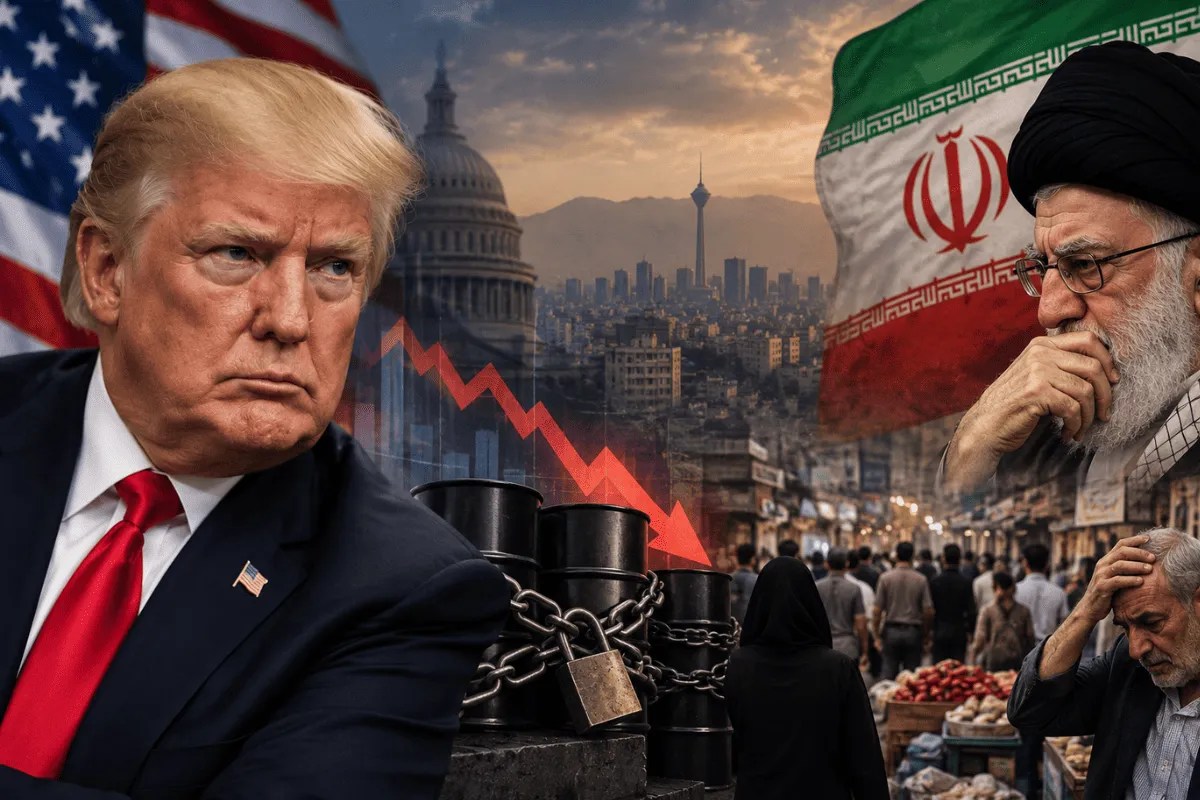
In the quiet hours before dawn in Tehran, the scent of crushed cardamom and woodsmoke hangs heavy over alleyways lined with bitter orange trees. A young man named Ali sweeps the concrete outside his grandfather's apothecary, his hands calloused, his mind fixed on the cost of a single crate of imported insulin. Above him, the sky turns the bruised color of a plum. He does not look up at the horizon to search for warplanes. He has spent his entire life under the shadow of invisible threats, living through currency collapses that rewrite his life's savings overnight, reading headlines written in Washington that speak of him as a statistic, a pressure point, a bargaining chip.
Far across the ocean, beneath the polished chandeliers of a mahogany-lined boardroom, maps are unrolled. Strategies are drawn with thick black markers. The theory is clinical, beautiful in its geometric symmetry. Starve the state of revenue. Choke the oil exports. Block the banking pipelines. Squeeze until the currency turns to dust, until the shopkeepers close their shutters for good, until the mother on the street corner has no choice but to scream at the gates of power. The calculation is simple physics. Apply maximum pressure, and the structure must buckle.
Yet, down in the dusty streets of Isfahan and the narrow bazaars of Shiraz, the physics break down.
Consider what actually happens when an empire tries to starve a nation through paperwork. The sanctions arrive like a slow-moving winter, freezing assets, locking international accounts, and turning routine trade into an elaborate game of maritime hide-and-seek. Official intelligence estimates in Washington whisper of a regime teetering on a knife-edge, its treasury bled dry, its legitimacy hanging by a frayed thread. Every macroeconomic indicator points toward total structural failure. The math is undeniable.
Except human beings are not equations.
When official trade routes slam shut, underground rivers open. In the labyrinthine corridors of the Grand Bazaar, merchants who have traded carpets and spices for centuries simply adapt. They build a parallel economy fueled by gray-market oil, cryptocurrency workarounds, and barter systems that bypass the Western financial grid entirely. A state-owned enterprise does not vanish because it is banned from SWIFT; it simply reinvents itself under a dozen shell companies, operating out of unmarked office blocks in neighboring capitals.
The political elite, the hardline core that Washington hoped to isolate from the populace, discovers a morbid paradox. Economic isolation does not weaken their grip; it tightens it. When a society is locked in a permanent state of economic siege, the individual's survival depends entirely on the state's rationing cards, subsidized bread, and internal security apparatus. The outside enemy becomes the convenient explanation for every empty shelf, every hospital bed lacking medicine, every broken promise of prosperity.
Dissent becomes a luxury for times of peace. In times of siege, survival is the only political currency left.
We have seen this script before, played out on different stages across the globe. History is littered with the wrecks of empires that confused economic embargoes with political execution. They mistake the resilience of a populace for the popularity of a regime. They believe that by starving the body, they will awaken the soul to revolution. But more often than not, the starving body simply focuses all its remaining energy on finding its next meal, leaving no strength to storm the citadel.
Ali drops his broom against the wall. The morning traffic begins to roar, a chaotic symphony of old Paykan sedans and buzzing motorcycles choking the asphalt. He knows nothing of geopolitical containment strategies or the fine print of executive orders signed thousands of miles away. He only knows that the price of flour went up again today, and that somehow, miraculously, the bakery down the street is still open.
The strategy failed because it measured a civilization in dollars and barrels of oil while ignoring the stubborn, quiet art of endurance. The concrete cage remains standing, not because it is beautiful or just, but because its inhabitants have learned to turn the very walls of their prison into a home.