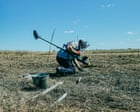
Clearing landmines on a scale last seen in Vietnam sounds like a pure engineering puzzle, until you realize the ground in Ukraine is still shifting under drone and artillery fire.
Roughly a quarter of Ukraine's territory has faced contamination from mines and unexploded ordnance, leaving millions of people living near hidden hazards and keeping huge stretches of farmland out of production. Estimates from the National Mine Action Platform put potentially contaminated area around 132,000 square kilometers as of early 2026, while official estimates of tens of billions of dollars over a decade show just how heavy the bill is. You can't solve a problem that size with guys poking dirt with prodders one square meter at a time. Not anymore. Also making waves lately: Liability Mandates and Public Assembly Why Municipal Insurance Rules Filter Civic Speech.
Why Vietnam Comparisons Only Get You So Far
Comparisons to Vietnam help people grasp volume, yet they miss what makes Ukraine a different beast. In Southeast Asia, clearance stretched across decades of postwar reconstruction through dense jungles and tropical terrain. In Ukraine, deminers are working across vast agricultural plains, scarred forests, shattered villages, and active or recently contested fronts where Russian forces have laid dense anti-tank and anti-personnel belts, rigged booby traps, and left behind heaps of unexploded shells and cluster submunitions.
Artillery and cluster munitions complicate the math right away. High dud rates on unexploded ordnance mean a seemingly quiet field after heavy shelling can still hold live explosives beneath the surface. And unlike classic post-conflict clearance where the shooting stops first, Ukrainian crews face ongoing aerial threats and strikes near active zones, forcing them to adapt tactics mid-operation rather than follow a neat peacetime playbook. More insights on this are detailed by The New York Times.
There's also a practical truth that surprises people outside the sector. Not every square kilometer of suspected land actually contains a mine. Non-technical surveys—talking to locals, reviewing satellite imagery, mapping combat movements, and flying reconnaissance drones—often rule out large swaths of suspected ground before a single sapper steps onto it. That distinction between suspected danger and confirmed contamination saves massive amounts of time and money.
How Machines, Drones, and AI Change the Math
Traditional manual demining is painstakingly slow, careful work. One person working a single patch of ground can take a long time just to clear a tiny footprint, and heavy vegetation, metal debris, or frozen soil slows things down even further. That's why Ukraine has become a testing ground for unmanned vehicles, remote-controlled tools, and computer vision.
- Remote-controlled ground vehicles: Systems like tracked flail and tiller machines—alongside lighter Ukrainian-built platforms such as Zmiy and compressed-air demining rigs like the DMR-7—let operators stay back while machines detonate, clear, or uncover hazards in tough terrain.
- Aerial surveys and AI image analysis: High-resolution drones paired with AI algorithms can spot surface tripwires, unexploded shells, or disturbed soil across wide fields far faster than walking grids on foot.
- Mine detection dogs and trained crews: K9 teams still add value in specific environments, working alongside certified manual sappers who handle final clearance in tight or cluttered spots where heavy gear can't go.
Still, tech isn't a magic wand. Robots break down in mud, overheat under heavy workloads, and struggle with complex booby traps or tripwires hidden in tall weeds. Even the sharpest AI model needs human verification before a farmer drives a tractor across a field, because a missed anti-tank mine or cluster munition can wreck a combine or kill a driver.
What Actually Slows Demining Down
If you ask field specialists why progress sometimes crawls, they won't blame physics first. They'll point to bureaucracy, safety protocols, equipment maintenance, and funding gaps.
International Mine Action Standards exist for a reason—cutting corners gets people killed—yet strict certification, slow procurement, overlapping agency responsibilities, and spare-parts bottlenecks can stall operations for months. At the same time, international donors and agencies like the United Nations Mine Action Service, UNDP, and humanitarian operators have poured substantial money and training into building local Ukrainian capacity. Returning land to farming pays off quickly in food production and local recovery, even while full clearance remains a multi-decade project.
Honestly, the biggest mistake people make is treating demining like a single finish line. It's a tiered triage effort. You clear main roads, power lines, water infrastructure, and prime farmland first so communities can function again, while forests, riverbanks, and heavily mined former front lines take much longer.
Practical Ways to Track or Support the Work
If you want to follow this issue or contribute meaningfully without falling for hype, focus on verified operational data and established programs rather than sensational headlines:
- Follow official mine action trackers and UN updates: Check reports from the UN Mine Action Service and national Ukrainian mine action portals to see updated survey figures, cleared land totals, and risk education efforts.
- Prioritize accredited operators: If you donate or advocate, look at established humanitarian demining organizations and multilateral programs that publish transparent safety and clearance metrics rather than unverified gadget claims.
- Watch land-use recovery, not just headline numbers: Track whether agricultural land, schools, and local transport routes are reopening in liberated areas, since safe economic use is the real measure of success.


