The neon glare of a twenty-four-hour diner in Fresno casts a long, damp shadow across the asphalt. Inside, a truck driver named Tomas stares into a cup of black coffee, watching the steam rise and vanish into the air conditioning. He is thinking about his diesel bill. He is thinking about his daughter’s tuition at Fresno State. Most of all, he is thinking about a feeling that has been creeping up on him for a decade: the sense that the state he was born in is drifting away from him, floating off into some rarefied stratosphere where regular people cannot breathe.
Three hundred miles south, in a pristine backyard in Los Angeles, the conversation is entirely different. The talk there is of global climate leadership, systemic equity, and the preservation of a progressive vanguard that protects the vulnerable.
These are not just two different zip codes. They are two different realities, two competing versions of the American Dream, locked in a quiet, simmering civil war for the soul of the Golden State.
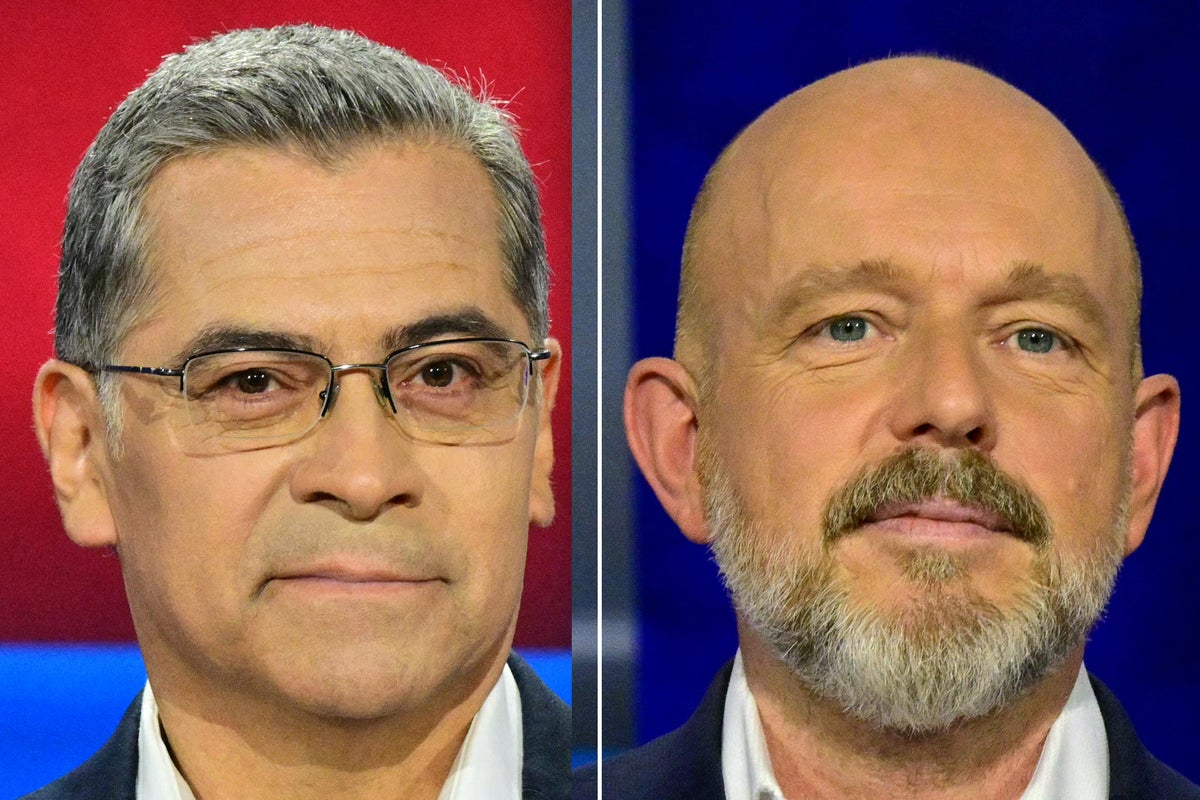
Now, that war has a face. Actually, it has two.
The ballots have been counted, the primary dust has settled, and the stage is set for a gubernatorial race that will define California for a generation. In one corner stands Xavier Becerra, the Democratic heavyweight, a seasoned creature of the political establishment who embodies the state’s current power structure. In the other stands Steve Hilton, the Republican challenger, a British-born policy iconoclast and former television host who has channeled the burning frustrations of the state's interior.
This is no ordinary election. It is a referendum on whether the California machine can survive its own weight, or whether a populist wrecking ball will smash the gears.
The Architect of the Status Quo
To understand why this matchup feels so seismic, you have to look at Xavier Becerra. He is the political equivalent of a polished marble pillar in the state capitol. A former assemblyman, a long-serving congressman, the state’s attorney general, and the federal Secretary of Health and Human Services. His resume is not just a list of jobs; it is a map of the progressive establishment.
For millions of Californians, Becerra represents safety. He represents a bulwark against the chaotic tides of national conservatism. When the federal government threatened California's environmental laws or immigration sanctuaries in years past, Becerra was the man who filed the lawsuits. He was the shield.
But shields are heavy. And for people like Tomas at the diner, the shield feels less like protection and more like a weight crushing his chest.
Consider the daily friction of California life. The gas taxes that tick upward automatically. The housing regulations that make a modest three-bedroom home in Bakersfield cost more than a mansion in Texas. The sense that the government is deeply concerned with cosmic, global issues while the sidewalks of San Francisco and Los Angeles tell a story of human misery and neglect.
Becerra walks into this campaign carrying the baggage of the incumbents. He is the defender of the kingdom at a time when many of the subjects are eyeing the castle walls with pitchforks. His challenge is not merely to defeat an opponent, but to convince a deeply fatigued electorate that the current path is still leading somewhere worth going.
The Outsider in the Golden Gate
Then there is Steve Hilton.
If you were scripting a Hollywood movie about a California populist, you probably wouldn't invent a guy who grew up in Britain, went to Oxford, and served as the chief strategist to a British Prime Minister. Hilton speaks with a distinct English accent that feels entirely alien to the Central Valley. Yet, when he speaks, audiences in Bakersfield, Redding, and San Diego lean in.
Why? Because he articulates a specific, targeted rage.
Hilton’s political journey is a strange one. After helping David Cameron reshape British conservatism with a "compassionate" tint, he moved to California, fell in love with its raw entrepreneurial energy, and became horrified by its governance. He spent years hosting a show on Fox News, building a brand as a champion of the forgotten worker against the "ruling class."
When Hilton announced his run, the political class laughed. California is a deep-blue fortress. A Republican hasn't won a statewide race here since Arnold Schwarzenegger left office. The party’s registration numbers have dwindled to near-irrelevance in the major metro areas.
But Hilton didn't run a traditional Republican campaign. He didn't spend his time courting the country club set or repeating old partisan talking points. Instead, he went straight to the places that felt abandoned by Sacramento. He talked about the "positive populism" of rebuilding local communities, slashing the bureaucracy that chokes small businesses, and breaking the monopoly of the state teachers' unions.
His victory in the primary, securing the second spot to advance to the general election against Becerra, was a shock to the system. It proved that the frustration in California is not confined to standard partisan lines. It proved that people are hungry for a different vocabulary.
The Invisible Stakes
We often treat elections like sports matches, tracking the poll numbers and the fundraising hauls like box scores. But the true stakes of the Becerra-Hilton matchup are lived out in the quiet corners of the state.
Imagine a small business owner in Fresno named Elena. She runs a boutique grocery store. Every month, she fills out dozens of state forms, pays some of the highest commercial utility rates in the country, and watches her margins shrink to the width of a razor blade. She wants to pay her workers more, but the state's regulatory mandates dictate exactly how she must run her operations, leaving her no room to breathe.
When Elena looks at Xavier Becerra, she sees a system that views her as an ATM to fund grand social experiments. When she looks at Steve Hilton, she sees a gamble. A massive, unpredictable gamble.
That is the choice hovering over California. It is a choice between the predictable erosion of the status quo and the unpredictable eruption of a political outsider.
The debate will inevitably center on the big, flashy issues. Homelessness. Crime. The cost of living. Climate change. But underneath the talking points, the argument is really about power. Who deserves to hold it? The experts who have spent their lives studying policy in the halls of Sacramento, or the communities that have to live with the consequences of those policies?
Becerra will argue that California’s problems are global in scale, requiring sophisticated, experienced leadership to navigate. He will paint Hilton as an extremist, a foreign import trying to bring Trump-style populism to a state that rejects it. He will remind voters of the progress made on healthcare access and clean energy, framing the election as a defense of California’s values.
Hilton will counter with a simple, devastating question: Are you better off now than you were ten years ago? He will point to the billions spent on homelessness with almost no visible improvement. He will point to the families packing up U-Hauls and moving to Idaho or Utah. He will frame himself not as a partisan ideologue, but as a practical reformer coming to clean out a corrupt house.
The Long Road to November
The months ahead will be loud. The airwaves will be flooded with hundreds of millions of dollars in advertising. The state will be carved up into media markets, with consultants analyzing every demographic shift and voting bloc.
But the election won't be decided in the campaign offices. It will be decided in places like Tomas’s diner. It will be decided by the voters who don't usually answer pollsters, the ones who feel a quiet, simmering resentment every time they look at their paycheck or their neighborhood park.
California has always been a place of reinvention. It is the state where people come to build the future, to escape the constraints of the past. For decades, that future was defined by an expansive, optimistic liberalism that believed government could build a paradise on the Pacific.
That belief is now facing its ultimate test.
As the sun begins to rise over the Sierra Nevada, painting the Central Valley in shades of amber and dust, Tomas pays his bill and walks out to his rig. He climbs into the cab, starts the engine, and looks out at the highway stretching ahead into the dawn. He doesn't know who he will vote for yet. He only knows that the state he loves is running out of time to fix itself, and the road ahead looks steeper than it ever has before.