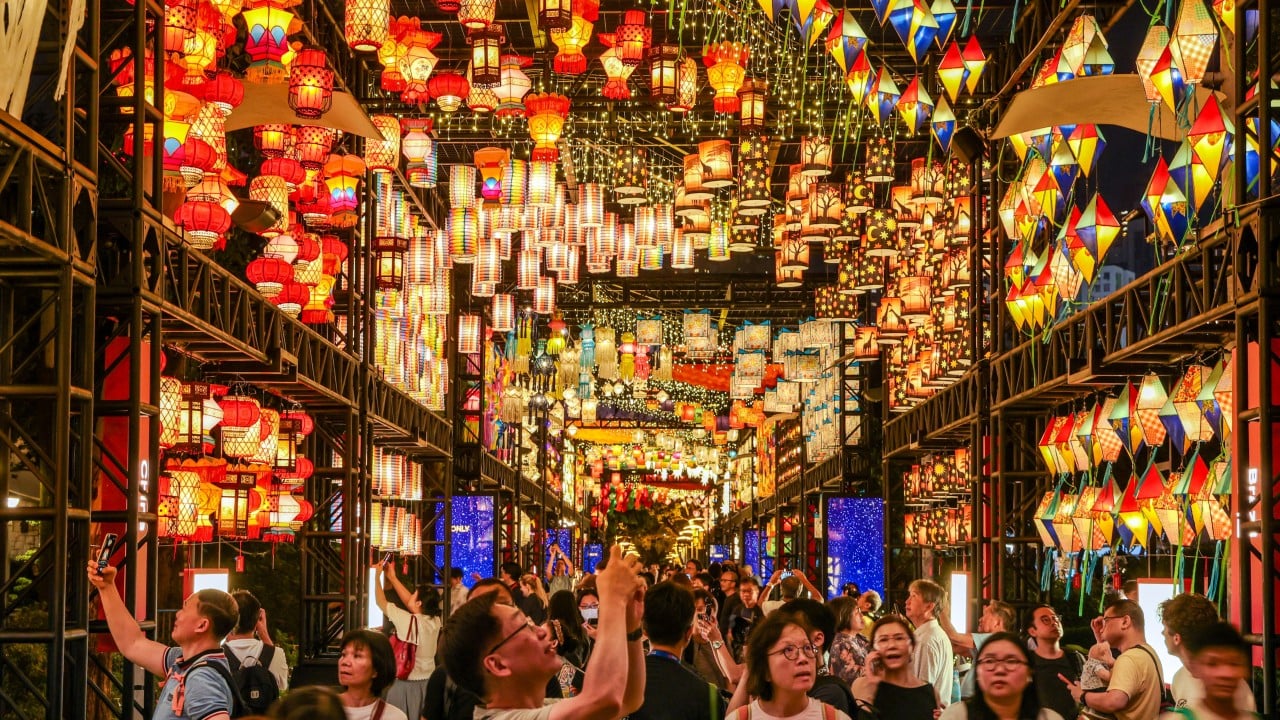
The air in Hong Kong during the eighth lunar month does not cool; it thickens. It carries the faint, stubborn scent of roasting lotus seeds, old incense, and the briny breath of Victoria Harbour. For three hundred and sixty-four days a year, this city is a machine built of glass, steel, and relentless acceleration. People collide on escalators. Subways roar through subterranean arteries. Neon signs blink in a manic code of commerce.
Then, the moon fills.
And everything stops, or at least, bends toward the sky.
To understand the Mid-Autumn Festival in Hong Kong is to understand a collective psychological pivot. It is an ancient longing interrupting a hyper-modern metropolis. Millions of people, crammed into vertiginous canyons of concrete, suddenly remember that there is something older and wider than the stock market. They look up.
Consider what happens next.
The Smoke and the Scales
In the narrow, incense-choked lanes of Tai Hang, the past does not whisper; it roars.
Long before open-top buses carved through neon corridors, long before Victoria Park became an ocean of glowing plastic lanterns shaped like cartoon characters and historical deities, there was a plague and a dragon. Legend, that stubborn ghost of history, tells us that in the nineteenth century, a small Hakka fishing village suffered a devastating python attack, followed by a plague. An elder dreamed that dancing with a dragon woven from straw and burning incense sticks would cleanse the village. It worked. The python vanished; the plague receded.
Today, the Tai Hang Fire Dragon Dance is a violent, beautiful collision of mythology and endurance.
Imagine standing shoulder-to-shoulder in an alleyway so narrow you can touch the laundry lines overhead. The temperature spikes. The air turns grey with acrid, sweet-smelling smoke from thousands of burning joss sticks planted directly into the spine of a three-hundred-foot monster. Drumbeats hit your chest like physical blows.
Boom. Boom. Boom.
More than three hundred performers heave the massive structure—heavy with pearl grass and tens of thousands of glowing incense sticks—through the gridlocked streets. Sparks shower down on the crowd. Children scream with a mixture of terror and glee. Grandmothers murmur quiet prayers, their palms pressed together. This is not a tourist show, though thousands watch from behind police cordons. This is an active exorcism of modern anxiety, a ritual renewal executed with sweat, muscle, and fire.
From Alleyways to Open Skies
When the dragon’s fire dies down to glowing embers in the gutter, the city shifts its gaze upward and outward.
If you want to witness the sheer scale of Hong Kong’s festive transformation without losing your footing in the pedestrian tides of Victoria Park, you climb aboard an open-top tram or a double-decker bus. This is where the modern celebration truly reveals its texture.
The bus lunges forward, leaving the cramped alleys behind for the wide, glittering boulevards of Hong Kong Island and Kowloon. Up top, the wind catches your hair. Streetlights streak past like comets. But look higher—just above the second-story shop signs, past the web of air conditioning units and tangled electrical wires.
Red. Crimson. Scarlet.
Tens of thousands of traditional red silk lanterns drape from scaffolding, balconies, and lampposts, turning the concrete canyons into glowing tunnels of celebratory fire. The bus dips into Causeway Bay, where Victoria Park sprawls across nineteen hectares. From the upper deck, the park looks like a fallen constellation. Millions of glowing lights—ranging from traditional paper-and-bamboo masterpieces crafted by aging local artisans to towering, high-tech LED installations—blaze against the dark backdrop of the hills.
People flood the park by the hundreds of thousands. Families walk in slow, deliberate loops. Children pull glowing plastic rabbits on wheels. Lovers share a quiet bench away from the noise, their faces washed in the amber glow of giant lotus-shaped lanterns.
It is loud. It is overwhelming. Yet, beneath the clamor, there is a strange, profound stillness. Everyone is looking for the same thing.
The Architecture of Longing
The moon, on the fifteenth night of the eighth lunar month, is scientifically no different than any other full moon. But human geography transforms it.
In Hong Kong, moongazing (賞月, seung yuet) is not a passive act. It is a pilgrimage. When the urban density presses too tightly against the chest, people seek the edges of the water. They flock to the Tsim Sha Tsui Promenade, the Central and Western District Promenade, or climb the steep, winding trails of Victoria Peak.
Water reflects light. The harbor becomes a mirror, doubling the neon towers on one side and the silver disk of the moon on the other.
Stand on the waterfront at midnight. Look across the water toward the skyline of Hong Kong Island. The skyscrapers are giants wrapped in festive light displays, projecting giant glowing rabbits and cascades of digital moonbeams onto their glass facades. Down below, sitting on seawalls and granite benches, families peel pomelos.
The pomelo is essential. Its thick, pale rind protects a sweet, segmented heart. In Cantonese culture, sharing a pomelo signifies family unity and completeness. Beside the fruit sit mooncakes—dense, heavy pastries filled with rich lotus seed paste and golden, salted egg yolks that represent the full moon itself.
To the uninitiated western palate, a traditional mooncake can be an intense experience. It is dense, oily, and intensely sweet-salty. A single slice packs the caloric equivalent of a small meal. But you do not eat a mooncake for a casual snack. You eat it in paper-thin slices, washed down with bitter, boiling Pu'er tea, while discussing the distance between where you were born and where you are now.
That is the invisible stake of the Mid-Autumn Festival.
Migration defines Hong Kong. Generations have arrived here fleeing war, poverty, or political upheaval, carrying their ancestral villages in their memories. Even for those born beneath the neon towers, the modern world scatters families across oceans—to Vancouver, London, Sydney, Taipei.
The festival demands reunion. If you cannot be in the same room, you must at least look at the same moon. The ancient myth of Chang’e—the immortal goddess who drank an elixir of immortality and floated up to live on the moon, leaving her mortal husband behind on earth—loses its fairy-tale quality here. It becomes a map of human separation. The moon is not just a celestial body; it is a permanent meeting place for those who are apart.
Navigating the Sea of Lanterns
To experience this festival as a traveler rather than a mere spectator requires shedding the instinct for efficiency.
Hong Kong is a city obsessed with speed. MTR trains arrive every two minutes. Elevators whisk you fifty floors up in seconds. But during Mid-Autumn, efficiency dies. You must let yourself be swept along.
Start your evening early, just as the sun dips below the South China Sea and paints the harbor in bruises of purple and gold. Avoid the temptation to take a taxi; the street closures around Causeway Bay and Victoria Park will trap you in a gridlock of festive revelry. Instead, ride the historic ding-ding—the double-decker trams that have rattled through the island's spine for more than a century. Sit right at the front of the upper deck. Watch the city unfold through salt-streaked glass.
Alight near Victoria Park just as the crowds thicken. Do not rush past the lantern displays. Stop and look closely at the craftsmanship of the older pieces. Notice the translucent silk stretched tightly over slender bamboo ribs, tied together with string rather than glue. These are the dying arts of Hong Kong, preserved by master craftsmen who have spent decades folding paper into life.
When the park becomes too dense, when the crush of humanity threatens to swallow your thoughts, walk down toward the Wan Chai waterfront. Catch an open-top bus tour that traces the harbor's edge. Let the night air cool your skin. As the bus crosses bridges and weaves past towering residential blocks, look up into the illuminated windows of the apartments.
You will see dining tables pushed together. You will see grandmothers pouring tea. You will see generations gathered under the cold, blue light of television screens and the warm, golden glow of paper lanterns.
That is the true spectacle. Not the fireworks, not the LED displays, not the roaring fire dragon in Tai Hang.
It is the moment a city of seven million souls, jammed into some of the most expensive and claustrophobic real estate on earth, collectively pauses, lifts its chin, and remembers what it means to be whole.
The bus rounds a final corner. The neon signs of Victoria Harbour ignite the dark water in a riot of magenta and emerald. Overhead, unbothered by the turbulence of human history, the moon hangs low and heavy, silver as a coin dropped in the dark.