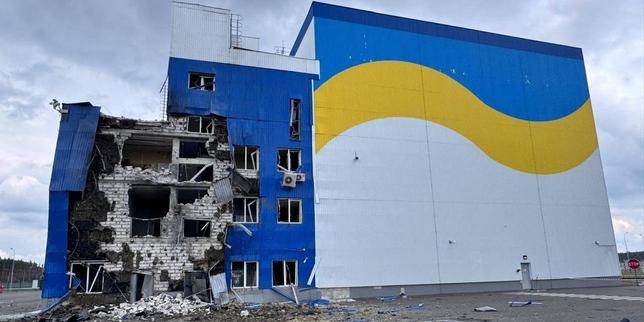
The world treats the Chornobyl exclusion zone like a closed chapter of history, a ghost story wrapped in concrete. It isn't. An overnight strike smashed that illusion, proving that the radioactive ruins remain a volatile front line.
A Russian Shahed-type drone slammed directly into the Centralized Spent Fuel Storage Facility inside the Chornobyl exclusion zone. The blast tore through the container reception building around 2:10 a.m., sparking a 40-square-meter inferno, shattering windows, and shredding the facility's facade.
We got lucky. Energoatom, Ukraine's state nuclear operator, confirmed that no spent fuel was inside that specific building during the strike. Radiation levels haven't spiked. No one died. But relying on luck next to millions of kilograms of highly radioactive waste is a terrible strategy. This isn't an isolated mishap. It is a terrifying pattern of behavior that shows how close we are to a manufactured catastrophe.
The Illusion of Chornobyl as a Safe Monument
Most people think the Chornobyl threat ended when the last reactor shut down in 2000, or when the massive New Safe Confinement arch slid into place over Unit 4. That's wrong. The exclusion zone isn't a passive museum. It holds vast amounts of highly radioactive spent fuel accumulated from Ukraine's operating nuclear plants.
The site targeted in this latest raid is the Centralized Spent Fuel Storage Facility. It lies roughly 15 kilometers from the main reactor complex. Think of it as a massive, heavily guarded parking lot for the deadliest waste material on Earth.
Rafael Grossi, the Director General of the International Atomic Energy Agency (IAEA), didn't mince words. He called the incident deeply concerning. The drone struck a building standing just meters away from active nuclear storage silos. Had the trajectory shifted by a microscopic margin, the explosion could have penetrated the dry storage casks.
This raid follows a similar incident where a drone strike damaged the outer cladding of the New Safe Confinement arch itself. The protective shield lost part of its primary sealing function, requiring emergency repairs. The pattern is obvious. Russia is treating these high-consequence facilities as collateral damage, or worse, using them as tools for geopolitical leverage.
The Strategy Behind Targeting Nuclear Infrastructure
Military experts know that a full-scale nuclear meltdown at Chornobyl wouldn't just poison Ukraine. Wind currents would carry a radioactive plume across Belarus, Poland, and deep into Western Europe. Why would anyone risk playing with that kind of fire?
It comes down to leverage. By intentionally routing attack paths through nuclear exclusion zones, Russian forces create a tactical dead zone. Ukrainian air defense systems face an impossible dilemma. Do they shoot down a fast-moving Shahed drone directly above a spent fuel facility and risk falling debris puncturing a silo? Or do they hold their fire and hope the drone misses?
Ukrainian Foreign Minister Andrii Sybiha called out the practice, labeling it systemic nuclear blackmail. By forcing the IAEA to constantly deploy inspection teams and issue frantic statements, Moscow projects a specific message. They want the world to know they can compromise European radiation safety at any moment without firing a single ballistic missile at a western city.
What Happens if a Strike Actually Breaches a Cask
Let's clear up a major misconception. Smashed storage facilities won't cause a Hiroshima-style atomic explosion. That's physically impossible. Spent fuel doesn't possess the critical mass required for a nuclear detonation.
The real danger is a dirty bomb scenario on an industrial scale.
- Conventional Blast Dispersion: An explosive payload from a heavy drone can pulverize spent fuel assemblies into fine, airborne particulates.
- Thermal Uplift: The intense fires sparked by drone fuel can create thermal updrafts, carrying radioactive isotopes high into the atmosphere.
- Long-Term Contamination: Unlike short-lived isotopes, spent nuclear fuel contains Cesium-137 and Strontium-90. These isotopes have half-lives of roughly 30 years. They stick around, poisoning soil, groundwater, and agriculture for generations.
The dry casks used at the facility are incredibly tough. They are built from reinforced concrete and thick steel linings designed to withstand plane crashes. They aren't completely invincible against sustained, deliberate military strikes or high-grade military explosives designed to pierce heavy armor.
Defending the Indefensible
Fixing this requires shifting how the international community handles nuclear security during active conflicts. Expecting a toothless international agency to change the calculus of a hostile military hasn't worked.
The IAEA can deploy inspectors, take radiation readings, and publish strongly worded press releases. They have done all of that. It hasn't stopped the drones from flying. International law means nothing without an enforcement mechanism.
Western allies must prioritize delivering specialized, high-precision air defense systems specifically dedicated to shielding nuclear infrastructure. Counter-drone technologies, including electronic warfare jamming stations and automated kinetic interception systems, need to be deployed permanently around Chornobyl and the operating plants at Rivne, South Ukraine, and Khmelnytskyi. These defensive rings must operate independently of the wider power grid, ensuring they stay online even during total blackouts.
Relying on the assumption that a catastrophic breach won't happen because it hasn't happened yet is a luxury we don't have. The margin between a minor fire and an international radiation emergency is shrinking with every single drone that crosses into the exclusion zone.