The steel underfoot does not feel like a machine. When you are standing on the deck of a Hunt-class minesweeper, drifting in the suffocating humidity of the Persian Gulf, the ship feels like a living, breathing creature. It shudders against the swell. It hums with a low, nervous energy. Beneath that fiberglass hull—chosen because steel hulls trigger magnetic mines—lies a stretch of water that dictates whether a factory in Ohio stays open, whether a supermarket in Liverpool can stock its shelves, and whether the global economy holds its breath or collapses.
This is the Strait of Hormuz.
At its narrowest point, the shipping lane is just two miles wide. On a map, it looks like a fragile throat. Through this throat flows roughly a fifth of the world’s petroleum. It is the most volatile maritime chokepoint on earth, a place where a single spark can ignite a global crisis.
Right now, as diplomats in Vienna sit in air-conditioned rooms arguing over the fine print of Iran’s nuclear capabilities, a very different kind of negotiation is happening on the water. The Royal Navy is quietly preparing for the worst. They are sending Hunt-class mine countermeasures vessels into the thick of it. This is not a show of force. It is an exercise in invisible math.
Consider the mechanics of a modern sea mine. It is not the spiked, rusty ball from old black-and-white movies. Today's mines are quiet, patient, and terrifyingly smart. They sit on the seabed, hidden in the silt, listening. They count the thud of propellers. They measure the water pressure. They wait for a specific signature—a specific size of vessel—before they wake up.
If Iran decides to close the Strait, they won't need an armada. They only need to drop a handful of these hidden killers. The mere rumor of a single mine can spike global oil prices by ten percent overnight. Insurance rates for commercial tankers would skyrocket to prohibitive levels. Shipping stops. The grid locks.
That is why the British sailors out here view their mission through a lens of extreme focus.
The Sound of Waiting
Imagine a twenty-two-year-old crew member. Let's call him Evans. He grew up in a landlocked town, maybe somewhere in the Midlands, where the closest thing to an ocean was a rain-slicked motorway. Now, he sits in a darkened operations room, staring at a sonar screen that pulses with green light.
His world is defined by acoustic signatures.
Every ship has a song. A massive container ship roars with a deep, guttural bass. A fast-attack missile boat from the Islamic Revolutionary Guard Corps whines like an angry hornet. Evans’s job is to listen past the noise of the ocean—the clicking of shrimp, the shifting of sand, the distant throb of commercial traffic—to find the silence that indicates a hidden threat.
The tension on board is thick, heavy, and constant. It tastes like salt and stale coffee.
Outside, the political landscape is shifting. The Joint Comprehensive Plan of Action—the Iran nuclear deal—hangs in a delicate balance. Western powers want stability. Tehran wants leverage. In the high-stakes poker game of international diplomacy, the Strait of Hormuz is the pile of chips sitting in the center of the table.
But out on the water, geopolitics ceases to be abstract. It becomes a matter of proximity. Iranian fast boats regularly buzz these Western naval vessels, coming close enough for the crews to see the expressions on each other's faces. It is a dance of chicken played with automatic weapons and multi-million-dollar warships.
The British strategy here is not about aggression. It is about reassurance. By deploying these specialized mine-clearing assets, the Royal Navy is sending a clear signal to global markets: the lanes will remain open.
The Invisible Tech Beneath the Waves
How do you find something designed to never be found?
It requires a blend of brute force and delicate science. The Hunt-class vessels use high-frequency sonar to paint a digital picture of the seabed. When an anomaly appears—a shadow where there should be smooth sand—the crew doesn't send a diver. Not yet.
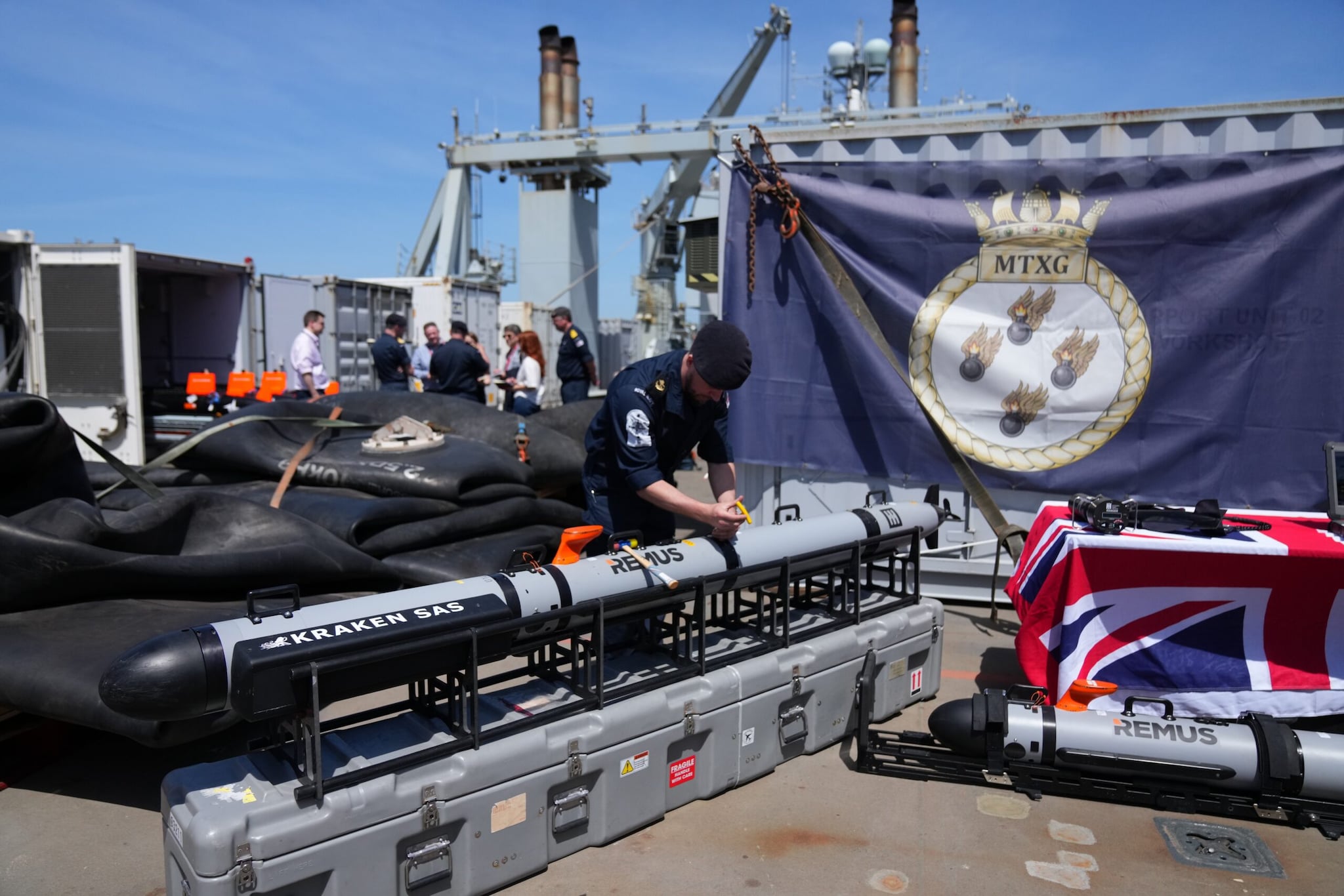
Instead, they deploy the Seafox.
This is an unmanned underwater vehicle, a sleek, remote-controlled submarine packed with cameras and sensors. It swims down into the murk, guided by a fiber-optic cable. The operator on the ship guides it via a joystick, navigating the treacherous currents of the Strait.
If the Seafox identifies the object as a mine, it has two choices. It can place a small explosive charge next to the threat and detonate it from a safe distance, or, in extreme cases, the vehicle itself becomes the weapon, sacrificing itself to neutralize the danger.
It is tedious, exhausting work. Hours of staring at grainy, gray images of the sea floor, looking for a cylinder that might just be an discarded oil drum, or might be fifty pounds of high explosives capable of tearing a hole in a destroyer.
The public rarely hears about this. We read the headlines about nuclear talks, about embargoes, about speeches made at the United Nations. We see the suits. We do not see the sailors sweat through their coveralls in forty-degree heat, trying to keep a remote-controlled submarine from being swept away by a four-knot current.
What Happens if the Talks Fail?
The connection between the diplomatic tables in Europe and the gray hulls in the Gulf is direct.
If negotiations stall, the economic pressure on Iran increases. When a nation is backed into a corner, its options narrow. The threat to close the Strait of Hormuz is Iran’s ultimate trump card. They do not even need to successfully block it; they just need to create enough chaos to make the transit untenable for commercial shipping.
Consider what happens next if a single tanker is struck.
The global supply chain is a house of cards built on the concept of "just-in-time" delivery. Supermarkets do not hold weeks of inventory; they rely on ships currently crossing the ocean. Refineries operate on tight schedules, expecting a steady intake of crude. A disruption in the Strait doesn't just mean higher prices at the petrol pump next week. It means a systemic shock that cascades through every industry, from electronics manufacturing to agriculture.
The Royal Navy’s presence is an insurance policy against that specific catastrophe.
It is a strange way to live, balanced on the knife-edge of war and peace. The crew knows that their safety depends entirely on the sanity of political leaders thousands of miles away. They also know that if a conflict breaks out, they are on the front line of the front line.
The Weight of the Horizon
As night falls over the Gulf, the temperature barely drops. The humidity clings to everything like a wet wool blanket. On the bridge, the officer of the watch peers through night-vision goggles, scanning the black water for the unlit hulls of smuggling boats or revolutionary guard vessels.
The lights of commercial tankers flicker on the horizon, moving in a slow, solemn procession. They look like a floating city, oblivious to the invisible grid beneath them.
The sailors on the minesweeper watch them pass. There is no glory in mine hunting. There are no dramatic dogfights, no thunderous broadsides, no cinematic triumphs. Success is defined by what doesn't happen. Success is a quiet night where the sonar stays clear, the shipping lanes remain open, and the world goes to sleep without worrying about the price of oil.
The talks in Vienna will continue. Drafts will be written, revised, and discarded. Statements will be issued to the press.
But out here, where the water turns black under a starless sky, the true cost of peace is measured in the steady, rhythmic ping of a sonar beam cutting through the dark, searching for the traps we set for one another.