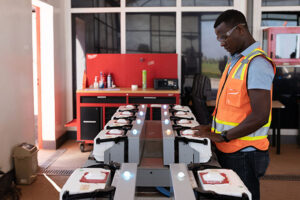
Beijing has initiated a state-backed surge in compute capacity aimed at slashing the cost of generative model training and inferencing, effectively transforming raw compute into a heavily subsidized public utility. While American technology giants battle over constrained power grids and astronomical capital expenditure, Chinese municipal governments and state-owned enterprises are underwriting massive data center clusters from Shenzhen to Guizhou. By treating compute tokens—the fundamental unit of large language model output—as an economic commodity to be produced at industrial scale, China intends to lower the operational threshold for domestic software firms and undercut Western market pricing.
The strategic shift represents a calculated transition from hardware acquisition to token throughput optimization. Blocked from importing Nvidia's premier hardware under American export restrictions, Chinese tech policy has pivoted toward massive aggregation. The strategy relies on bridging thousands of lower-tier domestic chips through custom networking topologies, heavily subsidized renewable energy feeds, and direct municipal token vouchers handed out to local startups. In related news, take a look at: The Economics of Autonomous Air Power Mass Attrition and Algorithmic Integration.
The Subsidized Compute Model
Western capital markets demand clear monetizable paths for AI investment, forcing Silicon Valley to charge premium rates for model access. China is pursuing the opposite strategy. Municipalities across the country have established "compute power exchanges" where AI developers purchase processing time at rates discounted up to 50 percent through government-backed vouchers.
Shanghai, Shenzhen, and Hangzhou treat raw processing throughput the same way they historically treated roads, bridges, and high-speed rail. The goal is not immediate profitability for the data center operator. The goal is industrial dominance down the supply chain. TechCrunch has analyzed this important subject in great detail.
When a Beijing-based artificial intelligence firm runs an inferencing cluster, state subsidies offset the local electric utility costs. This artificial depression of operational expenditure allows domestic firms to offer API tokens to developers for a fraction of what Western competitors charge. A developer building an automated logistics workflow or customer service engine in Asia faces drastically lower marginal costs when routing queries through domestic Chinese networks.
This strategy relies on an old industrial playbook. Build excess capacity, subsidize the core input, force down unit costs, and starve international competitors of market share in price-sensitive developing economies.
Bridging the Hardware Gap
US export controls were designed to choke off China's access to high-bandwidth memory and advanced compute architectures. In response, Chinese research institutes and hardware vendors stopped trying to match single-chip performance and started focusing on cluster architecture.
To build competitive capability out of silicon that runs slower and generates more heat, state engineering projects focus on three core areas:
- Custom Optical Interconnects: Reducing latency across massive arrays of heterogeneous processors.
- Software-Level Parallelism: Utilizing specialized compilers that split training workloads across mismatched hardware configurations.
- Collocation with Green Energy: Placing megawatt-scale compute nodes directly adjacent to solar and wind installations in western provinces like Ningxia and Gansu.
A local tech firm operating in Beijing does not need access to an isolated, cutting-edge supercomputer if its training run can be distributed across a state-subsidized, highly redundant grid of lower-performance chips. The physics are less efficient. The power draw is significantly higher. Yet, when the state absorbs the electricity bill, the pure economic math works out in favor of the local developer.
The Friction in the Machine
Subsidizing compute tokens like steel or aluminum sounds compelling on paper. In practice, the system faces severe technical bottlenecks that money alone cannot instantly fix.
Aggregating thousands of domestic processors creates immense software overhead. When hardware architecture is non-uniform, software engineers spend an inordinate amount of time debugging memory leaks and optimizing pipeline parallelism rather than improving model architecture. American developers work on standardized CUDA software environments that have been refined over decades. Chinese developers using domestic hardware must frequently write custom drivers and low-level code just to keep the cluster running without crashing during multi-week training runs.
Heterogeneous chip clusters suffer from diminishing returns. Doubling the processor count in an unoptimized domestic array often yields less than a 40 percent increase in actual training speed due to communication bottlenecks between nodes.
Energy transmission presents another structural obstacle. Moving massive datasets from commercial hubs like Shanghai to solar farms in the western desert introduces real latency. Training runs require low-latency read-write cycles across memory pools. If the data center sits thousands of miles from the engineering team, network jitter can ruin a training checkpoint, setting projects back by days.
Furthermore, token subsidies create market distortions inside China's domestic ecosystem. Phantom startups have already emerged purely to capture municipal compute vouchers, reselling cheap compute time or using state-backed processing power to mine cryptocurrency under the guise of model training. Local governments are forced to build intrusive auditing mechanisms to verify that subsidized tokens are actually being burned on legitimate artificial intelligence research.
Western Margins vs Asian Volumes
American AI leaders operate under strict quarterly earnings scrutiny. If Microsoft, Meta, or Alphabet spend tens of billions on capital expenditures without showing clear margin expansion, shareholders react violently. They must charge real money for API access, enterprise subscriptions, and consumer tools.
China’s state-capitalist framework allows domestic firms to bypass short-term margin requirements. By turning the token into a commoditized utility, Beijing aims to capture the broader application layer across Southeast Asia, Latin America, and the Middle East.
Consider a hypothetical fintech startup building automated credit risk models in Jakarta. If an American vendor charges two cents per thousand tokens while a Chinese provider offers equivalent functional accuracy for two-tenths of a cent—backed by state-subsidized infrastructure—the financial choice for the startup becomes obvious.
The strategy accepts lower model elegance in exchange for overwhelming distribution scale. Beijing is betting that for 90 percent of enterprise use cases, a slightly less sophisticated model operating at a fraction of the cost will win the global market every single time.
The Industrial Compute Grid
To achieve this scale, China is executing a centralized infrastructure initiative known as "East-Data-West-Computing." The project re-routes raw data from dense eastern urban centers to resource-rich western regions, creating an integrated national computing network that operates like an electric power grid.
Municipal authorities treat compute allocation as an economic development metric. Regional officials are no longer evaluated solely on GDP growth or real estate development; they are now judged on the total petaflops of compute capacity brought online and the number of active AI models running within their jurisdiction.
+-----------------------------------------------------------------------+
|                 CHINA'S COMMODITIZED TOKEN PIPELINE                   |
+-----------------------------------------------------------------------+
|                                                                       |
|  [ Western Provinces ]                                                |
|  Stranded Wind & Solar Power ---> Mega Compute Clusters               |
|                                         |                             |
|                                         v                             |
|  [ State Grid Interconnects ]                                         |
|  Ultra-High Voltage Lines & Low-Latency Fiber Links                   |
|                                         |                             |
|                                         v                             |
|  [ Municipal Exchanges ]                                              |
|  Shanghai / Shenzhen Voucher Subsidies (-50% Operating Cost)          |
|                                         |                             |
|                                         v                             |
|  [ End-User Application ]                                             |
|  Low-Cost Global API Tokens for Enterprise & Export Markets           |
+-----------------------------------------------------------------------+
This structural realignment changes the competitive dynamic entirely. The battle is no longer purely about who designs the smartest neural network inside a Silicon Valley laboratory. It is about who can build the most resilient, cost-effective industrial assembly line for generating tokens.
If Western technology firms remain hyper-focused on raw hardware superiority while ignoring the underlying unit economics of token delivery, they risk building pristine, hyper-intelligent systems that are simply too expensive for the global market to run at scale. Subsidized compute networks are coming online rapidly, and the true cost of generating an AI token is about to hit rock bottom.