The Silence in the Exam Hall
Put yourself in a dimly lit hall in Bath, England, or Cluj-Napoca, Romania. The air smells of graphite, stale tea, and cold sweat.
Six problems. Nine hours. Two days.
For sixty-six years, the International Mathematical Olympiad has served as the supreme crucible of human reasoning. These are not calculations. You do not plug numbers into a formula and crank a handle. These are labyrinthine puzzles of pure logic, geometry, and number theory designed by the sharpest minds on Earth specifically to break other sharp minds. Most brilliant teenagers walk away from a single problem with six pages of crossed-out scribbles and zero points.
To earn a gold medal is to touch the ceiling of human intellect. To score a perfect score, one hundred percent, is to enter a modern mythology.
Then came the silicon.
In a quiet announcement that sent shockwaves through university faculty lounges from Boston to Beijing, two Chinese artificial intelligence systems achieved what was once considered mathematically impossible for machines: flawless, perfect scores on the world’s hardest math exam.
No human errors. No hesitation. Just complete, unambiguous victory over the ultimate test of human genius.
The Ghost in the Scratchpad
To understand why this breaks something fundamental in our collective psyche, you have to understand how a high school prodigy solves an Olympiad problem.
Picture a seventeen-year-old student named Lin. Hypothetically, let us place him in a small apartment in Hangzhou, staring at Problem 6—the feared final question of Day Two.
For three hours, Lin does not write a solution. He sits in total stillness. He draws a circle, erases it, draws a line, and watches it fall apart. He is not searching for a rule he memorized in class. He is building a mental bridge across an abyss that no human has ever crossed before. He relies on intuition, on an aesthetic sense of mathematical elegance, on a sudden, spark-like realization that this symmetry matches that hidden property.
When a human solves an Olympiad problem, it feels like poetry.
Machine learning, historically, did not work this way. Traditional language models were statistical regurgitators. Ask them to write a essay on Shakespeare, and they predict the next most likely word with uncanny grace. Ask them to solve a novel geometric proof requiring formal logic, and they hallucinate. They confidently stride off a cliff because they do not understand the ground beneath their feet.
The engineering teams behind these new Chinese systems took a radically different path. They stopped treating math as a language to be imitated and started treating it as a game to be played.
Code That Thinks in Proofs
The breakthrough did not happen overnight, nor did it happen by simply stacking more computer processors together.
Instead, researchers combined deep neural networks with formal verification languages—systems like Lean, which act as unyielding digital referees. If a human or a machine proposes a step in a mathematical proof, Lean checks every single axiom. If there is a microscopic flaw in the logic, the program rejects it instantly.
Think of it as training a chess computer, but the chessboard is infinite and the pieces are abstract concepts.
The models spent months playing against themselves in this logical arena. Millions of iterations. Millions of failed proofs discarded in fractions of a millisecond. When faced with a problem from the Olympiad, the systems did not simply output a lucky guess. They systematically explored millions of potential logical pathways, pruned away dead ends, and constructed a rigorous, bulletproof mathematical argument from first principles.
When the final scores were tallied, the verdict was absolute.
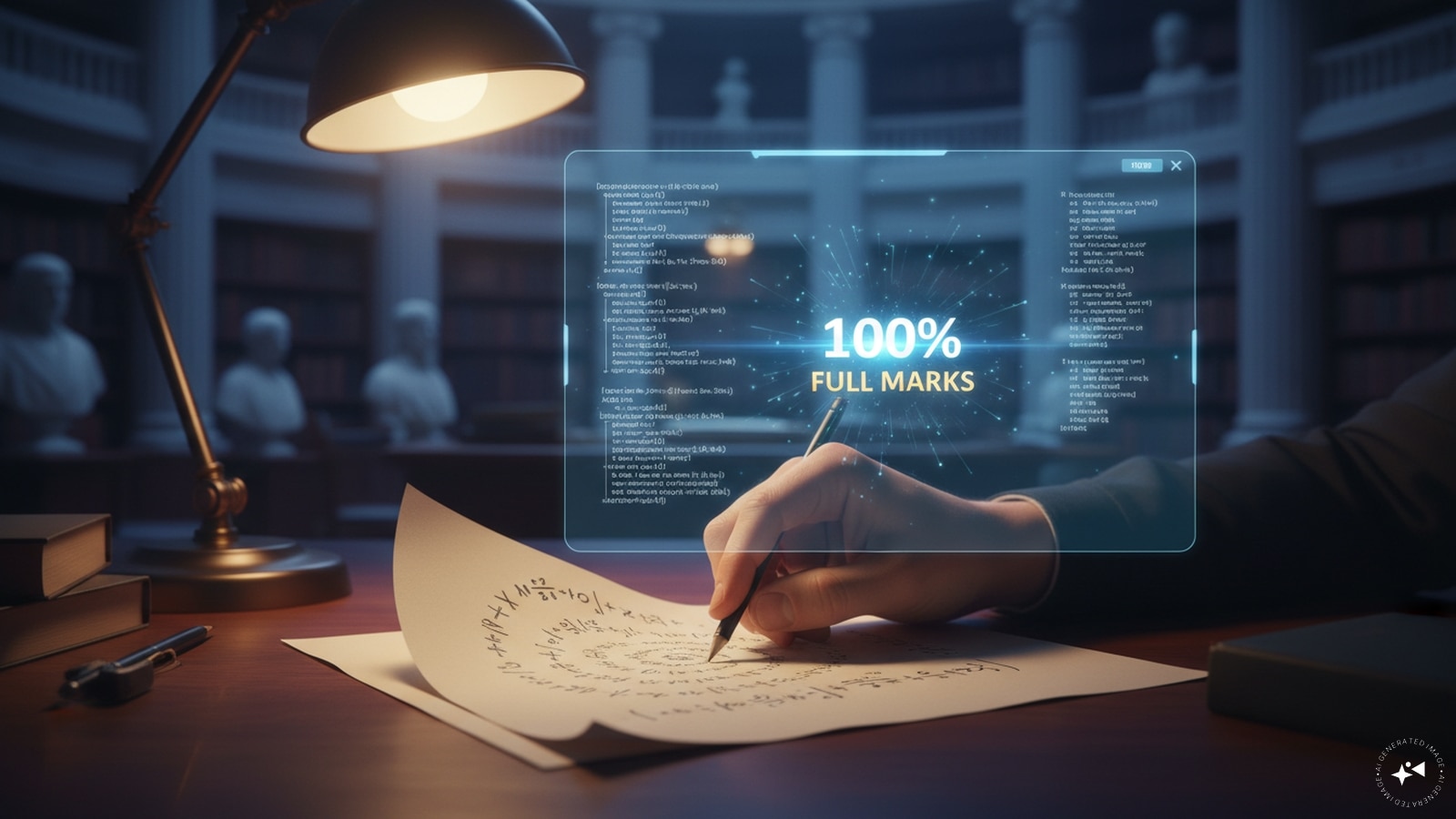
Twelve out of twelve potential solutions across both systems were verified as completely, undeniably correct. One hundred percent.
The Tremor in the Faculty Lounge
A few years ago, the common consensus among computer scientists was that automated systems would master creative arts before they touched pure logic. We assumed poetry and painting were easy for machines, while deep mathematical intuition was uniquely, sacredly human.
We had it completely backward.
The implications ripple far beyond high school competitions. The International Mathematical Olympiad is not just a game for clever kids; it is the testing ground for the foundational ideas that underpin quantum physics, cryptography, material science, and economic theory.
If a machine can independently prove theorems that baffle elite researchers, it is no longer just a calculator. It is a collaborator.
Mathematicians who spent their entire careers working through proof steps manually are suddenly confronting a strange, dizzying reality. For centuries, progress in higher mathematics was bottlenecked by human stamina. A human brain tires after six hours. A human eye misses a subtle edge case in an algebraic expansion. A human lifetime is only long enough to explore a tiny corner of the mathematical universe.
These algorithms do not sleep. They do not get tired. They do not make arithmetic slips when they are hungry or anxious.
The Unseen Stakes
There is an understandable anxiety creeping into the background of this triumph.
If machines can out-think us at the absolute peak of our intellectual hierarchy, what is left for us to claim as uniquely ours? If an algorithm can construct a forty-page formal proof in two minutes, where does that leave the kid sitting in that Bucharest exam hall with graphite on his fingers?
The answer lies in why we do math in the first place.
When running shoes were invented, humans did not stop running the marathon. When chess engines surpassed grandmasters, millions more people started playing chess, fascinated by the incredible, wild ideas computer programs revealed to the world.
These Chinese AI models did not erase human genius; they shone a searchlight into the dark corners of a universe we were too slow to explore on our own. They showed us that logic is not an exclusive human preserve, but a property of the cosmos waiting to be uncovered by any system capable of looking hard enough.
Lin, our hypothetical student in Hangzhou, will still sit at his desk. He will still draw his circles and erase his lines. But when he gets stuck, he will no longer have to wait years for a mentor to guide him. He will hand his scratchpad to an entity that has mapped the entire mountain, ready to show him where the trail begins.
The chalk dust has settled on the old board. The new era has already written its first perfect equation.