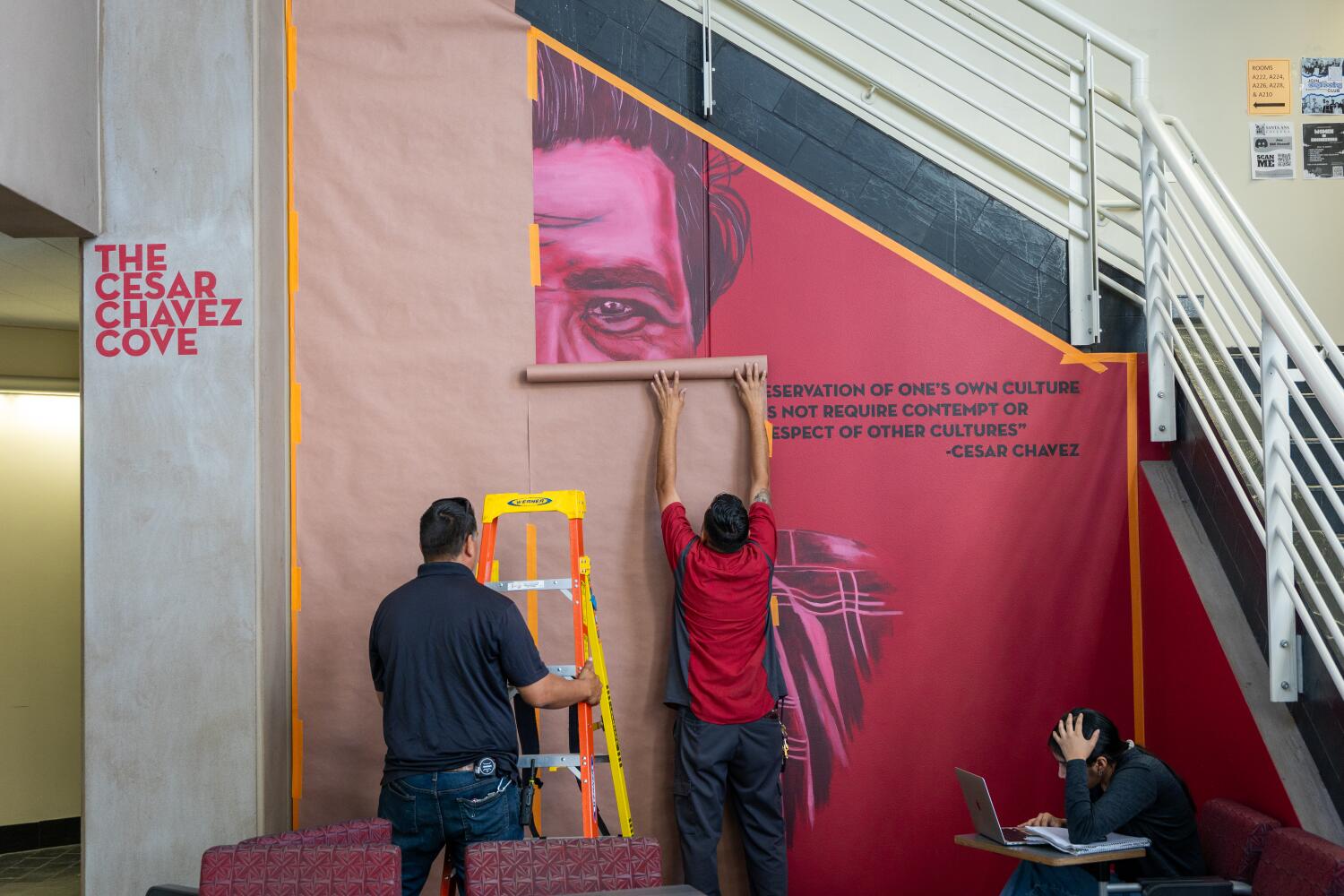
Keeping a photo of César Chávez on your wall in 2026 isn't an act of rebellion. It is an act of historical taxidermy.
For decades, the American Left and the Latino middle class have treated Chávez as a secular saint, a non-threatening brown version of Martin Luther King Jr. whose image can be slapped onto postage stamps and murals to signal "social justice" without actually doing the work. When Gustavo Arellano and others defend their refusal to take down the iconic photo, they aren't defending a living movement. They are clinging to a security blanket made of 1960s nostalgia while the actual house of labor burns to the ground.
The hard truth is that the Chávez we’ve canonized—the soft-focus hero of the grape boycotts—is a filtered version of a man whose real legacy is far more complicated, far more jagged, and arguably, far more relevant to our current failures than the myth we worship.
If you want to honor the man, stop looking at the photo. Start looking at the wreckage of the United Farm Workers (UFW) and the uncomfortable lessons we refused to learn.
The Myth of the Unstoppable Momentum
The common narrative suggests that Chávez and the UFW created a blueprint for permanent labor power. We are told that if we just "organize" with enough heart and "Sí, se puede" spirit, the corporate goliaths will eventually fold.
This is a lie.
Look at the data. At its peak in the late 1970s, the UFW had roughly 80,000 members under contract. Today? That number has cratered. Depending on which auditor you trust, the UFW represents a fraction of 1% of California’s farmworkers. While we were busy naming streets after Chávez, the actual union he built became a shadow of its former self, transitioning from a powerhouse labor organization into a well-funded non-profit and political endorsement machine.
We fell in love with the aesthetics of the struggle while the mechanics of the struggle rusted out. We traded collective bargaining for "awareness." Awareness doesn't pay the rent. Awareness doesn't stop a pesticide-spraying tractor from running 20 feet away from a pregnant worker.
The Border Policy Nobody Wants to Talk About
Here is the part where the "progressive" defense of Chávez usually hits a wall of cognitive dissonance. In the 1970s, Chávez wasn't a proponent of open borders or "undocumented" solidarity. He was a hardliner. He viewed undocumented workers—or "wetbacks," a term he used frequently at the time—as strike-breakers.
He went so far as to set up the "wetback line," a paramilitary-style patrol of UFW members along the Arizona-Mexico border to physically stop migrants from crossing. This wasn't a minor footnote; it was a core strategy. He believed that an infinite supply of cheap, exploitable labor was the greatest threat to the bargaining power of the American farmworker.
Modern activists who display his photo while advocating for total amnesty are participating in a massive feat of historical erasure. You cannot have the Chávez of the "Illegals are scabs" era and the Chávez of the "Universal Brotherhood" era at the same time. By sanitizing him, we lose the brutal, pragmatic logic of labor: supply and demand.
If you don't control the labor pool, you have no leverage. Chávez understood this. Modern labor "leaders" are too afraid of being called names on social media to admit it. They want the saintly glow without the messy, xenophobic-adjacent reality of protecting a closed shop.
The Cult of Personality as a Structural Flaw
I’ve seen organizations blow millions trying to replicate the "Chávez magic" by looking for a charismatic savior. This is the ultimate trap. Chávez was a brilliant tactician, but he was also a paranoid leader who eventually purged the UFW of its best organizers—the people who actually knew how to run a union—because he feared they were becoming too independent.
He became obsessed with "The Game," a bizarre synanon-inspired psychological exercise that involved aggressive verbal confrontation and public shaming within the union’s inner circle. This wasn't "fostering" a movement; it was a slow-motion implosion.
By the time the 1980s rolled around, the UFW was losing more members to internal strife than to grower opposition. When we keep the photo up, we aren't just celebrating the 1965 Delano strike. We are subconsciously endorsing a model of leadership that prizes loyalty over results, and cultish devotion over institutional stability.
Why Your Iconography is a Distraction
People ask: "Why shouldn't I keep the photo? It inspires me."
It inspires you to do what? To post a tweet? To buy organic grapes and feel like you've done your part?
The hyper-fixation on 20th-century icons acts as a sedative. It convinces us that the "big battles" were already fought and won by giants, and all we have to do is curate their memory. Meanwhile, the modern gig economy has turned almost every sector into a digital plantation. Uber drivers, Amazon warehouse pickers, and freelance coders are the new farmworkers, yet we are still trying to use a 1966 playbook to solve a 2026 problem.
Chávez succeeded because he was a master of the secondary boycott—he targeted the grocery stores, not just the fields. He made the struggle visible in every suburban kitchen. But that tactic worked in a mono-culture world. Today, the supply chain is a fragmented, globalized labyrinth. You can’t boycott an algorithm. You can’t march against a cloud-based logistics hub with the same visual impact as a dusty road in the Central Valley.
Stop Looking Back
If you're still defending that photo, you're likely more interested in identity politics than in the cold, hard math of power. Keeping Chávez on your wall is a way of saying, "I belong to this tribe." It’s a badge of cultural belonging.
But labor isn't a tribe. It’s an economic weapon.
The moment an icon becomes comfortable enough to hang in a corporate lobby or a politician’s office, it has lost its teeth. Chávez's image has been declawed. It’s been made "safe" for the very establishment he used to terrify.
If you want to actually honor the spirit of what Chávez tried to do, take the photo down. Stop looking for heroes in the rearview mirror. The conditions that allowed the UFW to rise are gone. The legal frameworks are shredded. The demographic realities have shifted.
The real work of 2026 isn't about "staying true" to a 60-year-old movement. It’s about building something that would make the 1965 version of César Chávez look like a moderate. It’s about aggressive, uncomfortable, and likely unpopular strategies that don't fit on a commemorative poster.
Burn the idols. Organize the workers.
Would you like me to analyze the specific economic data regarding the decline of union density in the agricultural sector over the last forty years?