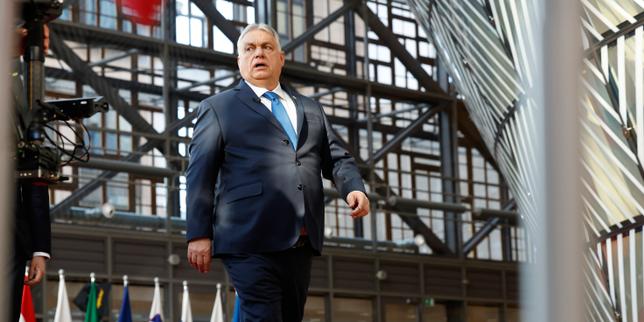
Viktor Orbán and Peter Pellegrini are not just complaining about high prices; they are actively attempting to dismantle the European Union's unified front against Russian energy. The Hungarian Prime Minister, now bolstered by the Slovakian President, has formally called for a suspension of sanctions on Russian oil and gas, arguing that the current trajectory is a slow-motion suicide for the manufacturing cores of Central Europe. This isn't a mere policy disagreement. It is a fundamental break in the geopolitical logic that has governed the EU since 2022.
While Brussels remains committed to "de-risking" and "de-coupling" from the Kremlin, Budapest and Bratislava see a different reality. They see factories closing because of electricity costs that remain three to four times higher than those in the United States or China. To them, the sanctions are a self-inflicted wound that Russia has already learned to bypass by selling its resources to India and China at a slight discount.
The landlocked dilemma driving the dissent
Geography dictates the politics of energy. Nations like France or the Netherlands have the luxury of coastal access to Liquefied Natural Gas (LNG) terminals. They can pivot to tankers from Qatar or the Gulf of Mexico. Hungary and Slovakia do not have that luxury. They are tied to the Druzhba pipeline, a Soviet-era steel umbilical cord that remains the most efficient way to keep their refineries running.
Forcing these nations to abandon Russian crude requires more than just a political decree. It requires billions of euros in infrastructure overhauls. Refineries built to process the heavy, sour Urals grade of crude cannot simply switch to light Arabian or Brent overnight. It takes years of engineering and massive capital expenditure to recalibrate the chemical processes involved. Orbán knows this. He is betting that the economic pain of the transition will eventually outstrip the political will to punish Moscow.
The hidden costs of the LNG pivot
The shift toward American LNG was framed as a victory for energy security. In reality, it traded one dependency for another, and at a much higher price point. US gas must be supercooled, loaded onto specialized vessels, shipped across the Atlantic, and then regasified. Every step in that chain adds a layer of cost that the Russian pipeline model simply didn't have.
For the heavy industry in Central Europe—the steel mills, the chemical plants, and the automotive factories—this price gap is terminal. If energy costs do not stabilize, the "German engine" and its regional satellites in the East will continue to bleed jobs to North America and Asia. Pellegrini and Orbán are positioning themselves as the only leaders willing to say this out loud, even if it earns them the label of Kremlin apologists in the Western press.
Why the sanctions regime is leaking
Sanctions work best when they are universal and inescapable. The energy sanctions against Russia are neither. The "shadow fleet" of aging tankers continues to move Russian oil across the globe, often using ship-to-ship transfers to obscure the origin of the cargo. By the time that oil reaches a refinery in India, is processed into diesel, and sold back to Europe, it is legally no longer Russian.
Europe is effectively paying a "middleman tax" to buy the same molecules it used to get directly. This absurdity is a primary talking point for the Hungarian-Slovakian alliance. They argue that if the goal was to bankrupt the Russian war machine, the plan has failed, as Russia's GDP grew despite the restrictions. Meanwhile, European industrial production has stagnated or shrunk in key sectors.
The fracture of the Visegrad Group
The alliance between Budapest and Bratislava has effectively killed the old Visegrad Four (V4) dynamic. Previously, Poland and the Czech Republic stood shoulder-to-shoulder with Hungary on many issues. No longer. Poland has become the most hawkish anti-Russian voice in the bloc, investing heavily in its own Baltic pipe networks and nuclear ambitions.
This leaves Orbán and Pellegrini in a lonely, yet strategically potent, position. By acting as a bloc within the bloc, they can veto major funding packages or hold up further rounds of sanctions. Their power comes from the EU's requirement for unanimity on foreign policy. They aren't just shouting from the sidelines; they have their hands on the steering wheel, and they are pulling it toward a "pragmatic" peace that restores the energy status quo.
The green transition as a political lightning rod
Brussels wants to solve the energy crisis by accelerating the "Green Deal." The logic is that every wind turbine or solar panel installed is one less cubic meter of gas needed from a hostile power. It is a long-term play that makes sense on paper.
On the ground, however, the timeline doesn't match the urgency. You cannot run a steel foundry on intermittent wind power without massive, expensive battery storage that doesn't exist at scale yet. The populist surge across Europe is fueled by the perception that the elite in Brussels are prioritizing climate targets over the ability of a working-class family to heat their home or keep their job.
The Slovakian shift under Pellegrini
Peter Pellegrini’s rise to the presidency represents a solidification of the populist-left/nationalist-right coalition in Slovakia. While he presents a more polished, diplomatic face than the combative Robert Fico, his core message is the same: Slovakia first. His alignment with Orbán marks the first time Hungary has had a reliable partner in the European Council who shares its skepticism of the Brussels-Washington consensus.
Together, they represent a "sovereigntist" bloc that views the EU not as a moral project, but as a functional economic union. When the economic benefits are outweighed by the costs of a distant war, they see no reason to maintain the pretense of unity.
The risk of a tiered European Union
If Orbán and Pellegrini succeed in carving out permanent exemptions or forcing a suspension of sanctions, it creates a two-tier Europe. One side will be integrated into the high-cost, high-security Western energy market, while the other remains tethered to the East. This divergence would make any future political integration nearly impossible.
The energy crisis is not just about heating bills. It is a stress test for the very concept of a "European" interest. If a nation’s survival depends on a pipeline coming from its supposed enemy, its loyalty to its allies will always be conditional.
The American factor
The United States has been the primary beneficiary of Europe’s energy pivot. US LNG exporters have seen record profits, and the Inflation Reduction Act is actively luring European manufacturers with the promise of cheap, subsidized energy and tax breaks. From the perspective of Budapest, the EU is being cannibalized by its own protector.
Orbán’s frequent trips to meet with American conservatives are not accidental. He is looking for a shift in US foreign policy that would de-prioritize the Ukraine conflict and allow for a return to "business as usual" with Moscow. He is playing a long game, waiting for a political shift in Washington that mirrors his own.
The industrial exodus is already happening
Look at the data from the Eurozone's manufacturing hubs. Chemical production is down. Aluminum smelting is becoming unviable. These are the foundation stones of a modern economy. Once these industries leave, they do not return. They take the R&D, the supply chains, and the tax base with them.
The call to suspend sanctions is a desperate attempt to freeze this decline. Whether it is morally right or strategically sound in the context of the war in Ukraine is, for Orbán and Pellegrini, a secondary concern. Their primary concern is the total de-industrialization of their home turf.
The EU now faces a choice that will define the next decade. It can continue to squeeze its own industrial base in the hope that Russia breaks first, or it can acknowledge that the energy map of the continent cannot be rewritten by decree alone. If the bloc chooses the former, it must be prepared for more leaders to follow the path of the Hungarian and Slovakian dissenters.
Power on the continent is shifting away from the idealistic center toward the pragmatic, and often ruthless, periphery. The era of easy energy is over, and the era of political fragmentation has begun.
Keep an eye on the industrial production indices in the Rhine-Ruhr valley and the Danube basin over the next six months. If those numbers don't recover, the "revolt" in Central Europe will turn into a full-scale mutiny.