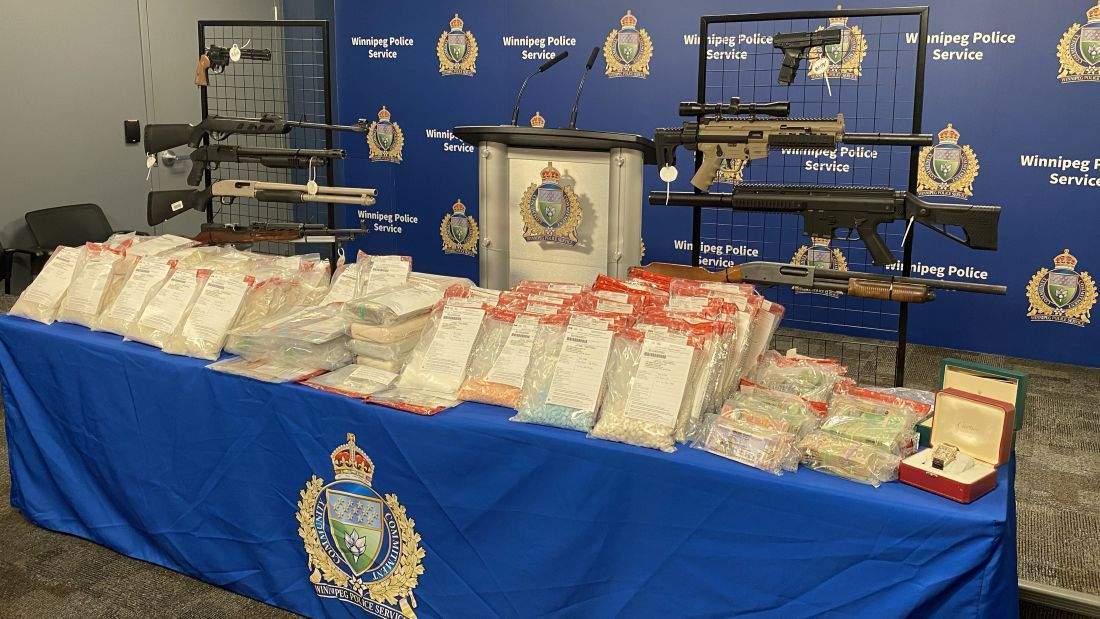
Look at the headline. Read it twice. "$970K worth of drugs seized in Winnipeg, Ontario in Project Pink Panther."
First, a basic geography lesson for the copy-paste journalism machine: Winnipeg is in Manitoba, not Ontario. If a media outlet cannot even place a major Canadian city in the right province, why are we trusting their math on street-level narcotics valuations? You might also find this connected coverage useful: Calgary's 15% Property Tax Bombshell Is Only Half the Bill.
Second, and far more importantly, this kind of press-release regurgitation is a masterclass in missing the forest for a single, slightly wilted tree. Local news outlets love a flashy number. Law enforcement drops a press release with a table full of plastic baggies, a couple of seized firearms, and a six-figure valuation, and reporters dutifully transcribe it as an unqualified triumph in the war on organized crime.
It is lazy consensus. It treats a routine supply-chain hiccup as a mortal wound to regional trafficking networks. Having spent years analyzing illicit supply chains, law enforcement logistics, and public policy outcomes, I have watched municipalities celebrate millions in "street value" seizures while overdose deaths in the exact same zip codes climb steadily upward. As highlighted in detailed coverage by The Guardian, the implications are widespread.
If you want to understand what Project Pink Panther actually represents, you have to stop looking at the press conference photo-op and start looking at the economics of prohibition.
The Myth of "Street Value" Accounting
When police announce a $970,000 seizure, how do they arrive at that figure? They do not audit a cartel's balance sheet. They calculate the maximum theoretical retail price if every single gram were cut down to street-level purity and sold in the smallest possible increments.
Imagine a scenario where a shipment of wholesale coffee beans falls off a truck, and the local chamber of commerce announces that $500,000 worth of lattes were just destroyed. That is the exact accounting trick used in drug bust press releases.
To an actual trafficking syndicate, that $970,000 haul does not represent a $970,000 loss. At wholesale levels—before the product is stepped on with cutting agents and distributed through three layers of mid-level dealers—the actual replacement cost to the organization is a fraction of that headline number. Often, it is less than twenty percent of the stated street value.
Organized crime syndicates operate with the exact same supply-chain redundancies as multinational retail corporations. They factor seizure rates into their quarterly shrinkage budgets. When a task force takes down a stash house in Winnipeg, the syndicate does not pack up and go home. They simply write off the shrinkage, adjust their wholesale pricing by a few percentage points, and push a backup shipment down the corridor from Vancouver or Toronto within forty-eight hours.
Why Geography Errors Reveal Media Laziness
Let us go back to that glaring error in the competitor's headline: "Winnipeg, Ontario."
That is not just a typo. It is a symptom of automated, uncritical news aggregation. When an outlet misidentifies the province of a major bust, it proves nobody on the editorial desk actually investigated the operation. Nobody called a criminologist. Nobody checked the court filings. Nobody asked what happens to the local street market the day after the arrests.
When journalism becomes a stenography service for police public relations departments, the public gets fed a comforting fiction: that tactical arrests equal strategic victory.
In reality, major operations like Project Pink Panther—names usually reserved for multi-jurisdictional investigations targeting mid-to-upper-level distribution networks—often create immediate, unintended consequences on the ground.
The Vacuum Effect
When law enforcement removes an established distribution cell from a city, they do not eliminate demand. Demand for illicit substances is notoriously inelastic. People struggling with severe substance use disorders do not suddenly enter recovery because a stash house got raided.
Instead, removing a reliable supplier creates a market vacuum. And in illicit markets, vacuums are filled in one of two ways:
- Violent Turf Wars: Rival crews immediately move in to claim the newly unguarded corners and customer lists. Studies published by organizations like the International Centre for Science in Drug Policy have repeatedly demonstrated that aggressive supply-side crackdowns frequently correlate with spikes in gun violence as competing factions fight for market share.
- Increased Potency and Contamination: When supply tightens, remaining dealers stretch their inventory. They do this by adding cheaper, deadlier adulterants—like illicitly manufactured fentanyl analogs or veterinary sedatives such as xylazine—to maintain volume and potency.
The immediate aftermath of a celebrated "million-dollar bust" is often a spike in fatal overdoses, because users are forced to buy from unfamiliar suppliers selling wildly inconsistent product. This is the side of the ledger that never makes it into the initial press release.
Dismantling the Common Questions
When headlines like this trend, the public usually asks the exact same set of predictable questions. Almost all of them are built on flawed premises.
Does a major bust actually reduce drug availability in a city?
No. Not for more than a few days. Decades of empirical data across North America show that even massive interdictions at borders and ports fail to produce sustained increases in street prices or decreases in purity. If a $100 million seizure at a major shipping port barely registers as a blip on retail availability, a $970,000 regional seizure in central Canada will not dry up the local market for a single weekend.
Are projects like Pink Panther a waste of taxpayer money?
This is where nuance matters, and it is the downside to the purely cynical anti-policing take. Calling these operations a complete waste is just as intellectually lazy as calling them a total victory.
When a task force dismantles a network, they almost always seize illegal firearms, laundered cash, and encrypted communications alongside the narcotics. Getting illegal handguns off the street and disrupting violent extortion rings has immediate, tangible value for community safety. The problem is not that police are investigating organized crime; the problem is pretending that drug seizures are a viable public health strategy. They are not. They are a containment strategy, and a temporary one at that.
Why do police still publicize the dollar value if it is misleading?
Because metrics drive funding. Police departments, like every other bureaucratic institution, have to justify their budgets to city councils and provincial legislatures. It is much easier to secure funding for a specialized tactical unit when you can point to a neat ledger showing "$970,000 in drugs removed from our streets" than it is to explain the complex, multi-year realities of financial crime investigations and intelligence gathering.
What Actually Disrupts Illicit Networks
If seizing physical inventory is just playing an endless, expensive game of whack-a-mole, what actually works? If you want to dismantle a trafficking network permanently, you have to stop attacking the product and start attacking the infrastructure.
- Follow the Ledger, Not the Baggies: A syndicate can replace a kilogram of fentanyl in a week. They cannot easily replace a sophisticated money-laundering apparatus. Targeting the shell companies, real estate holdings, and underground banking networks that clean illicit proceeds inflicts permanent structural damage. When you freeze the capital, the organization cannot pay its couriers, bribe its lookouts, or buy its next wholesale shipment.
- Target the Precursor Supply Chains: Modern synthetic drug markets do not rely on agricultural crops; they rely on industrial chemicals. Disrupting the diversion of specific precursor chemicals at the regulatory and customs level forces manufacturers to constantly re-engineer their synthesis routes, driving up costs and lowering production efficiency far more effectively than street-level arrests ever will.
- Starve the Demand Through Clinical Intervention: Every person who transitions out of active addiction through evidence-based treatment—such as opioid agonist therapy—permanently removes a revenue stream from the cartel's balance sheet. You cannot arrest your way out of a demand-driven market, but you can treat your way out of it.
The Reality Check
Look closely at the next drug bust headline you see. Strip away the dramatic code names—whether it is Project Pink Panther or whatever operation comes next. Ignore the inflated street-value estimates laid out neatly on folding tables for the television cameras.
Ask yourself a simple question: Six months from now, will it be any harder to buy those exact same substances in that exact same city?
Until media outlets stop acting as cheerleaders for routine enforcement metrics, and until policymakers stop confusing supply-chain shrinkage with actual victory, we are just celebrating the score at halftime while losing the game.