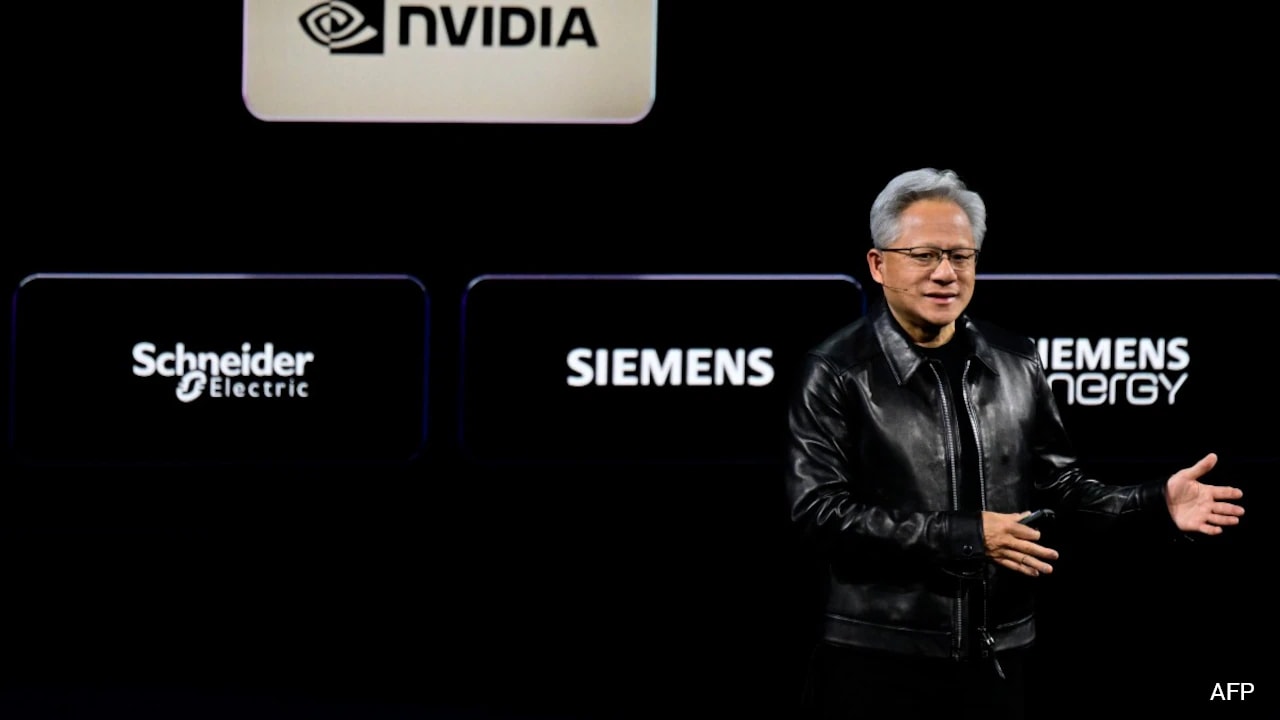
Evaluating Nvidia's ascent to a multi-trillion-dollar market capitalization through a biographical rags-to-riches lens obscures the actual operational mechanics of the business. The standard narrative—tracing Jensen Huang from service-sector labor at Denny’s to the helm of the world’s dominant accelerated computing monopoly—attributes systemic market capture to individual grit. While operational stamina informed Huang’s managerial style, Nvidia’s valuation is the direct output of a specific, multi-decade capital allocation strategy: subsidizing a proprietary software ecosystem using the cash flows of a commoditized gaming hardware business until an architectural inflection point rendered competitors obsolete.
To understand how Nvidia captured the foundational layer of modern artificial intelligence, one must examine the structural decisions made between 1993 and 2026. The company’s trajectory is not a linear climb, nor does the sensationalized framing of a "fall" reflect operational reality; rather, it represents extreme valuation volatility caused by cyclical capital expenditure shifts among hyperscale cloud providers.
The Structural Flaws of Biographical Attribution
Popular business analysis frequently commits the fundamental attribution error, over-indexing on founder personality traits while under-indexing on market structure and switching costs. Huang’s early employment at Denny’s and his subsequent engineering roles at LSI Logic and Advanced Micro Devices (AMD) did not create a monopoly. Those experiences established a baseline tolerance for operational friction and a familiarity with semiconductor design cycles, yet thousands of executives share similar backgrounds without building multi-trillion-dollar enterprises.
The actual differentiator in Nvidia’s early history was surviving the late-1990s graphics processing unit (GPU) consolidation. Between 1995 and 2000, dozens of graphics chipmakers—including 3dfx, S3 Graphics, and Matrox—either went bankrupt or exited the high-performance market. They failed because they treated graphics rendering as a purely hardware-driven, fixed-function pipeline problem. Each generation required bespoke silicon designs tailored to specific APIs, creating massive research and development overhead with zero architectural continuity.
Nvidia survived this culling by recognizing that semiconductor economics favor unified, programmable architectures over specialized, fixed-function hardware. The release of the GeForce 256 in 1999 marked the integration of transform and lighting calculations onto a single chip, shifting the computational burden away from the central processing unit (CPU). This was not merely a product launch; it was the initial phase of a vertical integration strategy aimed at owning the entire compute stack.
The CUDA Capital Allocation Gamble
The single most consequential strategic decision in Nvidia’s history occurred in 2006 with the introduction of CUDA (Compute Unified Device Architecture). At the time, Nvidia’s revenue was almost entirely dependent on discrete graphics cards for PC gaming. Wall Street analysts viewed general-purpose computing on graphics processing units (GPGPU) as an expensive distraction with no addressable market.
Huang’s strategy required diverting hundreds of millions of dollars in free cash flow from profitable gaming silicon into a software abstraction layer that allowed developers to program GPUs using standard languages like C and C++. This created a classic two-sided market problem, compounded by severe margin compression in the short term.
- Supply-Side Subsidization: Nvidia absorbed the engineering cost of building compilers, libraries, and debugging tools without charging end-users a licensing fee. The software was bundled free with the hardware.
- Installed Base Seeding: By embedding CUDA support into every consumer GeForce card shipped to gamers, Nvidia inadvertently placed millions of parallel-computing nodes into the hands of academic researchers and graduate students worldwide.
- Switching Cost Construction: As researchers wrote foundational machine learning frameworks—such as early versions of AlexNet in 2012—exclusively in CUDA, the switching cost away from Nvidia hardware escalated from the price of a silicon chip to the total engineering hours required to rewrite entire codebases.
This mechanism is known in economics as a complementary good strategy. By commoditizing the complement (the CUDA software layer) to zero cost, Nvidia maximized demand and pricing power for the core product (the proprietary silicon). Competitors like AMD focused on raw hardware performance-per-dollar metrics, failing to recognize that enterprise buyers do not purchase silicon; they purchase time-to-market and developer productivity.
Architectural Inflection and the AI Monopoly
The transition from a gaming component supplier to the primary infrastructure provider for artificial intelligence was not a pivot; it was the maturation of a sixteen-year capital bet. The fundamental physics of computing shifted as Moore’s Law—the doubling of transistor density roughly every two years—began to decelerate due to thermal and quantum tunneling limits at sub-10-nanometer process nodes.
Traditional CPUs are optimized for serial processing, featuring a small number of complex cores designed to minimize latency for single-threaded tasks. Conversely, deep learning algorithms—specifically transformer architectures introduced in 2017—rely entirely on massive matrix multiplications that are embarrassingly parallel. GPUs, composed of thousands of smaller, simpler cores, are physically optimized for high-throughput parallel execution.
When the industry hit the serial-computing wall, Nvidia was the only entity possessing:
- Full-Stack Optimization: Co-designed silicon (Tensor Cores introduced in the Volta architecture), interconnects (NVLink), and software libraries (cuDNN).
- System-Level Integration: Following the $6.9 billion acquisition of Mellanox Technologies in 2020, Nvidia stopped selling chips and began selling entire data center architectures. By controlling the high-speed networking fabric (InfiniBand and Spectrum-X Ethernet), Nvidia eliminated communication bottlenecks between tens of thousands of GPUs operating as a single cluster.
- Annualized Cadence: Compression of the hardware release cycle from two years to one year (moving from Hopper to Blackwell to Rubin architectures), forcing competitors to chase a moving target while depreciating their own R&D investments twice as fast.
Deconstructing the Rise and Fall Narrative
Media narratives tracking Nvidia’s valuation swings between $3 trillion, $4.5 trillion, and subsequent corrections mischaracterize cyclical capital expenditure adjustments as structural collapse. To evaluate whether Nvidia is experiencing a terminal decline or a standard hardware cycle, one must analyze the unit economics of its primary customers: the hyperscale cloud providers (Microsoft, Alphabet, Amazon, Meta).
The core vulnerability in Nvidia’s business model is customer concentration and return on invested capital (ROIC) asymmetry. In 2024 and 2025, hyperscalers allocated hundreds of billions of dollars toward AI infrastructure. Nvidia captured the vast majority of this spend, maintaining gross margins exceeding 70 percent—an anomaly for a fabless semiconductor company reliant on Taiwan Semiconductor Manufacturing Company (TSMC) for fabrication.
However, a severe imbalance emerged between infrastructure spend and end-user software revenue. While Nvidia realized immediate hardware profits, its customers faced multi-year depreciation schedules for clusters whose revenue-generating capacity remained unproven at scale. This asymmetry triggers three predictable market reactions:
- Digestion Periods: Hyperscalers periodically pause procurement to optimize software utilization on existing clusters, causing sharp contractions in Nvidia’s sequential revenue growth and triggering equity sell-offs.
- Custom ASIC Substitution: To escape the "Nvidia tax," every major cloud provider developed proprietary application-specific integrated circuits (ASICs)—such as Google’s TPUs, Amazon’s Trainium, and Microsoft’s Maia. While these chips lack the general-purpose flexibility of Nvidia GPUs, they offer superior energy efficiency and lower total cost of ownership (TCO) for specific, known workloads like inference.
- Inference vs. Training Shift: Training frontier models requires massive, interconnected GPU clusters where Nvidia’s NVLink and CUDA moat are absolute. Inference—running trained models to generate outputs—can be distributed across cheaper, less complex hardware. As the AI market matures from model training to inference deployment, Nvidia’s pricing power faces structural downward pressure.
Operational Mechanics of Flat Management
A critical component of Huang’s execution speed is Nvidia’s organizational structure, which deliberately violates standard corporate governance principles. While most enterprises of comparable scale utilize hierarchical reporting structures and formal business units to manage complexity, Nvidia operates with a flat hierarchy where up to 60 vice presidents report directly to the CEO.
This design eliminates middle-management information filtering. In traditional hierarchies, bad news regarding tape-out delays or software bugs is sanitized as it moves upward, resulting in delayed strategic corrections. By maintaining direct reporting lines and eliminating formal status reports in favor of "Top 5" email lists sent directly to executive leadership, Huang enforces real-time operational visibility.
The operational trade-off of this structure is extreme organizational friction and cognitive load at the executive level. It prevents the creation of isolated silos—ensuring that the networking team, the silicon architects, and the CUDA software engineers operate with shared context—but it creates a single point of failure. The company’s decision-making velocity is entirely dependent on the cognitive bandwidth of its founder, representing a severe key-person risk that institutional investors routinely discount during periods of rapid growth.
Strategic Vulnerabilities and Constraint Analysis
No monopoly is immune to economic gravity. Nvidia’s market dominance is constrained by four physical and geopolitical bottlenecks that limit infinite scaling:
- Foundry Concentration: Nvidia is a fabless designer. Its advanced architectures depend entirely on TSMC’s leading-edge process nodes and CoWoS (Chip-on-Wafer-on-Substrate) advanced packaging capacity. Supply chain constraints at TSMC directly cap Nvidia’s unit volume, regardless of market demand.
- Power and Thermal Limits: Modern AI data centers are no longer constrained by floor space or capital; they are constrained by gigawatts of electrical power and thermal dissipation limits. The shift from air cooling to direct-to-chip liquid cooling introduces physical infrastructure bottlenecks that slow down cluster deployment timelines.
- Geopolitical Export Controls: United States Department of Commerce restrictions on exporting high-bandwidth, high-compute silicon to China forced Nvidia to engineer degraded, region-specific chips (such as the H20). This permanently impaired access to one of the world’s largest enterprise technology markets while simultaneously incentivizing domestic Chinese competitors like Huawei to accelerate indigenous semiconductor manufacturing.
- Open-Source Software Erosion: Initiatives like OpenAI’s Triton compiler and PyTorch 2.0’s native compilation features are actively abstracting away the hardware layer. By allowing developers to write high-performance code that compiles efficiently across non-Nvidia silicon, these software tools slowly erode the exclusive lock-in of the CUDA ecosystem.
The Strategic Imperative for Enterprise Leaders
Analyzing Nvidia’s trajectory provides a clear blueprint for capital allocation and competitive defense, alongside an explicit warning regarding vendor lock-in.
For technology executives and capital allocators, relying exclusively on a single-vendor hardware stack exposes the enterprise to catastrophic margin compression. The optimal response is not attempting to replicate Nvidia’s full-stack monopoly—a strategy that requires billions in sunk capital and a decade of software ecosystem cultivation—but rather aggressively commoditizing the software abstraction layer. Enterprise engineering teams must mandate hardware-agnostic compilation frameworks (such as OpenXLA or Triton) for all internal machine learning workloads, strictly decoupling proprietary business logic from CUDA-specific libraries. Simultaneously, capital expenditure must be bifurcated: utilize Nvidia’s integrated rack architectures for frontier model training where interconnect bandwidth dictates success, while systematically migrating high-volume, predictable inference workloads onto custom ASICs or competing silicon architectures to capture immediate total-cost-of-ownership reductions.