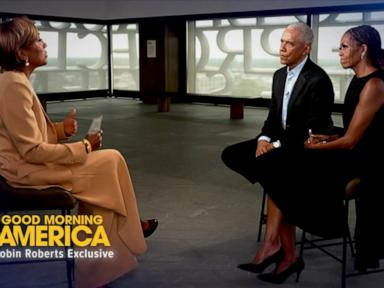
The modern political interview is rarely an exercise in spontaneous disclosure. When Barack and Michelle Obama sit down for a high-profile network broadcast, the event functions less as a journalistic inquiry and more as a carefully timed deployment of institutional influence. These rare joint appearances are designed to project stability and continuity, yet they always arrive precisely when the current political faction requires a calibration of its core message. By examining the mechanics of these media rollouts, we can see exactly how the former first couple uses controlled access to shape public narrative without ever getting their hands dirty in the day-to-day partisan grind.
The strategy relies on a delicate balance between public intimacy and strict boundary management.
The Anatomy of the Controlled Broadcast
Major networks treat joint interviews with the Obamas as prestige events. The setting is invariably intimate, bathed in soft lighting that signals comfort and reflection rather than the harsh glare of a standard press briefing. This aesthetic choice is deliberate. It shifts the viewer's psychological posture from critical scrutiny to receptive listening.
When you strip away the polished anecdotes and the familiar chemistry, the true utility of these appearances becomes clear. They serve as a mechanism for subtle policy course correction. While active politicians must defend specific legislative failures or shifting economic metrics, the Obamas operate from a cultural high ground. This position allows them to address systemic anxieties—whether economic uncertainty, social polarization, or institutional distrust—without tethering themselves to the immediate failures of the current administration.
The messaging functions through a specific rhetorical pattern. First, an acknowledgment of widespread public frustration establishes empathy. Next, this frustration is reframed not as a failure of specific leadership, but as part of a longer, historical struggle toward progress. Finally, the conversation is steered toward personal responsibility and civic engagement, effectively shifting the burden of change from political institutions back onto the individual citizen.
The Myth of the Unprepared Subject
Behind every exclusive broadcast lies an intricate web of pre-negotiation. High-level political figures do not walk into rooms without knowing the general trajectory of the conversation. While direct script approval is rarely granted openly, the thematic boundaries are firmly established long before the cameras start rolling.
Networks accept these conditions because the rating potential and prestige of the access outweigh the desire for a confrontational interrogation. The journalist becomes a facilitator rather than an adversary. Questions are structured to allow for expansive, philosophical answers rather than demanding specific, binary commitments on controversial topics.
Consider how touchy subjects like rising inflation or foreign policy entanglements are handled in these settings. You will not see a demand for a defense of specific budgetary line items. Instead, the interviewer asks how the couple feels about the current national mood, or how they talk about these challenges at their own dinner table. This normalization technique transforms massive structural crises into relatable, domestic conversations, blunting the sharp edges of public anger.
The Separation of Cultural Power and Political Risk
The Obamas have successfully decoupled their immense cultural capital from the volatile fortunes of the contemporary Democratic party. This separation is their greatest asset. By operating through a multi-faceted media apparatus that includes documentary production, publishing, and targeted philanthropic initiatives, they maintain a permanent line of communication with the public that completely bypasses traditional political structures.
This independent media footprint creates a unique power dynamic. They can choose when to lend their authority to a specific candidate or cause, and more importantly, when to withhold it. This selectivity ensures that their endorsement retains its premium value. When they do step into the media spotlight, it signals to the donor class and the grassroots base that a specific moment requires unified action.
However, this distance creates a distinct tension within their own political movement.
The Generational Divide in Political Messaging
Younger activists increasingly view this highly managed, optimistic rhetoric with skepticism. Where the Obama brand offers long-term historical optimism, the rising base of the party often demands immediate, material concessions on housing, climate change, and economic inequality. The gap between the poetry of inspiration and the prose of material condition is widening.
- Rhetorical Optimism: Focusing on democratic norms, institutional faith, and gradual progress over decades.
- Material Pragmatism: Demanding immediate legislative intervention, economic redistribution, and structural overhaul of existing institutions.
This divide explains why these exclusive interviews often feel oddly disconnected from the urgent tone of modern internet-driven politics. They are targeted at a specific segment of the electorate—moderate, middle-class voters who crave a return to perceived political decorum and stability. For this demographic, the reassuring presence of the former first couple acts as a psychological balm against the chaotic nature of the current news cycle.
The Legacy Blueprint as a Corporate Entity
To truly understand these media appearances, one must view them through the lens of modern brand management. The post-presidency is no longer a period of quiet retirement or simple memoir writing. It is a highly sophisticated, multi-million-dollar corporate enterprise that requires constant narrative maintenance.
Every public statement, book tour, and network exclusive feeds into a larger ecosystem of content generation. The goal is to ensure that the historical narrative of their time in office remains pristine, defended against both conservative critique and progressive disappointment. By controlling the venues in which they discuss their past choices, they effectively write their own history in real-time, long before academic historians can reach a consensus.
This approach carries inherent risks for the broader political ecosystem. When the most effective communicators of a political philosophy choose to operate almost entirely within protected, highly curated media environments, they weaken the party's capacity for raw, unscripted political combat. The current generation of politicians is left to fight in the mud of daily press scrums, while the architects of the modern party apparatus look on from a comfortable, televised distance.
The ultimate consequence of this strategy is a fragmentation of political authority. The power to inspire remains concentrated in a retired executive branch, while the responsibility to govern and take the blame rests with a struggling, active leadership. This imbalance cannot hold indefinitely. As long as the political establishment relies on periodic, carefully orchestrated media interventions from its past leaders to stabilize its present crises, it avoids the necessary, painful work of building a viable message for the future.