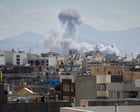
The latest surge of airstrikes launched by the United States and Israel against Iranian-linked targets across the region represents a definitive shift from containment to active dismantling. This is no longer a tit-for-tat exchange of warnings. By hitting high-value logistics hubs and command centers simultaneously, the coalition is attempting to strip away the physical infrastructure of Iran’s regional influence before a larger, more direct confrontation becomes unavoidable. The primary goal is to paralyze the "Ring of Fire"—the network of proxies surrounding Israel—while forcing Tehran to decide if it will risk its own borders to protect its expeditionary forces.
For years, the geopolitical consensus relied on the idea of "strategic patience." That era is over. The current strikes target the precise intersection of Iranian drone manufacturing and the transport corridors that feed weapons into Lebanon, Syria, and Yemen. If you look at the map of recent impacts, a pattern emerges that suggests a deliberate effort to create a vacuum in leadership and supply.
The Logistics of a Widening Front
Military operations of this scale do not happen in a vacuum. They are preceded by months of intelligence gathering and "pattern of life" analysis. When American precision munitions hit a warehouse in eastern Syria, they aren't just destroying crates of missiles. They are signaling that the exact arrival time, the personnel involved, and the final destination of those weapons were known weeks in advance.
The strategy relies on a concept known as "kinetic diplomacy." It is the use of overwhelming force to narrow an opponent's options until only two remain: total retreat or a desperate, suicidal escalation.
Israel’s role in this current wave is markedly different from previous campaigns. Traditionally, the Israeli Air Force focused on "the war between wars"—small, surgical strikes meant to slow down the inevitable. Now, the pace has accelerated. They are targeting the deep-tier command structures of the Islamic Revolutionary Guard Corps (IRGC). This isn't about deterrence anymore. It is about decapitation. By removing the middle management of the proxy networks, the coalition leaves the rank-and-file fighters without the technical expertise required to operate advanced weaponry.
The Drone Economy and the Cost of War
One factor consistently ignored by mainstream reports is the economic fallout for Tehran. Iran has invested billions into its domestic drone and missile programs, viewing them as a cost-effective way to project power without a traditional navy or air force.
- Manufacturing bottlenecks: The strikes are hitting the specific facilities that integrate foreign-sourced microchips into Iranian airframes.
- Fuel and Energy: Attacks on secondary infrastructure make it harder for the Iranian government to justify foreign adventures to a domestic population struggling with massive inflation.
- Supply Chain Rupture: The destruction of the Al-Bukamal crossing has forced smugglers to take longer, more exposed routes, making them easy targets for satellite tracking.
The sheer cost of replacing these assets is staggering. While a drone is cheap, the facility required to build its guidance system is not. When these facilities go up in smoke, the "low-cost" advantage of proxy warfare begins to evaporate.
Intelligence Failures and the Fog of Proxy War
To understand why this escalation is happening now, one must look at the recent failures of regional intelligence. For a long time, the West believed that economic pressure would be enough to keep Iran at the bargaining table. That was a miscalculation.
The IRGC used the period of relative calm to harden its positions. They built "missile cities" deep underground, some of which are hundreds of feet below the surface. Standard munitions cannot reach these. This explains the deployment of specialized bunker-busting technology in the recent wave of attacks. It is a technological arms race played out in the dirt and rock of the Levant.
A common counter-argument suggests that these strikes only serve to radicalize the local population. This view is simplistic. While civilian casualties are a tragic and inevitable consequence of urban warfare, the primary drivers of this conflict are state actors, not grassroots movements. The militias in Iraq and Syria operate as professionalized extensions of the Iranian military. They have payrolls, ranks, and bureaucratic structures. When those structures are hit, the organization doesn't just get "angry"—it loses the ability to function as a military unit.
The Silence from Moscow and Beijing
Perhaps the most telling aspect of the current escalation is what isn't happening. Russia, traditionally a backer of the Syrian regime and a partner to Iran, has remained uncharacteristically quiet. Their own distractions in Eastern Europe have left a power gap that the U.S. and Israel are now filling.
Beijing, meanwhile, is watching the oil prices. Iran provides a significant portion of China's energy needs through "dark fleet" tankers. If the conflict moves from the desert outposts of Syria to the Persian Gulf, the global economy faces a shock that could dwarf the 2008 crisis. The threat of a closed Strait of Hormuz remains the ultimate trump card for Tehran. It is the one move that could force the international community to demand an immediate ceasefire.
However, the U.S. has prepositioned carrier strike groups specifically to prevent this. It is a high-stakes game of chicken played with nuclear-capable aircraft and ballistic missile destroyers.
The Internal Pressure on Tehran
Inside Iran, the regime is facing a crisis of legitimacy. The "Woman, Life, Freedom" protests of previous years haven't disappeared; they’ve gone underground. Every dollar spent on a Hezbollah rocket is a dollar not spent on the crumbling power grid in Tehran or the water shortages in the south.
The leadership in Tehran is trapped in a "security dilemma." If they don't respond to the strikes, they look weak to their proxies and their own hardliners. If they do respond too forcefully, they risk a direct attack on their sovereign soil—something the regime might not survive.
The current wave of attacks is designed to widen this internal rift. By humiliating the IRGC on the regional stage, the coalition is betting that the Iranian public’s frustration will eventually outweigh their fear of the secret police. It is a gamble on regime fragility.
Tactical Realities on the Ground
If you talk to veterans of the Middle East desk, they will tell you that terrain dictates the outcome. The vast, open deserts of the Syrian-Iraqi border provide no cover for convoys.
- Air Superiority: The U.S. and Israel effectively own the skies. This allows for constant loitering of armed drones that can strike the moment a target emerges from a tunnel.
- Electronic Warfare: Before the first bomb drops, the communication networks of the target are usually fried. This prevents commanders from calling for reinforcements or warning their subordinates.
- Human Intelligence: The precision of these strikes suggests that the coalition has high-level assets within the militia structures. Someone is talking.
A New Map of Power
The geography of the Middle East is being redrawn by fire. The old borders of the post-WWII era are increasingly irrelevant, replaced by "influence corridors" and "security zones."
The United States has signaled that its departure from the region was premature. After years of trying to "pivot to Asia," Washington has been dragged back into the sand by the reality that the Middle East still controls the global energy valve. The difference this time is the lack of "boots on the ground." This is a war of standoff distance—fought with sensors, satellites, and long-range missiles.
Israel, for its part, has decided that the status quo is an existential threat. The events of the past year have convinced their leadership that they cannot live next door to a fully-armed Iranian proxy. This has led to a policy of "maximum friction," where the goal is to provoke a reaction that justifies a larger, definitive strike.
The risk of a total regional war is higher than at any point in the last forty years. Miscalculation is the greatest danger. A single missile hitting the wrong target—a crowded apartment building, a diplomatic mission, or a hospital—could ignite a fire that no amount of diplomacy could extinguish.
The current strikes are not an end point. They are the opening movements of a multi-year effort to push Iran back to its own borders. Whether the Iranian leadership will accept a diminished role or choose to burn the entire house down remains the central question of our time.
The hardware is in place. The targets are identified. The only thing left is to see who blinks first in a theater where blinking is often a fatal mistake. Check the flight paths of the refueling tankers over the Mediterranean tonight; they will tell you more about the next 24 hours than any press release from the Pentagon.


