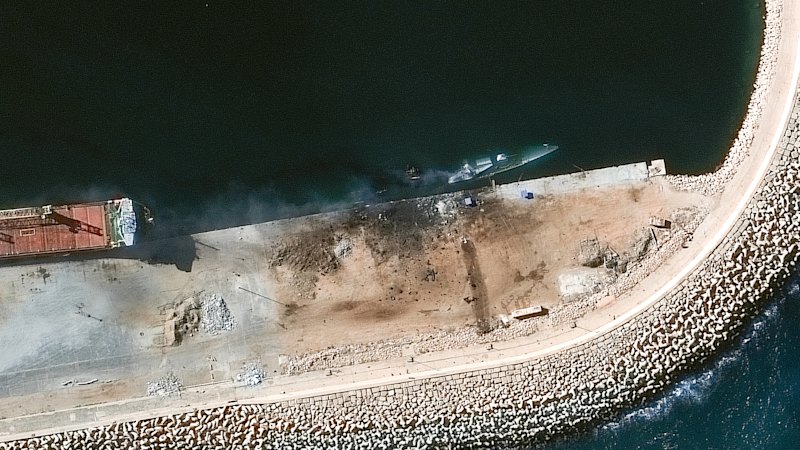
Everybody is cheering for the cheap explosive boat that just turned a Russian naval vessel into scrap metal in a Libyan harbor. The defense commentators are breathless. The headlines are screaming about the death of the surface navy and the dawn of asymmetrical maritime warfare.
They are completely missing the point. Read more on a similar subject: this related article.
If you look at the smoke rising over the Mediterranean and see a revolution, you are falling for the oldest optical illusion in military history. You are confusing a tactical embarrassment with a strategic victory. Worse, you are watching a playbook get burned in real time—a playbook that loses its value the exact second it succeeds in a theater like North Africa.
The mainstream consensus argues that uncrewed surface vessels have permanently broken the cost-exchange ratio of naval power. Spend a few hundred thousand dollars on a fiberglass hull packed with commercial electronics and high explosives, pilot it via satellite into a multi-million-dollar warship, and declare victory. It sounds brilliant on paper. It makes for incredible viral video. Additional analysis by Al Jazeera delves into comparable views on this issue.
It is also a dead end.
The Geography Illusion and the Myth of Endless Reach
Let us dismantle the primary myth circulating right now: the idea that because an attack happened in a Libyan port, no Russian vessel anywhere on earth is safe.
The armchair admirals are treating the Mediterranean like an extension of the Black Sea. They are ignoring basic maritime geography, logistics, and the brutal physics of maritime interdiction. In the Black Sea, Ukrainian uncrewed surface vessels operated in a closed bathtub. Launch points were a few hundred miles from targets. Friendly coastlines provided radar coverage, electronic warfare support, and recovery options.
Libya is not a bathtub. It is an open-ocean logistical nightmare.
To hit a ship in a Libyan harbor, you do not just press a button in Odesa and steer a drone two thousand miles through the Bosporus, across the Aegean, and down to the North African coast. The Bosporus is closed to military transit under the Montreux Convention. That means any drone operating in the Mediterranean had to be smuggled in pieces, assembled in a clandestine workshop on foreign soil, fueled by local networks, and launched from a compromised coastline.
That is not scalable warfare. That is a special operations stunt.
I have watched defense startups and procurement officers burn billions chasing "expeditionary" drone concepts that look invincible in controlled tests and fall apart the moment they hit real-world friction. When you move a drone operation out of your backyard and into a third-party nation, you trade your greatest advantage—mass production and rapid iteration—for extreme fragility. Every local fixer you hire is a security leak. Every warehouse you rent is a target for host-nation intelligence or rival militias.
In Libya, a country fractured between competing governments and flooded with foreign mercenaries, nothing stays secret for long. You might pull off one spectacular strike. Maybe two. After that, the local supply chain gets rolled up, the port security tightens, and your "revolutionary" weapon system is stranded without fuel, parts, or launch ramps.
The Tactical Sugar High
Military history is littered with wonder weapons that delivered massive tactical shocks while failing to alter the strategic reality of a war.
Think about the German U-boat campaigns in both World Wars, or the Exocet missile strikes during the Falklands War. When the HMS Sheffield went down to a single sea-skimming missile in 1982, the exact same chorus of experts declared the surface warship obsolete. Yet forty years later, navies still build destroyers, cruisers, and aircraft carriers. Why? Because nothing else can hold maritime space, project sustained power, or protect commercial shipping lanes.
A sea drone cannot blockade a port. It cannot board and inspect a merchant vessel. It cannot project air defense over a contested coastline. It is a single-use munition with a long steering wheel.
By celebrating the destruction of a single Russian vessel in Libya as a decisive blow, analysts are confusing attrition with defeat. Russia does not need a pristine blue-water fleet in the Mediterranean to achieve its objectives in Africa. Moscow’s presence in Libya and the Sahel relies on cargo planes, Wagner-successor paramilitary units, gold smuggling, and political coercion—not amphibious assaults. Losing a ship in port is humiliating for the Russian Admiralty, and it forces them to spend money on harbor defenses. It does not stop a single Ilyushin transport plane from landing at Al-Jufra airbase with weapons and advisors.
Meanwhile, what did the attackers spend to pull this off? Not just the cost of the drone. They spent irreplaceable human intelligence assets, covert logistics networks, and diplomatic capital with whatever local faction looked the other way. That is an awful trade if the only return on investment is a burning hull and a news cycle.
Why Harbors Are Actually Death Traps for Drones
The conventional wisdom says ships in port are sitting ducks. They are stationary, their crews are on shore leave, and their primary weapon systems are powered down.
That is true—for about twenty-four hours after the first attack.
In reality, a fortified harbor is the worst possible environment for an uncrewed surface vessel once the element of surprise is gone. In the open ocean, a low-profile drone is notoriously difficult to spot on marine radar, especially in rough sea states. The clutter of the waves hides the fiberglass hull until it is within a few hundred meters.
Inside a harbor, all of those advantages vanish.
- Choke Points: Every port has a narrow entrance. You do not need sophisticated phased-array radar to defend a two-hundred-meter channel. You need a heavy machine gun, a thermal camera, and a floating boom made of steel cable and timber.
- Acoustic Clutter: In calm harbor waters, the high-pitched whine of a jet-ski engine or an outboard motor—the propulsion systems used by almost every maritime drone—carries for miles.
- Electronic Saturation: A stationary port facility does not have to worry about the power constraints of a moving ship. Defenders can run massive, continuous electronic warfare jammers across every commercial satellite and radio frequency without draining a vessel's batteries.
When you attack a ship in port, you are fighting the enemy on the exact terrain where static, low-tech defenses are most effective. Naval engineers like Wayne Hughes, whose foundational work Fleet Tactics and Coastal Combat remains the bible of modern naval warfare, emphasized that the littoral environment favors the defender who controls the land. Once a port commander strings anti-torpedo nets across the harbor mouth and mounts stabilized autocannons on the breakwaters, your $250,000 drone becomes useless floating scrap before it ever clears the seawall.
Answering the Questions Nobody Wants to Ask
When news like this breaks, the public immediately rushes to search engines with the same predictable questions. Almost every single one of them is built on a flawed premise.
Are aircraft carriers and destroyers now completely obsolete?
No, and asking this proves a fundamental misunderstanding of what warships actually do. A warship is not designed to be invulnerable; it is designed to absorb damage while delivering massive firepower and maintaining presence. Saying warships are obsolete because a drone sank one in port is like saying infantry is obsolete because snipers exist. Navies adapt. Right now, shipyards around the world are bolting directed-energy weapons, high-rate-of-fire cannons, and autonomous interceptor drones onto existing hulls. The surface warship is evolving, not dying.
How can a country without a navy defeat a naval superpower?
It cannot. A country without a navy can deny a superpower easy access to coastal waters. That is called sea denial, and it is a purely defensive posture. Sea control—the ability to use the ocean freely for trade and military movement—still requires ships, submarines, and aircraft. You cannot win a maritime war solely by blowing things up from the shadows; eventually, you have to protect your own ships, and an explosive drone cannot escort a grain freighter.
Will terrorist groups start using sea drones to attack commercial shipping?
They already have, most notably in the Red Sea, and the results prove my point about their limitations. Despite launching dozens of uncrewed boats and aerial drones, Houthi militants have failed to halt global trade or sink a single major naval combatant. They have raised insurance premiums and forced reroutes, which is a nuisance, not a strategic collapse. Commercial shipping is too vast, and maritime security firms are already deploying armed guards with thermal optics and anti-materiel rifles that shred fiberglass drones at a thousand yards.
The Counter-Intuitive Reality of Asymmetrical Warfare
Here is the brutal truth that defense contractors and cheerleaders of unmanned warfare refuse to admit: asymmetrical weapons have a shorter shelf life than conventional ones.
A guided-missile destroyer built in 2005 is still lethal in 2026 because its core architecture can accept new software, new radar modules, and new missiles. Its value compounds over decades.
An improvised sea drone relies entirely on exploiting blind spots in enemy doctrine and gaps in commercial technology. Every time it succeeds, it teaches the enemy how to kill it. The Russian Navy was caught flat-footed in the Black Sea in 2022 and 2023 because its crews were trained for Cold War fleet engagements, not speedboats packed with C4. They paid for that arrogance with sunken ships.
Now, look at what happened in response. Russian vessels started welding cage armor onto their superstructures, mounting extra heavy machine guns on every deck, deploying helicopter patrols specifically dedicated to drone hunting, and saturating coastal waters with GPS spoofing. The hit rate for Ukrainian sea drones dropped precipitously once the novelty wore off, forcing operators to launch swarms of ten or twelve drones just to get one through.
When you export that tactic to Libya, you reset the clock for a single afternoon. You catch a complacent crew off guard in a sleepy port far from the front lines. You get your headlines. You get your dramatic satellite photos of a charred hull.
And in exchange, you just alerted every Russian naval commander from Murmansk to Vladivostok—and every port authority in Tartus, Tobruk, and Port Sudan—to lock down their harbors. You gave them the exact intelligence they needed to close the final loophole in their perimeter defense.
The Downside of the Contrarian View
To be completely honest, betting against disruptive technology carries a massive risk. If you dismiss cheap, autonomous systems too quickly, you end up like the cavalry officers in 1914 who insisted horses would always beat machine guns.
There is one scenario where the mainstream hype becomes reality: true, unjammable autonomy at scale.
Right now, sea drones still rely heavily on human operators and satellite links like Starlink to guide them during the terminal phase of an attack. That dependency is their Achilles' heel. If an attacker fields a fleet of sea drones equipped with fully onboard, AI-driven optical targeting—systems that require zero radio emissions, cannot be jammed, and can hunt in coordinated wolfpacks across open oceans without human intervention—then everything changes. At that point, the cost-exchange ratio permanently breaks, and every surface fleet on earth faces an existential crisis.
We are not there yet. Today’s sea drones are still glorified remote-control boats tethered to fragile communications links and vulnerable to basic physical barriers.
Stop Worshiping the Weapon and Start Looking at the Logistics
If you are analyzing modern naval conflict, stop staring at the explosion and start looking at the supply chain. The real story in Libya is not the drone; it is the collapse of operational security in North Africa that allowed a hostile strike team to operate unimpeded in a Russian-aligned port.
The next phase of naval warfare will not be decided by who builds the sleekest fiberglass suicide boat. It will be decided by boring, unglamorous fundamentals:
- Port Hardening: Physical barriers, acoustic sensor arrays, and automated close-in weapon systems will turn major harbors back into sanctuaries.
- Counter-Autonomy: Navies will deploy their own cheap, persistent unmanned patrol boats to act as picket lines miles outside port entrances, intercepting threats before they reach the main fleet.
- Supply Chain Interdiction: Intelligence agencies will shift focus from hunting drones at sea to tracking the commercial off-the-shelf components—the marine engines, the satellite terminals, the industrial explosives—before they ever reach a coastline.
The burning ship in Libya is a triumph of audacity, intelligence, and covert logistics. It is a masterclass in humiliating an adversary far from home.
Just do not mistake a brilliant ambush for the future of war. By the time the smoke clears over the Mediterranean, the weapon that caused it will already be obsolete.