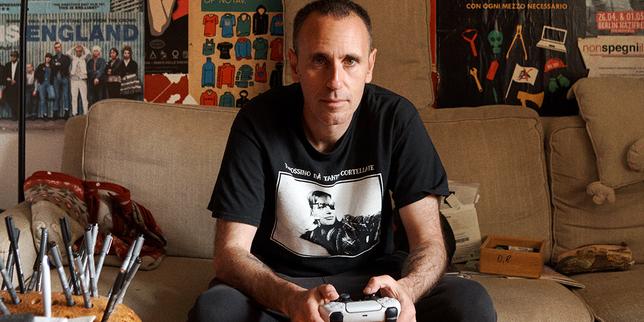
Michele Rech, known globally by his pen name Zerocalcare, has become the defining voice of contemporary Italian counterculture. His graphic novels do not just sell hundreds of thousands of copies; they serve as cultural mirrors for a generation stranded between political disillusionment and economic stagnation. When Zerocalcare openly critiques the modern left for merely attempting to manage the misery of the present rather than offering a transformative vision, he diagnoses a systemic failure that stretches far beyond the borders of Italy. The core of his appeal lies in this raw honesty, translating a deep-seated institutional paralysis into narrative art that resonates with millions of displaced citizens across Europe.
The Reblooming of Political Graphic Novels
For decades, the comic book medium in Europe was largely pigeonholed into two categories: escapist fantasy or niche intellectualism. Zerocalcare shattered this division by anchoring his narratives in Rebibbia, a working-class neighborhood in Rome. His work does not treat the periphery as an exotic backdrop for social suffering. Instead, it serves as the emotional and philosophical epicenter of his worldview.
The traditional political press often struggles to capture the slow, grinding erosion of working-class security. Investigative journalism can present the statistics on youth unemployment or precarious labor contracts, but it frequently misses the psychological toll of those numbers. This is where the graphic novel format succeeds. By blending pop culture nostalgia—manifested through his anthropomorphic conscience, the Armadillo—with gritty street-level reality, Rech visualizes the internal friction of modern survival.
The success of Tear Along the Dotted Line and This World Can't Tear Me Down on Netflix proved that this hyper-local Roman experience possesses a universal currency. Audiences from Paris to Berlin recognized the same anxieties: the pressure to succeed in an economy that offers no stable ground, the alienation of shifting neighborhoods, and the total vacuum left by traditional political parties.
The Management of Present Misery
The most scathing element of Zerocalcare’s commentary targets the very political faction he is historically aligned with: the anti-fascist, progressive left. His critique hits a nerve because it highlights a fundamental shift in how political organizations operate.
Historically, the European left proposed structural transformations of society, advocating for wealth redistribution, robust public infrastructure, and labor rights that challenged capital dominance. Today, institutional progressive parties largely operate as technocratic managers. Their campaigns focus on harm reduction rather than structural change. They position themselves as the stable alternative to right-wing populism, promising only that under their watch, things will decline at a slower, more humane pace.
This defensive posture creates an ideological vacuum. When progressives abandon the language of class struggle and material security, they cede that ground to nationalist movements. Right-wing populists successfully exploit the resulting anger, directing it toward minority groups and immigrants, while the institutional left remains stuck defending a status quo that the working class finds increasingly unlivable.
The Illusion of Social Mobility
A recurring motif in Rech’s bibliography is the failure of the promise of education and meritocracy. The generation born in the 1980s and 1990s was told that academic achievement and flexibility would guarantee a stable life. Instead, they encountered an economy defined by gig work, unpaid internships, and skyrocketing housing costs.
Zerocalcare captures the specific shame that accompanies this failure. Because the dominant cultural narrative insists that success is a matter of individual effort, those who struggle to pay rent or secure a permanent contract blame themselves. His characters embody this collective neurosis, constantly overanalyzing their choices, paralyzed by the gap between expectation and reality.
The Tension Between Activism and Mass Media
As an artist rooted in the autonomous social centers of Rome, Rech faces a constant paradox. He is an anti-capitalist creator operating within a highly commercialized media ecosystem. This tension is not unique to him; it is the central dilemma of any radical voice that achieves mainstream visibility.
When a major streaming platform finances and distributes an animated series criticizing systemic inequality, the critique itself risks becoming a commodified product. The radical edge can be blunted, transformed into an aesthetic that viewers consume from the comfort of their couches without ever engaging in actual political action.
+------------------------------------------------------------------------+
|                      THE CREATIVE DILEMMA                              |
|                                                                        |
|  [Grassroots Activism]  ---->  [Mainstream Success]                    |
|  - Local social centers        - Global Netflix distribution           |
|  - Uncompromising politics     - Mass market commercialization         |
|                                                                        |
|  Result: The risk of transforming systemic critique into a commodity.  |
+------------------------------------------------------------------------+
Rech addresses this contradiction openly within his work. He does not pretend to have an easy answer. He frequently depicts his own anxieties about selling out, using self-deprecation to disarm critics and maintain his connection to his roots. This transparency protects his credibility. By acknowledging that he is part of the system he critiques, he avoids the trap of moral superiority.
The Failure of Institutional Representation
The disillusionment voiced by Zerocalcare reflects a broader European trend where traditional political labels have lost their meaning for the younger electorate. The distinction between center-left and center-right has blurred into a unified economic consensus that prioritizes fiscal austerity and market deregulation.
Consequently, political engagement has shifted away from ballot boxes and toward localized, issue-specific activism. Mutual aid networks, environmental defense groups, and local housing occupations have become the real spaces where solidarity is practiced.
These grassroots efforts face severe limitations. They can patch the holes left by a retreating welfare state, but they lack the scale to challenge global economic structures or reverse systemic privatization. They offer a temporary refuge from the misery of the present, but they cannot, on their own, construct a new future.
Beyond Melancholy
There is a distinct melancholy that permeates Italian anti-fascist art, a feeling rooted in historical defeats and deferred promises. From the resistance movements of World War II to the social upheavals of the 1970s, the history of the Italian left is a chronicle of intense mobilization followed by severe state repression or institutional co-optation.
Zerocalcare inherits this historical weight. His stories are filled with ghosts—both literal and figurative—representing lost friends, failed struggles, and the erosion of community solidarity. Yet, reducing his work to mere pessimism misses the point.
The act of drawing these struggles is itself a form of resistance. By documenting the specific failures of the present, he preserves the memory of alternative possibilities. The ultimate value of his work does not lie in offering a polished political program, but in its refusal to accept the current degradation of social life as normal or inevitable. The first step toward building something new is having the courage to admit that what currently exists is broken.