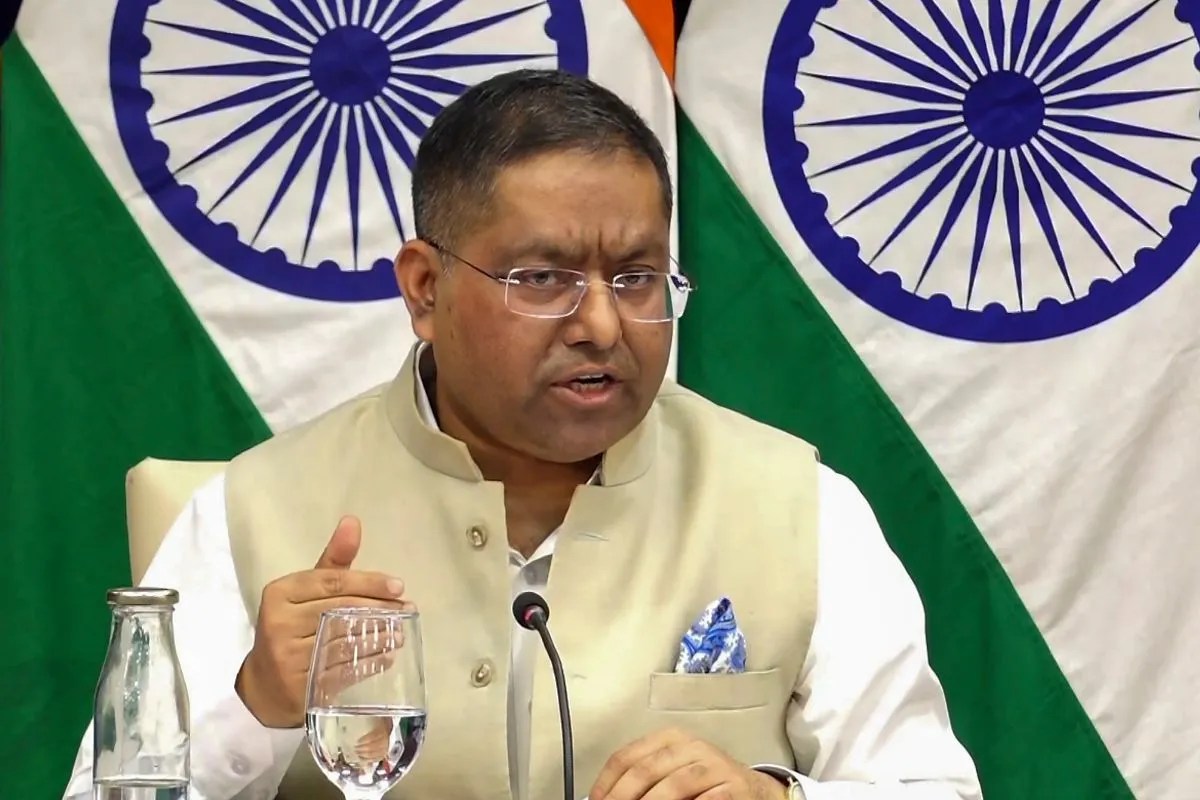
The recent surge in regional hostilities that left three Indian citizens injured in the United Arab Emirates marks a dangerous shift in the security of the Persian Gulf. For years, the Indian workforce has been the backbone of the Emirati infrastructure, operating under a silent assumption of safety. That assumption has evaporated. India's Ministry of External Affairs has issued a stern demand for the cessation of attacks on innocent civilians, but the diplomatic reality is far more complex than a standard press release. This is not merely a localized skirmish between rebels and a sovereign state. It is a high-stakes proxy battle where Indian lives have become collateral damage in a fight for regional dominance involving Tehran, Riyadh, and Abu Dhabi.
New Delhi finds itself in a tightening vice. While the official rhetoric emphasizes the protection of the diaspora, the underlying geopolitical friction centers on how India can maintain its "Think West" policy without being pulled into a kinetic conflict. The injured Indians were workers at a fuel depot, a reminder that the targets in this shadow war are not just military installations but the very economic arteries that sustain the region. Meanwhile, you can find other events here: The Long Walk into the Ghost Army.
The Mirage of Gulf Security
For decades, the UAE marketed itself as a safe harbor in a volatile neighborhood. It was the place where global capital and labor could coexist without the direct threat of the wars raging in Iraq, Syria, or Yemen. That facade broke when long-range drones and missiles began penetrating Emirati airspace. The technology used in these strikes—widely attributed to Iranian manufacturing provided to Houthi militias—has reached a level of sophistication that traditional air defense systems struggle to intercept with total certainty.
The vulnerability of the Indian workforce is a direct consequence of where they are stationed. Indian nationals populate the logistics, energy, and transport sectors of the UAE. These are exactly the sectors being targeted to inflict maximum economic pain on the Emirates. When a fuel tanker or a storage facility is hit, it isn't the decision-makers in the high-rises who bleed; it is the laborers on the ground. To see the bigger picture, we recommend the detailed article by The New York Times.
Tehran’s Shadow and the Houthi Proxy
The Houthis in Yemen have claimed responsibility for the strikes, framing them as retaliation for Emirati involvement in the Yemeni civil war. However, the intelligence community views these claims through a wider lens. The precision and range of the hardware used suggest a level of state-sponsored expertise that points directly back to Iran.
India’s relationship with Iran is a delicate balancing act involving the Chabahar Port project and energy security. Yet, when Iranian-backed proxies injure Indian citizens, the diplomatic tightrope becomes frayed. India has tried to remain "neutral-plus," maintaining ties with all sides, but neutrality is an expensive luxury when your citizens are in the line of fire. The UAE has spent billions on the "Iron Dome" style defenses and US-made Patriot systems, but as the recent injuries prove, no shield is impenetrable against a swarm of low-cost, high-tech drones.
The Economic Heartbeat at Risk
There are over 3.5 million Indians living and working in the UAE. They remit billions of dollars back to the Indian economy annually. This is not just a human rights issue; it is a macroeconomic pillar for India. If the security situation continues to deteriorate, we could see a mass exodus of skilled and unskilled labor.
- Remittance Volatility: A sustained conflict could lead to a sharp drop in the $20 billion-plus that flows from the UAE to India.
- Energy Disruptions: Attacks on ADNOC facilities directly impact the global supply chain, driving up energy costs for an India that is already sensitive to fuel price hikes.
- Insurance Premiums: The cost of shipping and doing business in the Gulf is skyrocketing as "war risk" surcharges are applied to vessels and projects.
India's Diplomatic Deadlock
India's response—calling for an end to attacks on "innocents"—is a calibrated attempt to show strength without naming Iran directly. It is a classic move from the New Delhi playbook. By focusing on the humanitarian aspect, India avoids taking a hard side in the Saudi-Iran rivalry. But this "strategic autonomy" is being tested by the sheer frequency of these provocations.
The UAE expects more than just words from its strategic partners. Abu Dhabi has been a vocal supporter of India on various international platforms, including the Kashmir issue. In return, they expect New Delhi to use its considerable leverage in Tehran to act as a back-channel mediator. The problem is that Iran’s Revolutionary Guard (IRGC) often operates on a different wavelength than their foreign ministry, making diplomatic assurances from Tehran feel hollow on the ground in Abu Dhabi.
The Drone Proliferation Problem
The hardware being used in these attacks represents a shift in the nature of modern warfare. We are no longer talking about crude rockets. The loitering munitions used in the Gulf are capable of GPS-guided precision. They are small, have low radar cross-sections, and are incredibly cheap to produce compared to the multimillion-dollar missiles used to shoot them down. This asymmetry is what makes the current situation so perilous for civilian workers. You cannot protect every inch of a fuel farm from a drone the size of a suitcase.
Beyond the Official Statements
What the Ministry of External Affairs won't say publicly is that there is a deep sense of frustration regarding the intelligence failures that allow these attacks to succeed. India relies on Gulf intelligence agencies to keep its citizens safe. When those agencies are caught off guard, it forces India to reconsider its own role in regional maritime security.
We are seeing a slow but steady increase in the Indian Navy’s presence in the North Arabian Sea and the Gulf of Oman. Operation Sankalp is a testament to this, but even a carrier battle group cannot stop a drone launched from a hidden site in the Yemeni desert. The solution is political, not just military, yet the political will to end the Yemen conflict remains stagnant while the regional powers use the country as a laboratory for proxy warfare.
The Intelligence Gap
One of the most overlooked factors in the injury of these three Indians is the lack of a real-time warning system for civilian work sites. While military bases go into lockdown during an incoming threat, civilian infrastructure often continues to operate until the impact occurs. There is a desperate need for a synchronized alert system that spans across the GCC (Gulf Cooperation Council) and includes the diplomatic missions of labor-exporting nations.
If India wants to protect its people, it must move beyond issuing statements of "deep concern." It needs to demand that Indian-manned facilities in the UAE be equipped with better localized defense or at the very least, sophisticated early-warning protocols. The current "wait and see" approach is a gamble with human lives.
The Cost of Silence
The international community’s response has been fragmented. While the West condemns the Houthis, they are also wary of escalating tensions with Iran during sensitive nuclear negotiations. This leaves the UAE—and by extension, its massive foreign workforce—in a "gray zone" of security.
India’s reluctance to call out the source of the weaponry is seen by some as a sign of weakness, and by others as a sign of sophisticated diplomacy. Regardless of the interpretation, the results are the same: Indian blood has been spilled on Emirati soil. If this happens again, the pressure on the Modi government to take a more assertive stance will be overwhelming. The diaspora is a powerful voting bloc, and their safety is a non-negotiable metric of the government’s success abroad.
The New Reality for the Diaspora
The era of the Gulf being a "safe" gold mine for Indian workers is over. The region is now a frontline. Workers moving to the UAE must now weigh the economic benefits against the physical risks of being caught in a drone strike. This psychological shift could have long-term implications for India’s labor migration patterns.
Security is no longer a given; it is a variable that changes with every news cycle. The three injured citizens are a warning shot. They represent the vulnerability of a nation that has outsourced its economic future to a region that is increasingly unable to guarantee the safety of its own skies.
The Indian government must now decide if its "strategic autonomy" is worth the risk of being a silent witness to the targeting of its own people. Diplomacy that doesn't result in deterrence is simply documentation of a disaster. The path forward requires more than just calling for peace; it requires making the cost of harming Indians too high for any proxy or state actor to ignore.
New Delhi needs to leverage its growing role as a global power to demand a security architecture in the Gulf that prioritizes the safety of the millions who actually keep the lights on and the fuel flowing. Without that, the "Think West" policy is just a house of cards waiting for the next drone to fly through the window.