Geologists tracking Earth's deep history have pinpointed the Yarrabubba impact structure in Western Australia as the world's oldest known meteorite strike, dating back exactly 2.229 billion years. This precise dating solves a long-standing chronological mystery and forces a radical rewrite of how our planet exited its earliest global ice age. By analyzing microscopic shock-melted crystals, researchers proved the massive space rock slammed directly into a miles-thick continental ice sheet, vaporizing enough frozen water to violently alter the global climate.
The discovery shifts our understanding of planetary evolution. For decades, the scientific consensus attributed the end of the Huronian glaciation—a massive "Snowball Earth" phase—to gradual volcanic carbon dioxide buildup. The Yarrabubba data shatters that slow-motion model. It introduces a sudden, catastrophic trigger capable of instantly altering atmospheric chemistry.
Deep Time and Dead Craters
Finding an ancient impact zone is a nightmare of erosion. On an active planet like Earth, plate tectonics, wind, and water relentlessly erase the surface. While the moon remains scarred by billions of years of asteroid collisions, Earth hides its wounds. The famous Chicxulub crater in Mexico, which marked the end of the dinosaurs 66 million years ago, is buried deep under younger sediment. The Vredefort dome in South Africa, previously held as the oldest confirmed impact at just over 2 billion years, has been worn down to a subtle ring of hills.
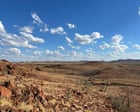
Yarrabubba is practically invisible. Located in the remote, arid outback of Western Australia northeast of Meekatharra, the original 70-kilometer-wide crater rim has vanished entirely. To the untrained eye, the site looks like any other flat, red stretch of the Australian shield.
Geologists rely on deep crustal remnants. When an asteroid several kilometers wide hits the crust at supersonic speeds, the energy release cannot be mimicked by earthly forces. The pressure converts rocks into unique mineral phases and creates shatter cones, which are distinct, fan-shaped rock fractures that point toward the blast center.
The ultimate proof lies at the atomic level. Researchers from Curtin University and the University of Glasgow targeted specific minerals within the granitic rocks at Yarrabubba. They extracted sub-millimeter crystals of zircon and monazite. These minerals are nearly indestructible time capsules. During a high-velocity impact, the intense shock pressure and immense heat partially melt the outer layers of these crystals, resetting their internal radioactive clocks.
Secrets in the Shocked Crystals
The methodology behind dating the oldest meteorite strike requires extreme laboratory precision. Scientists use a massive instrument called a Sensitive High-Resolution Ion Microprobe, or SHRIMP. By firing a focused beam of primary ions at the microscopic grains of shocked zircon, the machine sputters secondary ions from the crystal surface. This allows researchers to measure the exact ratio of uranium to lead isotopes.
Radioactive uranium decays into lead at a fixed, immutable rate over billions of years. When the Yarrabubba asteroid struck, the localized thermal flash expelled existing lead from the outer rims of the zircon grains while leaving the core intact. By analyzing only these recrystallized outer edges, the team locked down the age to 2.229 billion years, with a tiny margin of error of just plus or minus five million years.
This date matters because it aligns perfectly with a sudden shift in the global rock record. Before this discovery, the end of the Huronian glaciation was a fuzzy line in geological strata. The Yarrabubba date places the impact precisely at the moment the ice sheets began their rapid retreat, transforming a regional curiosity into a global climate suspect.
The Steaming of Snowball Earth
The traditional explanation for ending a global ice age relies on planetary suffocation. When ice covers the oceans and continents, it reflects solar radiation back into space, creating a freezing loop known as the albedo effect. To break out, volcanoes must pump carbon dioxide into the atmosphere for millions of years until the greenhouse effect overrides the ice reflectivity.
Yarrabubba offered a faster bypass. Numerical models run by the research team simulated what happens when a 7-kilometer-wide rock plows into an ice sheet running several kilometers deep. The result is a thermodynamic nightmare. The kinetic energy instantly transitions from mechanical force to raw heat, vaporizing hundreds of billions of tons of glacial ice in seconds.
- Immediate Vaporization: The impact blasts half a trillion tons of water vapor straight into the upper atmosphere.
- The Ultimate Greenhouse Gas: While carbon dioxide gets all the modern attention, water vapor is actually the most potent greenhouse gas on Earth.
- Atmospheric Trap: Trapped in the stratosphere, this massive moisture blanket absorbs infrared radiation, spiking global temperatures within weeks.
This mechanism bypasses the millions of years required for volcanic outgassing. The sudden influx of atmospheric water vapor would have triggered rapid, destabilizing warming across the planet, kicking off a cascade that melted the global glaciers from the top down.
Gaps in the Modern Impact Record
While the Yarrabubba data presents a compelling timeline, the geological community remains cautious about drawing a straight line from a single asteroid to global climate collapse. The primary issue is the lack of preserved sedimentary rock layers from that specific era. To absolutely prove the impact caused the thaw, scientists need to find ejecta layers—the fallout dust from the blast—preserved in ancient marine sediments elsewhere on the globe.
Finding those layers is difficult. Much of the crust from 2.2 billion years ago has been swallowed by subduction zones or cooked by metamorphic heat deep inside mountain ranges. Some critics point out that the Huronian glaciation was already showing signs of weakening in certain regional rock formations before the Yarrabubba date. They argue the impact might have been a final blow rather than the sole cause.
The debate highlights how little we know about Earth's early history. We are viewing a billion-year narrative through a few cracked windows in Western Australia, South Africa, and Canada.
The Search for Hidden Craters
The validation of Yarrabubba proves that ancient impact signatures can survive billions of years of tectonic recycling if they occur within stable continental cores called cratons. Geologists are now applying these high-resolution zircon dating techniques to other poorly understood magnetic and gravitational anomalies across Africa, Scandinavia, and Canada.
There are likely older craters waiting to be found. Statistically, early Earth was bombarded far more heavily than it is today, as the remnants of the early solar system were still being cleared out. The only reason Yarrabubba holds the record is that we haven't yet pulled the right crystal from an even older piece of buried stone.
The hunt requires moving away from traditional satellite mapping, which looks for circular surface depressions, and moving toward deep geophysical imaging and mineralogical sampling. If a strike happened 3 billion years ago, the surface expression is completely gone. Only the isotopic scars inside deep-seated minerals can tell the story.
The Yarrabubba discovery reveals that our planet's climate transitions are not always slow, predictable cycles driven by orbital mechanics or gradual volcanic emissions. Sometimes, a single rock, arriving at the right velocity and striking the right frozen surface, can instantly alter the trajectory of global history.