He Xiaopeng has staked a literal body of work on a single calendar date. By August 30, 2026, the CEO of Xpeng claims his Vision Language Action (VLA) system will match or exceed the performance of Tesla’s Full Self-Driving (FSD) v14.2 on Chinese soil. If he fails, his head of autonomous driving, Liu Xianming, has pledged to run naked across the Golden Gate Bridge. It is a high-stakes wager that sounds like Silicon Valley bravado, but beneath the theatrics lies a cold, technical calculation. Xpeng isn't just trying to beat Tesla; it is attempting to solve a "generalization problem" that has historically paralyzed autonomous systems moving from the sanitized suburbs of California to the chaotic arteries of Guangzhou.
The primary hurdle is not just lines of code. It is the raw density of "edge cases" found in Chinese urban environments. Tesla’s FSD was birthed in the sprawling, predictable grids of North America. When it encounters the 300 million electric scooters that weave through Chinese traffic—often against the flow or across pedestrian crossings—it faces a sensory overload that western-trained models struggle to parse. Xpeng’s VLA 2.0 architecture is built on the premise that you cannot simply "hard-code" rules for this level of entropy.
The Shift to Physical AI
Xpeng’s strategy has pivoted away from the battery-war and into what He calls "Physical AI." This isn't marketing fluff. It represents a fundamental move toward end-to-end neural networks, where the vehicle’s cameras feed directly into a model that outputs steering and braking commands, bypassing the traditional "perception-prediction-planning" pipeline.
While Tesla pioneered this with FSD v12, Xpeng is betting that its local data advantage is the ultimate moat. On a standard 20-kilometer urban loop in China, internal data shows Tesla FSD v13.2.9 requiring roughly five manual takeovers. Xpeng’s current VLA system, in its penultimate form, has reportedly cut that down to one. The math is simple but the execution is brutal. For Xpeng to claim the crown in August, it must prove that its system can handle the "unspoken rules" of Chinese driving—the subtle nods, the aggressive lane-merging, and the total disregard for lane markings—with the same "reassuring" smoothness that Tesla exhibits on the 101 Freeway.
Hardware Parity and the LiDAR Divorce
One of the most controversial moves in this race was Xpeng’s decision to follow Tesla’s lead in abandoning LiDAR for its newest flagship, the P7+. For years, Chinese EV makers used LiDAR as a crutch, a high-cost sensor to compensate for weak software. Dropping it signals a massive confidence in vision-based AI. It also levels the financial playing field.
By removing expensive laser sensors, Xpeng has managed to push its high-end autonomous suite into the Mona M03, a vehicle priced around $20,000. This is the real threat to Tesla. Elon Musk has long promised a cheap Robotaxi-capable vehicle, but Xpeng is shipping the hardware today. Tesla’s FSD remains a premium add-on, often costing more than half the price of an entry-level Xpeng vehicle in China.
The Problem of Regulatory Limbo
There is a glaring irony in this August deadline. Tesla’s FSD is still effectively in a holding pattern regarding full regulatory approval for wide-scale Chinese deployment. While Musk has made multiple high-profile visits to Beijing to secure data-transfer deals and mapping permissions, the system is not yet a "product" in the same way Xpeng’s XNGP is.
This gives Xpeng a "home-field" window. They are collecting millions of kilometers of real-world Chinese data every week, while Tesla is limited to smaller test fleets and older "Enhanced Autopilot" versions. Xpeng knows that once Tesla is fully unleashed in China, the pace of its "shadow mode" learning will be explosive. The August goal is a defensive sprint to build a brand lead before the American giant actually enters the ring.
The Robotaxi Convergence
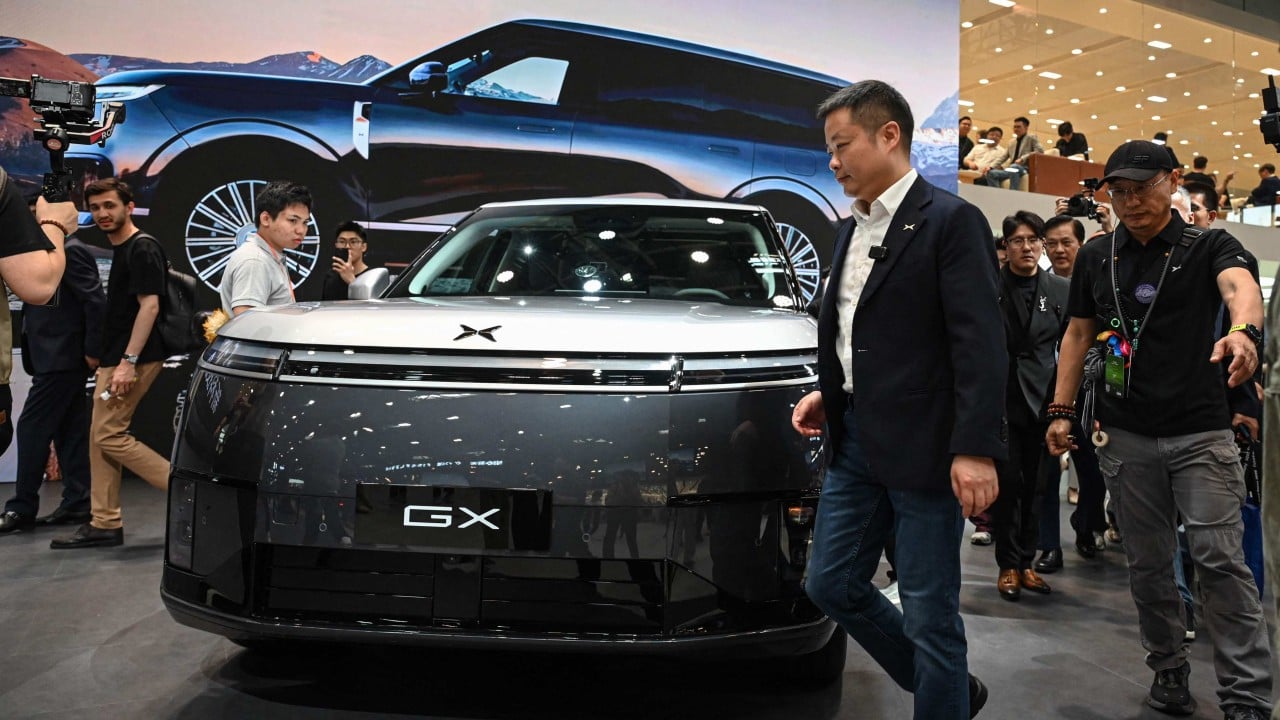
The stakes of the August wager extend into the future of public transit. He Xiaopeng noted after a five-hour test drive in San Francisco that the software running Tesla's private cars and its dedicated Robotaxis is virtually identical. Xpeng has adopted this "single-stack" philosophy. Its GX model, a factory-integrated Robotaxi, is designed to run the same VLA 2.0 software that a customer buys in a P7+ sedan.
This convergence means that every private Xpeng on the road serves as a training drone for a future ride-hailing fleet. The technical gap between "Advanced Driver Assistance" and "Level 4 Autonomy" is narrowing into a question of reliability—not capability. If Xpeng can achieve the "zero-intervention" drive across a city like Shenzhen by late summer, the distinction between a car you own and a car you summon becomes purely academic.
Why the Wager Matters
Critics argue that comparing FSD in Silicon Valley to VLA in China is comparing apples to durian. The traffic laws, pedestrian behavior, and even the reflectivity of road paint differ. But for the Chinese consumer, the nuance doesn't matter. They want to know if their car can handle the commute from the tech hubs of Hangzhou to the residential blocks of Pudong without the steering wheel jerking in fear.
The "naked run" bet is a calculated risk to prove that Xpeng's AI has finally outgrown its "follower" status. For a decade, Chinese firms have benchmarked Tesla. By setting an August 30 deadline, Xpeng is signaling that it no longer needs a benchmark. It is trying to become the standard.
Failure would be a PR disaster, but the technical momentum is undeniable. Morgan Stanley analysts who recently sampled the system described being "surprised" by the pace of improvement. The gap isn't just closing; it's evaporating. Whether or not anyone ends up running across a bridge in San Francisco, the shift in the global AI power balance is already visible on the streets of Guangzhou.
Success for Xpeng in August would mean that for the first time, a Chinese software stack has reached parity with the world's most advanced AI driving platform. It would validate the "AI-defined vehicle" as a reality rather than a slogan. More importantly, it would force Tesla to fight for its life in the one market it cannot afford to lose. The race to August is not about a bet. It is about who owns the brain of the modern car.