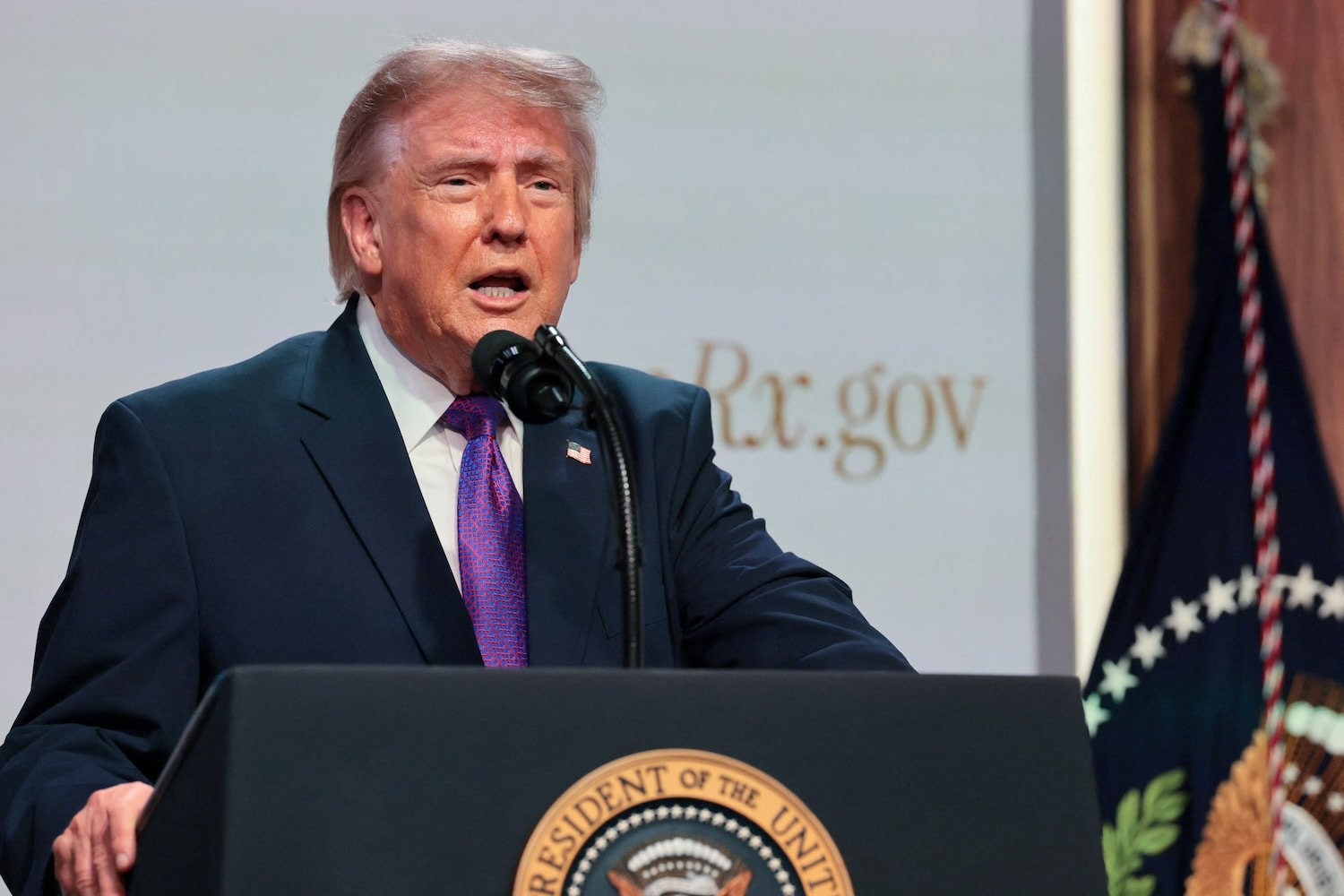
President Donald Trump is assembling his entire Cabinet at the secluded Camp David retreat on Wednesday. The official agenda leans heavily on a victory lap regarding small business wins, the Task Force to Eliminate Fraud, and routine economic briefings. But the real driver behind this rare mountain gathering is a high-stakes, highly volatile poker game with Iran. Negotiations to end the conflict are teetering between a landmark diplomatic breakthrough and a catastrophic military escalation, forcing the administration to coordinate its next moves in absolute secrecy.
The White House is projecting confidence, with Trump asserting that a comprehensive peace agreement is close. Yet the facts on the ground tell a different, far more dangerous story. Hours before the Cabinet was scheduled to depart, U.S. Central Command ordered "self-defense strikes" against Iranian missile launch sites and mine-laying fast boats near the strategic Strait of Hormuz. This sudden kinetic friction exposes the massive gulf between Washington’s public optimism and the brutal reality of a fraying ceasefire. Camp David is not being used for a routine policy review. It is a war cabinet environment being deployed because the administration’s strategy of maximum pressure mixed with rapid diplomacy has reached its absolute limit.
The Secret Leverage Game Over Frozen Billions
The administration wants the public to focus on the reopening of the Strait of Hormuz and a broad regional de-escalation framework. Behind closed doors, the immediate friction centers on a massive financial and nuclear standoff.
Tehran is demanding the immediate release of half its frozen global assets, roughly $12 billion of a total $24 billion, simply to sign a initial memorandum of understanding. The remainder would have to be transferred within 60 days. Iranian President Masoud Pezeshkian has used regional intermediaries in Qatar to signal that Iran is ready for a framework, but only if it secures this massive cash infusion up front.
Trump has introduced an aggressive counter-demand that introduces a high probability of structural gridlock. He explicitly stated that Iran’s enriched uranium stockpile must either be turned over to the United States for destruction or destroyed in place under international supervision.
"The Enriched Uranium (Nuclear Dust!) will either be immediately turned over to the United States to be brought home and destroyed or, preferably, in conjunction and coordination with the Islamic Republic of Iran, destroyed in place," Trump declared on social media.
This demand strips Tehran of its primary geopolitical leverage before the full implementation of financial relief. For the Iranian regime, giving up the uranium stockpile up front in exchange for half-frozen funds is an asymmetrical loss. For the Trump administration, releasing billions of dollars to an adversary while its proxy networks remain active across the Middle East is a non-starter. This is the structural flaw that the Camp David summit must address.
The Operational Meaning of Camp David
To understand how serious this moment is, one has to look at how infrequently this president utilizes the Maryland mountain retreat. Trump notoriously prefers the golf courses and familiar terrain of Mar-a-Lago or Bedminster. This trip marks only the second time he has convened his Cabinet at Camp David during his second term.
The historical precedent is ominous. The first time Trump brought his national security team to the retreat in this term was June 2025. Days later, the United States launched massive military strikes against Iran's nuclear infrastructure. The venue is chosen deliberately when a decision-making process requires complete isolation from the relentless leaks of downtown Washington, and when the military options on the table are live.
The presence of outgoing Director of National Intelligence Tulsi Gabbard adds another layer of internal friction to the summit. Gabbard is scheduled to leave her post on June 30, following intense internal staff fighting and reports that White House aides are actively forcing her out. Having a lame-duck intelligence chief present during the final, critical stage of a nuclear and maritime negotiation signals deep division within the security apparatus. The Cabinet is not just managing a foreign adversary; it is managing a fractured internal intelligence structure at the exact moment absolute consensus is required.
The Maritime Chokepoint and the Broken Truce
While diplomats argue over financial tranches in Doha, the actual threat of war remains concentrated in a narrow strip of water. The Strait of Hormuz is the economic artery of global energy transport, and the current framework hinges entirely on keeping it open.
The financial markets temporarily responded to the diplomatic chatter, with oil prices tumbling on the hope of a breakthrough. That optimism is detached from operational realities. The recent CENTCOM strikes targeted Iranian assets that were actively attempting to deploy maritime mines. Iran’s Islamic Revolutionary Guard Corps also claimed to have downed an American MQ-9 Reaper drone over the Persian Gulf after precise intelligence monitoring.
This is not a stable ceasefire. It is a highly reactive frontline where both sides are using kinetic actions to establish leverage at the negotiating table. The administration’s current posture relies on a dual-track strategy.
- Track One: Publicly project a willingness to sign a comprehensive deal to satisfy an American electorate highly fatigued by inflation and foreign entanglements.
- Track Two: Authorize immediate, aggressive military strikes to show Tehran that the U.S. will not tolerate creeping non-compliance during the text drafting.
The danger of this approach is miscalculation. If an American strike kills high-ranking Iranian personnel, or if an Iranian mine successfully damages a commercial vessel, the Doha talks will dissolve instantly. Iran has already warned Washington through regional channels that any escalation by regional allies, such as an Israeli strike on Beirut, will collapse the diplomatic track entirely.
The Domestically Driven Timeline
The urgency behind this sudden summit is heavily dictated by the domestic political calendar. The affordability crisis continues to squeeze American voters, creating severe headwinds for the Republican party as it attempts to maintain control of the House and the Senate in the upcoming midterm elections.
A definitive foreign policy victory, such as a signed peace deal that permanently stabilizes energy markets and prevents a broader regional war, is the ultimate political shield. Trump needs to prove that his transactional approach to foreign policy can deliver tangible economic relief.
The President is nearing his 80th birthday next month and has faced intense scrutiny regarding his health and public appearances. The White House intentionally publicized his recent annual physical examination at Walter Reed National Military Medical Center, declaring that everything checked out perfectly. Bringing the entire Cabinet to a rugged mountain retreat is a calculated display of administrative vigor and executive control, designed to silence doubts about leadership capability at a moment of international peril.
The administration cannot afford a prolonged, open-ended diplomatic process. If a memorandum of understanding is not achieved swiftly, the window for a peaceful resolution closes as the midterms approach and political positions harden. The Cabinet is meeting at Camp David because they have run out of time for standard diplomatic choreography. They must either lock down the terms of a highly transactional deal or prepare the state apparatus for the immediate economic and military fallout of total diplomatic failure.