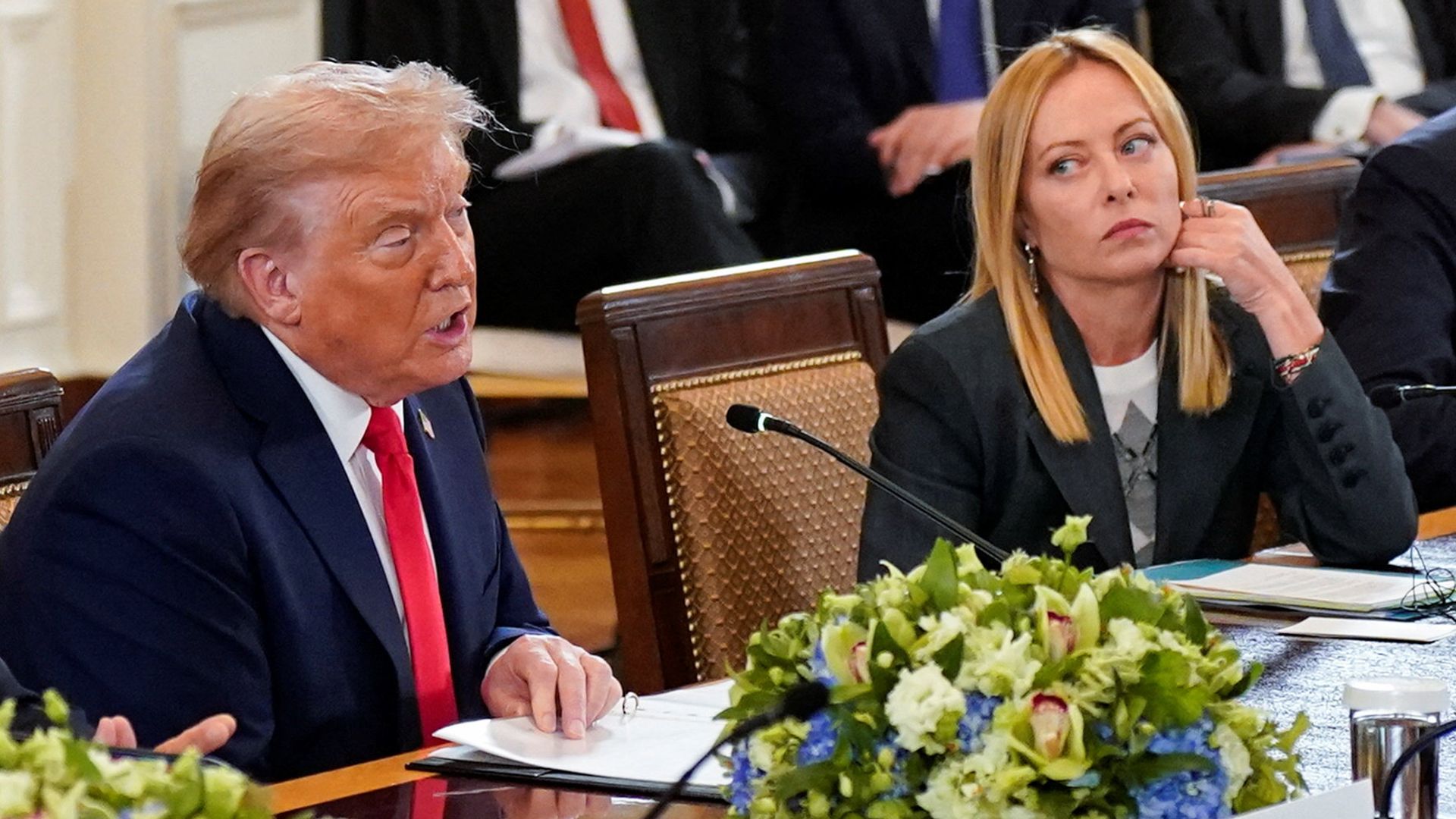
A single social media post can mask a geopolitical crisis, but it rarely contains it. When Donald Trump posted an image on Truth Social depicting Italian Prime Minister Giorgia Meloni looking up at him with the caption "Restraining order needed," the public saw a bizarre online spat. The reality is far more dangerous. This is not a dispute about a photograph or a social media meme. It is the public unraveling of a core Western alliance over sovereign military control and the shifting boundaries of American power in Europe.
The tension broke wide open following the G7 summit in Evian, France, where Trump claimed Meloni repeatedly begged him for a photo opportunity to save her domestic standing. Meloni fiercely hit back, stating that neither she nor Italy ever beg, setting off a chain reaction that saw Italian Foreign Minister Antonio Tajani cancel an official visit to Washington. But the roots of this fight stretch back to March 2026, when Rome quietly denied U.S. forces permission to use Italian military bases for an escalation in the Middle East.
The Airbase Standoff That Sparked the Flame
Washington expected compliance. Rome chose sovereignty. In early spring, the United States sought to utilize its long-standing strategic hubs in Italy to launch and support operational sorties. The target was Iran.
Italy operates under strict bilateral treaties regarding the use of American military infrastructure on its soil, most notably Signonella and Aviano. These agreements require mutual consent for operations that fall outside the traditional scope of collective NATO defense. Meloni refused to give that consent. For an Italian administration staring down an upcoming election cycle, greenlighting an unpopular offensive campaign against Tehran from Italian soil was an absolute non-starter.
This refusal directly disrupted Washington's tactical planning. It exposed a fundamental rift between Trump’s transactional foreign policy and Europe’s increasing reluctance to be dragged into unilateral American conflicts. Trump’s subsequent public claim that Meloni begged for his attention was not a random insult. It was a deliberate, calculated effort to diminish her authority on the international stage as punishment for her non-compliance.
The NATO Defense Spending Illusion
NATO Secretary General Mark Rutte has attempted to play the role of the quiet mediator. In recent weeks, Rutte went on American television to argue that European defense spending directly benefits the American economy by creating domestic manufacturing jobs. He even claimed that Italian facilities had assisted in hundreds of logistics missions to smooth over the disagreement.
The defense data tells a different story.
| Metric | Italy Defense Profile |
|---|---|
| Current Defense Spending | 1.45 percent of GDP |
| NATO Minimum Target | 2.0 percent of GDP |
| Unused EU Security Loans | 14.9 billion Euros |
| Primary Operational Stance | Logistical and Defensive Only |
Italy remains one of Western Europe’s most prominent defense spenders operating below the alliance threshold. Meloni’s government has actively resisted drawing down nearly 15 billion Euros in low-cost European Union loans designated for military expansion. To do so would require increasing the national debt, a move that opposition parties would weaponize instantly in the upcoming national elections.
Defense Minister Guido Crosetto has warned that Italy cannot ignore the worsening international security environment. Yet even Crosetto has been forced to downplay the severity of the American pressure, publicly framing Trump’s rhetoric as a harsh negotiating tactic designed to force allies into line. The strategy is failing because the political cost of compliance in Rome is currently higher than the cost of defiance.
The Collapse of Right Wing Alignment
The breakdown is particularly instructive because Trump and Meloni were widely expected to be natural ideological partners. Both rose to power on populist, anti-establishment platforms. Both emphasized national sovereignty, strict border control, and a rejection of globalist bureaucracies.
Personalities and national interests have collided with that theory. Meloni has spent years building her reputation as a serious, institutional European leader capable of working within multinational frameworks like the European Union and NATO. She cannot afford to look like a subordinate executing orders from Mar-a-Lago if she wishes to maintain her leadership of the European conservative movement.
Trump views international relations through a lens of personal loyalty and absolute dominance. A partner who says no is viewed not as a sovereign ally, but as a defector. By sharing a meme implying the Italian Prime Minister is obsessed with him, Trump attempted to reframe a serious geopolitical policy disagreement into a trivial matter of personal drama, a tactic designed to strip the Italian position of its diplomatic weight.
The Sovereign Backlash in Rome
Meloni’s response shifted the entire nature of the public dispute. Instead of ignoring the provocations, she released a direct video statement addressing the American president, declaring that Italy is a sovereign nation that does not bow to external pressure.
The political calculus behind her defiance is straightforward. Standing up to an overbearing foreign leader plays exceptionally well with the Italian electorate across the entire political spectrum. Even her domestic political opponents have found it difficult to criticize her for defending national dignity against social media insults.
The diplomatic fallout is real and expanding. The cancellation of Tajani’s trip to Washington was a severe step for a core G7 nation, signaling that Italy will not tolerate public humiliation as a standard cost of doing business with the United States. U.S. Ambassador Tilman Fertitta has attempted to issue reassuring statements about the enduring strength of the bilateral relationship, but these corporate platitudes cannot hide the operational gridlock behind closed doors.
The Turkish Summit and the Reality of Friction
As both leaders arrive in Turkey for the critical NATO summit, the personal animosity will face its most direct test. Alliance officials are desperate to project an image of absolute unity to external adversaries. That unity is being actively undermined by the actions of its most powerful member.
The issue of military base access remains completely unresolved. The Italian government has made it clear that as long as Meloni remains prime minister, the bilateral treaties will be enforced strictly according to the letter of the law, meaning no unilateral American strike missions will fly from Italian territory.
The United States faces a European continent that is increasingly wary of American volatility. Allies are no longer willing to automatically rubber-stamp strategic decisions made in Washington, especially when those decisions carry immense regional risks for Europe itself. The public feud is the predictable result of an unstoppable populist style colliding with the immovable reality of national sovereignty.