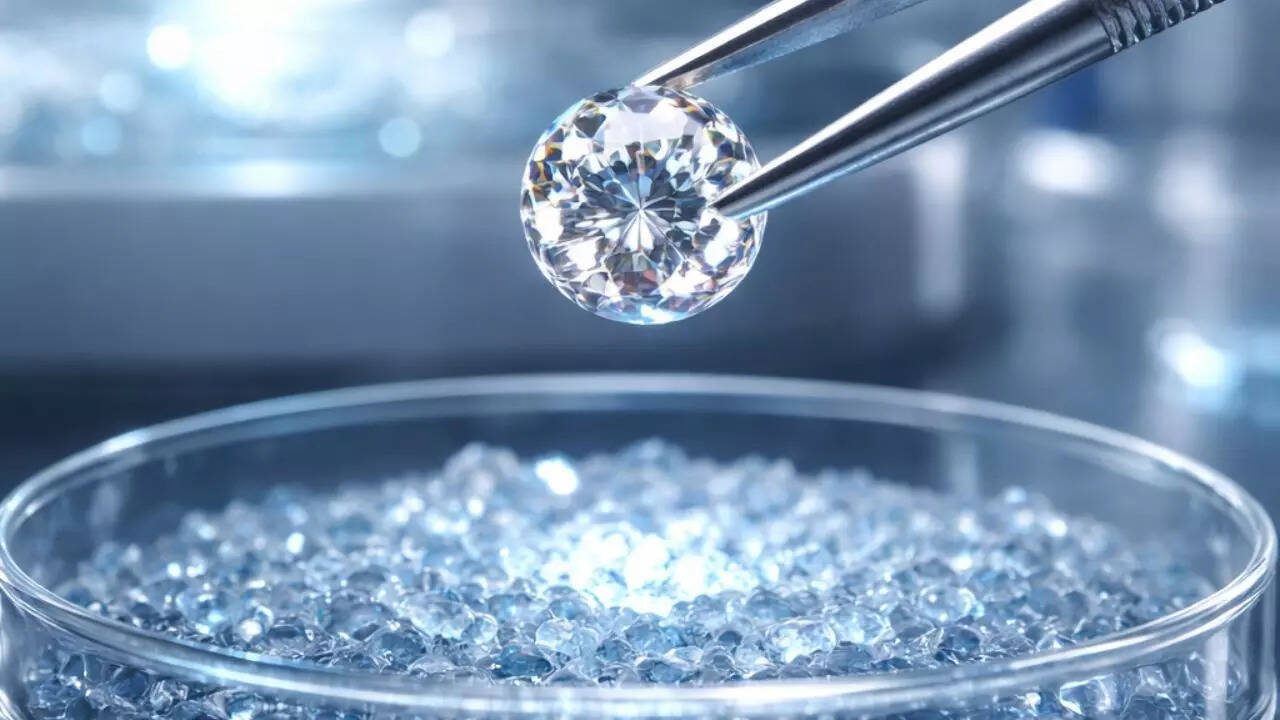
The diamond industry is currently cannibalizing itself. For decades, the narrative of "a diamond is forever" was protected by a supply chain so tightly controlled it bordered on the religious. Today, that altar has been smashed by plasma reactors and chemical vapor deposition. Lab-grown diamonds, once the scientific curiosity of General Electric researchers in the 1950s, have transitioned from high-tech breakthroughs to a race-to-the-bottom commodity.
The primary driver behind the current market saturation is not just scientific achievement, but the massive industrialization of the growth process in China and India. This shift has crashed prices by over 80% in some sectors within a five-year window. While consumers celebrate the ability to buy a two-carat stone for the price of a mid-range television, the underlying business model for lab-grown gems is facing a terminal identity crisis. We are witnessing the final stages of a luxury product being downgraded into a utility.
The Myth of the Century Long Failure
Popular history suggests that we spent a hundred years failing to make diamonds until we suddenly succeeded. This is a misunderstanding of industrial history. Scientists have been able to synthesize diamonds since the mid-20th century, but the goal was never jewelry. It was heat sinks, drill bits, and abrasive powders.
The physics of creating a diamond involves replicating the crushing pressures of the Earth's mantle—roughly 5 gigapascals—and temperatures exceeding 1,300 degrees Celsius. In the High Pressure High Temperature (HPHT) method, a tiny diamond seed is placed in carbon and subjected to these violent forces. The result is a stone that is chemically, physically, and optically identical to a mined diamond.
The industry did not "fail" for a century. Instead, it waited for the energy costs and the precision of Chemical Vapor Deposition (CVD) to reach a point where growing a gem-quality stone was cheaper than digging one out of a hole in Botswana. CVD is the real disruptor here. It allows carbon atoms to rain down onto a substrate like snow, building the crystal lattice layer by layer in a vacuum chamber. It is a cleaner, more scalable process that removed the need for the massive, house-sized hydraulic presses required by the HPHT method.
The Economic Suicide of Transparent Pricing
In the traditional mined diamond world, value is derived from perceived scarcity. De Beers and other giants controlled the "sightholder" system, ensuring that only a specific amount of rough stone hit the market at any given time. They created a floor for the price.
Lab-grown manufacturers did the opposite. They applied the logic of Silicon Valley to a product that depends on the logic of Mayfair. By treating diamonds like semiconductors, they ensured that the price would follow Moore's Law. As efficiency increased, the price plummeted.
This has created a bizarre paradox in the jewelry store. A jeweler now has to explain to a customer why a mined diamond costs $10,000 while the identical-looking lab version costs $1,500. When the customer asks if the lab diamond will hold its value, the honest answer is no. It has no resale value because the cost of producing the next one will be even lower. We have effectively turned a "store of value" into a "disposable luxury."
The Environmental Narrative is Overstretched
The marketing machine for lab-grown diamonds relies heavily on the "ethical" and "green" labels. It is a powerful pitch to Gen Z and Millennial buyers who are wary of the blood diamond legacy and the environmental scarification of open-pit mining.
However, the reality is more complex. Growing a diamond is a massive energy hog. To keep a plasma reactor running for weeks at a time requires a constant, unwavering draw on the electrical grid. In regions like Henan, China—a global hub for diamond synthesis—that electricity is often generated by coal.
- Carbon Footprint: While lab diamonds avoid the terrestrial destruction of mining, their carbon footprint is entirely dependent on the local energy grid. A lab diamond grown in a hydro-powered facility in Washington state is vastly different from one grown in a coal-heavy industrial park in Asia.
- The Human Cost: The "conflict-free" label is accurate in terms of war zones, but it ignores the economic displacement of millions of workers in developing nations who rely on the artisanal and large-scale mining sectors for their livelihoods.
The industry likes to present a binary choice: the "dirty" mine or the "clean" lab. In truth, both have significant footprints, and the lab-grown sector has been remarkably opaque about its actual kilowatt-hour consumption per carat.
The Tech Industry is the Real Winner
While the jewelry world frets over price charts, the true potential of this technology lies in power electronics and quantum computing. Diamond is the ultimate semiconductor. It has a higher thermal conductivity than any other known material and a wide bandgap that allows it to operate at much higher voltages and temperatures than silicon.
The "centuries of failure" led us to a point where we can now produce wafer-scale diamond plates. This is the foundation for the next generation of deep-space communications and high-speed rail power grids. The irony is that the jewelry market—the very thing that funded the recent scaling of this technology—is becoming the least interesting part of the diamond story.
The companies that survive this current price collapse won't be the ones selling engagement rings. They will be the ones selling diamond-based processors and thermal management systems for AI data centers. The gem-quality stone is merely a byproduct of a much more lucrative industrial race.
Why the Luxury Market is Moving the Goalposts
Predictably, the high-end luxury houses are retreating. Brands like Cartier and Tiffany & Co. have largely doubled down on mined diamonds, framing them as "miracles of nature" that took billions of years to form. They are pivoting away from the physical properties of the stone and toward the "romance of time."
This is a defensive maneuver. If you can't compete on the "what" (the chemical composition), you must compete on the "how" (the origin story). This creates a bifurcated market:
- The Commodity Market: Lab-grown stones used for fashion jewelry, travel rings, and budget-conscious weddings.
- The Heritage Market: Mined stones that serve as a status symbol specifically because they are expensive and "inefficient" to acquire.
The middle ground is disappearing. Independent jewelers who used to rely on the healthy margins of mined diamonds are finding themselves squeezed. They are selling more units (lab diamonds) but making less profit per sale, all while overhead costs continue to rise.
The Future of the Synthetic Stone
The technology will continue to advance until we can "print" diamonds in shapes that nature never intended. We are already seeing "all-diamond" rings carved from a single lab-grown block. This is where the innovation lies—not in mimicking a mined stone, but in doing what a mined stone cannot do.
We are approaching a point where the cost of a diamond will be roughly equivalent to the cost of a high-quality crystal or a piece of moissanite. At that point, the "investment" narrative of jewelry will finally die, replaced by a pure aesthetic appreciation. This is the most honest state the industry has been in since the Victorian era.
If you are buying a diamond today, ignore the salesperson's pitch about "inherent value." Buy the lab-grown stone if you want the look for less, but treat it like the purchase of a smartphone or a car. It is a depreciating asset. If you want a store of value, look elsewhere. The era of the diamond as a financial safety net was an artificial construct of the 20th century, and the lab-grown revolution has finally exposed the cracks in that foundation.
Stop looking at the certificate and start looking at the energy bill. That is where the real value of the stone is calculated.