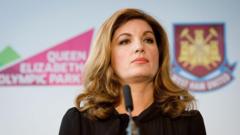
The departure of Baroness Karren Brady as vice-chair of West Ham United marks the end of a sixteen-year tenure that redefined the commercial identity of a Premier League club, but her exit arrives at a moment of profound vulnerability. On April 15, 2026, Brady officially severed her formal ties with the club she helped transform from a neighborhood institution into a global corporate entity. While the official narrative frames this as a voluntary transition to focus on the House of Lords and "The Apprentice," the timing is impossible to ignore. West Ham currently sits in 17th place, a mere two points above the relegation zone with five matches remaining. The architect of the "New West Ham" is leaving just as the foundation is showing its most alarming cracks.
Brady was never just an executive; she was the face of a specific, often divisive brand of football modernization. Her arrival in 2010 alongside David Sullivan and the late David Gold signaled a shift toward aggressive commercialization and a cold-eyed focus on infrastructure. For many years, her presence served as a shield for ownership, a high-profile figure capable of absorbing the heat of fan frustration while navigating the complex corridors of local government and global finance.
The London Stadium Legacy
The defining achievement of Brady’s career will always be the relocation from the Boleyn Ground to the London Stadium in 2016. It was a deal of historic proportions. By securing the tenancy of the 2012 Olympic flagship venue, Brady essentially gifted West Ham a 62,500-capacity arena for a fraction of what a ground-up development would have cost.
From a balance sheet perspective, it was a masterstroke. The club saw an immediate surge in match-day revenue and a significant bump in its valuation, which eventually paved the way for investment from Daniel Křetínský. However, the move came at a heavy cultural price. The "soulless" atmosphere of the converted athletics track became a focal point for supporter unrest that has persisted for a decade. Brady’s focus on the "customer experience" often clashed with the deep-rooted identity of the "fan." To Brady, the stadium was a commercial engine. To many supporters, it was a betrayal of the club’s soul.
The investigative reality suggests that while the stadium deal was a financial win, it created a permanent friction point between the boardroom and the stands. This friction has flared up repeatedly during periods of poor on-field performance, including the current 2025-26 season, where protests against the board have become a regular fixture.
The Power Vacuum in the Boardroom
Brady’s exit ends a business partnership with David Sullivan that spanned nearly forty years, dating back to their time at Birmingham City in the early 1990s. This isn't just a personnel change; it is the dismantling of a regime. Sullivan has long relied on Brady’s ability to handle the "non-football" side of the business with a ruthless efficiency.
With her gone, a significant power vacuum emerges. Daniel Křetínský, who holds a 27% stake, and Vanessa Gold, who recently took over her father’s 25.1% share, now face a club without its primary navigator. Křetínský, often referred to as the "Czech Sphinx," has been relatively quiet during his time at the club. Brady’s departure may force his hand, necessitating a more active role in the daily operations of a club that is currently flirting with the catastrophic financial implications of the Championship.
The Relegation Threat and Financial Stakes
The timing of this resignation is particularly galling for those who follow the money. If West Ham drops out of the Premier League this season, the drop in revenue will be staggering.
- Broadcast Revenue: A potential loss of over £100 million in the first year alone.
- Commercial Partnerships: Many sponsorship deals include "relegation clauses" that slash payments by half if the club is not in the top flight.
- Player Valuation: The squad's market value would plummet, potentially forcing the fire sale of assets just to stay compliant with financial regulations.
Brady’s departure on April 15 suggests she didn't want to be the one presiding over the final rites if the club fails to survive the drop. It is a strategic retreat. By leaving now, she tethers her legacy to the 2023 Europa Conference League victory rather than a potential 2026 relegation.
A Career Built on Glass Ceilings
It would be a disservice to analyze Brady’s exit without acknowledging her role as a trailblazer. In a Premier League ecosystem that is still overwhelmingly male, she was the first woman to hold a managing director role in the top flight. She thrived in a boardroom culture that was frequently hostile and overtly sexist.
Her ability to negotiate the £105 million sale of Declan Rice to Arsenal is a testament to her longevity and her refusal to be bullied at the negotiating table. She understood the value of the "West Ham brand" better than anyone, even if that brand felt alien to the people who grew up in the shadow of the old floodlights at Upton Park.
However, the "Baroness" persona—carefully curated through her TV appearances and political role—often made her feel distant from the local community. She operated in the stratosphere of global business, while the club’s core identity was grounded in the working-class roots of East London. This disconnect is what ultimately defined her tenure. She made West Ham more profitable, more famous, and more modern. She also made it more corporate.
The Immediate Operational Impact
In the short term, West Ham is now a club without a clear spokesperson. David Sullivan is a famously private and often erratic communicator. Without Brady to smooth over the rough edges of boardroom decisions, the club risks further alienation of its fan base. The search for a successor will be telling. Will the board opt for another high-profile "celebrity executive," or will they look for a football-first administrator who can repair the relationship with the supporters?
The current squad, under the leadership of Nuno Espírito Santo, is struggling for identity on the pitch. Off the pitch, the leadership is now equally fractured. The club needs a steady hand to navigate the five remaining games of the season, but the person who has been that steady hand for sixteen years just walked out the door.
Brady’s departure is the most significant indicator yet that the Sullivan era is entering its twilight. Whether this leads to a full takeover by Křetínský or a prolonged period of boardroom instability remains the critical question. For now, the "Iron Lady" of football has left the building, leaving behind a club that is richer on paper but arguably poorer in spirit. The real test of her legacy won't be the trophies in the cabinet or the capacity of the stadium, but whether the institution she helped build can survive the chaos she left behind.