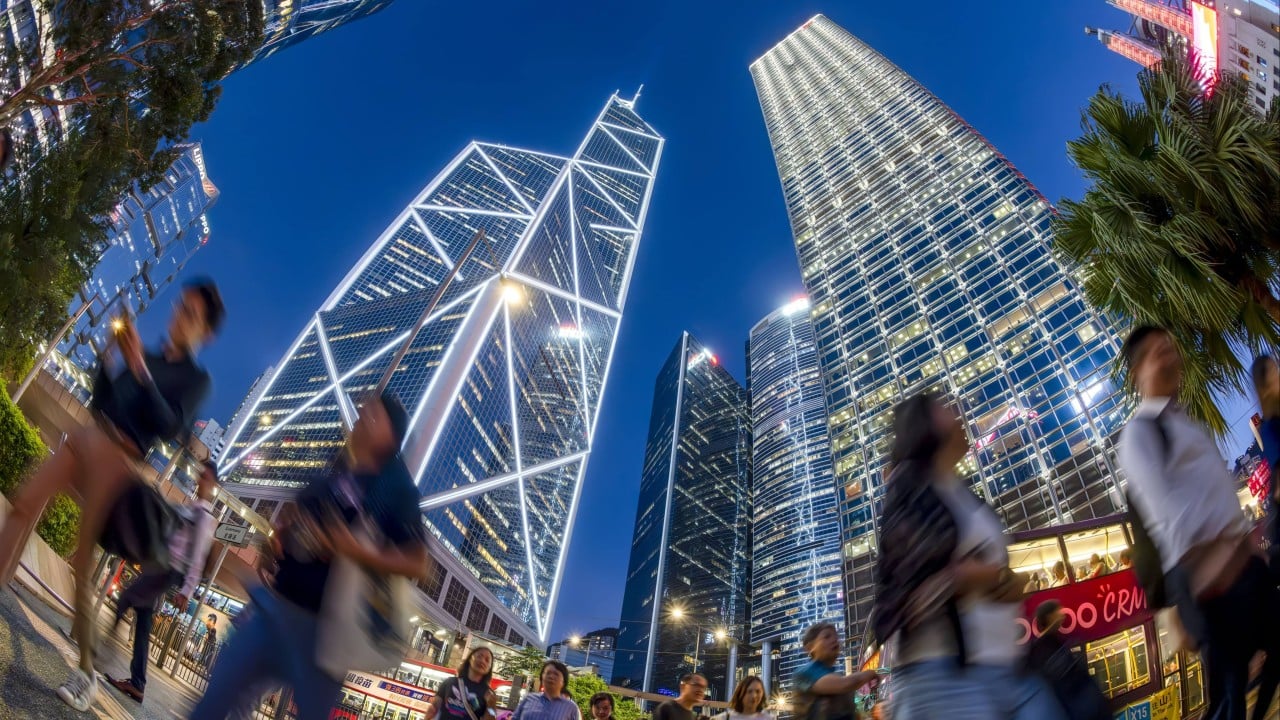
The Hong Kong Investment Corporation (HKIC) has a problem that no amount of polished annual report data can hide. While the sovereign-style fund was designed to be the city’s answer to Temasek, a strategic engine for "patient capital" in high-tech sectors, it is increasingly being eyed as a potential atmospheric stabilizer for a commercial real estate market that is effectively in freefall. The core premise—that the government can use its investment arm to prop up Grade A office demand by mandating that its portfolio companies take up local floor space—is meeting the harsh reality of a 16.3% vacancy rate.
This is not a minor adjustment or a temporary lull. It is a fundamental shift in how the city’s business district functions. By the end of 2024, the vacancy rate for Grade A offices in Central alone had surged past 13%, with some sub-markets seeing even more dramatic retreats. The HKIC is now attempting a "Synergy between Industry and Space" strategy. In plain English, this means the government is trying to manufacture tenants. If you want the HKIC’s money, you need to bring your people, your hardware, and your rent checks to Hong Kong.
The Mathematics of a Manufactured Recovery
The scale of the problem is staggering. There are over 2.1 million square meters of vacant office space sitting idle across the territory. To put that in perspective, the HKIC’s current portfolio of roughly 190 projects—ranging from biotech startups to RISC-V chip designers—is a drop in the ocean. Even if every single one of these companies established a sprawling regional headquarters tomorrow, they would barely dent the surplus.
The government’s math relies on a multiplier effect. CEO Clara Chan has frequently highlighted that every HK$1 invested by the fund attracts over HK$8 from long-term market capital. The hope is that by seeding these "anchor" tenants, the private sector will follow. But the private sector is currently looking at the exit. Between late 2023 and late 2024, office prices dropped by 22.6%. This is not the behavior of a market waiting for a signal; it is the behavior of a market repricing itself for a new, leaner era.
Forcing tech companies to occupy high-end real estate as a condition of investment is a double-edged sword. For a lean AI startup or a biotech firm focused on R&D, the overhead of a Central or even a West Kowloon office can be a lead weight.
Why the Patient Capital Label is a Shield
The term "patient capital" is used frequently by Financial Secretary Paul Chan. It is a clever bit of branding. It suggests a long-term vision that is immune to the quarterly panics of the stock market. In reality, it provides a convenient shield against the immediate lack of results. If the office market doesn’t recover in 2025 or 2026, the official response is simply that the investment hasn't reached maturity.
But patience is a luxury the commercial landlords don't have. With another 4 million square feet of new office space expected to hit the market on Hong Kong Island between 2025 and 2026, the supply-side pressure is relentless. The government has already halted the sale of commercial land sites—a move intended to "allow the market to absorb existing supply." It is a passive admission that the "Industry and Space" strategy isn't working fast enough.
The Conflict of Interest in Strategic Investment
There is a deeper, more systemic issue with using the HKIC as a real estate support mechanism. The fund’s primary mandate is to enhance Hong Kong’s competitiveness in Hard Tech, Biotech, and Green Energy. These are industries that thrive on agility, low burn rates, and global connectivity.
When you tether these investments to the local property market, you risk distorting their growth. A startup forced to lease 5,000 square feet of Grade A space to satisfy a government mandate is spending capital on rent that should be going into engineering or clinical trials. It creates a circular economy where government funds are essentially being used to subsidize the portfolios of the city’s major developers.
Furthermore, the "New Capital Investment Entrant Scheme" (CIES), which the HKIC also supervises, requires applicants to invest at least HK$30 million, with a portion directed into a portfolio managed by the HKIC. This funneling of private wealth into government-directed sectors is a bold experiment in state-led capitalism for a city that once prided itself on being the world’s freest economy.
The Missing Demand
The elephant in the room is the changing nature of work and the shifting geopolitical landscape. The "Eight Centers" plan, which seeks to position Hong Kong as a hub for everything from IP trading to international aviation, assumes that the demand for physical office space will return to pre-2019 levels. It ignores the fact that many of the multinational firms that once anchored Central have decentralized or moved functions to Singapore and Dubai.
Even the influx of Mainland Chinese firms—once thought to be the savior of the market—has slowed. These firms are now more cost-conscious, often opting for decentralized locations or smaller footprints. The HKIC’s focus on "New Quality Productive Forces" is a direct attempt to replace this lost demand with a new class of domestic and mainland-affiliated tech giants.
A Strategy of Managed Decline
If we look past the optimistic press releases, what we are seeing is a strategy of managed decline. The government knows the old model—reliant on high-frequency trading and western investment banks—is not coming back in its original form. The HKIC is an attempt to build a new foundation, but using it to shore up the office market is like trying to fix a dam with expensive, high-tech adhesive. It might look good on a technical spec sheet, but it doesn't change the volume of the water pushing against it.
The real test for the HKIC won't be how many companies it signs or how many square feet it fills in 2026. It will be whether these companies can survive without the umbilical cord of government capital. If they cannot, then the "synergy" the government is so proud of is merely a temporary lease on a future that may never arrive.
Investors and analysts should watch the vacancy rates in the Northern Metropolis and the San Tin Technopole. If the HKIC starts shifting its portfolio companies away from the traditional business districts and into these new, government-subsidized zones, it will be the final signal that the era of the Central office as the heart of Hong Kong’s economy is officially over.
The city is being rebuilt, but the bricks are being paid for by the state, and the rooms remain suspiciously quiet.