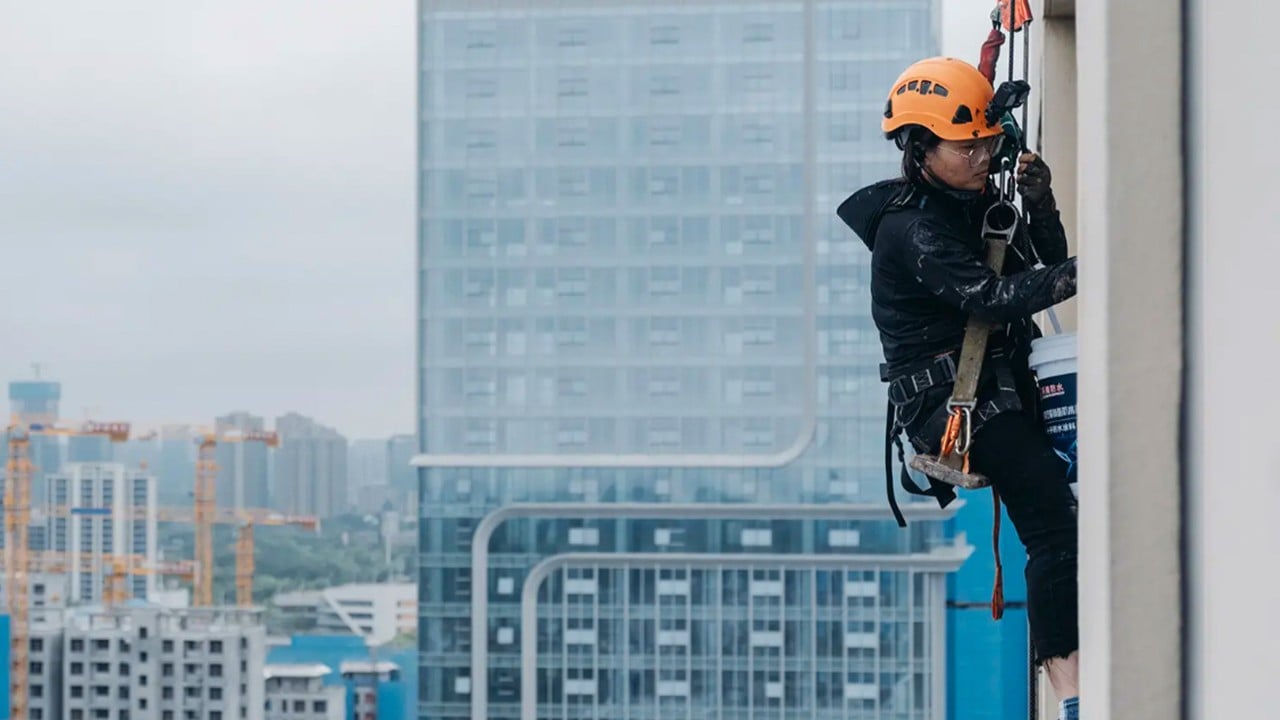
Every morning across major Chinese metropolises, thousands of workers clip themselves into simple ropes and drop off the edges of glittering skyscrapers. They are known as "spiderman" laborers, working in the informal economy to scrub glass and repair masonry hundreds of feet above the pavement. When a single mother in this industry gained viral fame as China's Spider-Woman, the internet celebrated her grit. She was balancing the grueling physical demands of high-rise maintenance with the emotional and financial burden of supporting a disabled son and an ailing elderly mother.
The viral narrative paints this as a heartwarming tale of maternal devotion. That narrative is wrong. Look closer, and her story exposes a desperate failure of the social safety net, systemic employment barriers for women, and the terrifying lack of structural support for families dealing with chronic illness and disability in modern China.
The Illusion of Choice in the Informal Economy
Rope access work is not a career choice made from a position of economic stability. It is an act of survival. For a single mother caring for two generations of dependents, the traditional Chinese corporate structure offers no flexibility. The standard 996 work schedule—9 a.m. to 9 p.m., six days a week—renders formal corporate employment impossible for full-time caregivers.
The informal economy becomes the only alternative. High-rise window cleaning and exterior maintenance offer flexible, piece-rate shifts where a worker can earn cash daily. But this flexibility comes at a staggering premium. There are no pensions, no paid sick leave, and no health insurance. If a worker slips, the family’s sole economic engine is permanently destroyed.
The pay structure itself incentivizes extreme risk-taking. Independent contractors are paid by the square meter or by the completed job, forcing workers to move at dangerous speeds. For a worker trying to secure medication for an ailing mother or specialized therapy for a disabled child, the temptation to cut safety corners to finish an extra panel before sundown is immense.
The Invisible Care Crisis and Hukou Barriers
To fully understand why a woman must scale a skyscraper to survive, one must understand the hidden mechanics of China’s social welfare system. The country relies heavily on family-based caregiving, assuming that the household will absorb the labor and cost of looking after the sick and disabled.
When a family lacks a secondary earner, this dynamic breaks down completely. Professional care facilities are prohibitively expensive for working-class families. State-subsidized care centers have massive waiting lists, often stretching on for years. This leaves single parents trapped in a vicious cycle: they cannot work traditional jobs because they must provide care, and they cannot afford professional care because they cannot work traditional jobs.
The Household Registration Bottleneck
The situation worsens significantly if the family belongs to the massive migrant worker population. The hukou system, China’s dual household registration mechanism, ties social benefits directly to an individual's registered hometown.
- Healthcare Reimbursements: Migrants working in major cities often find that their local medical insurance cards do not cover treatments or medications outside their home provinces, or they reimburse at a fraction of the cost.
- Specialized Education: Children with severe physical or developmental disabilities require specialized educational programs that are heavily guarded by urban residency requirements.
- Local Subsidies: Cash assistance programs for low-income households with disabled members are frequently non-transferable across provincial lines, leaving urban migrants entirely exposed.
This structural fragmentation ensures that the cost of managing long-term disability remains staggering, forcing marginalized earners into high-risk, unmapped industries to bridge the financial gap.
The Economics of High Rise Risk
The commercial real estate boom across China has created thousands of miles of glass facades that require constant upkeep. Property management companies frequently outsource this dangerous work to multi-tiered networks of sub-contractors to shield themselves from liability.
In this decentralized bidding system, margins are razor-thin. Sub-contractors look for ways to trim operational costs, and safety equipment is often the first target. While premium firms use industrial cradles and certified safety gear, smaller operations often rely on basic, unregulated ropes and wooden seats.
[Commercial Property Owner]
       │
       ▼ (Outsources maintenance)
[Primary Sub-Contractor]
       │
       ▼ (Sub-lets labor contract)
[Local Labor Broker]
       │
       ▼ (Recruits cash-in-hand workers)
[Informal High-Rise Worker] ◄── Assumes 100% of physical risk
The regulatory framework exists on paper, but enforcement remains highly inconsistent. Local labor bureaus struggle to monitor thousands of temporary construction and cleaning sites that pop up and vanish within forty-eight hours. When an accident occurs in the informal tier, proving an employer-employee relationship in court can take months of agonizing litigation, a luxury a desperate caregiver simply does not have.
Flipping the Script on Resilience Culture
The public fascination with tragic resilience serves a distinct societal purpose. By framing systemic survival strategies as individual acts of heroism, society avoids questioning the underlying structures that created the crisis in the first place.
Calling a desperate single mother a "Spider-Woman" transforms a systemic failure into a consumable piece of inspirational digital content. It shifts the burden of care from the state and the corporate sector squarely back onto the shoulders of the vulnerable individual. This glorification of extreme struggle obscures a simple truth: no one should have to risk their life on the side of a building just to keep their family alive.
Real, sustainable change requires moving beyond viral internet philanthropy. Relying on the erratic generosity of crowdfunding campaigns cannot replace structural reform. True progress requires deep, systemic policy intervention.
The Necessary Policy Shifts
Fixing this crisis requires addressing both labor enforcement and social safety nets simultaneously.
First, the outsourcing loop must be broken. Property owners must be held legally and financially liable for the safety standards of any worker on their facade, regardless of how many sub-contractors sit between them. If an independent worker lacks certified safety equipment and a comprehensive accident insurance policy paid for by the hiring entity, the building owner should face massive, prohibitive fines.
Second, the care infrastructure must be decoupled from the hukou system. Disability benefits, medical subsidies, and caregiver relief programs must follow the citizen, not their place of birth. Cities that benefit from the labor of migrant workers must absorb the social cost of supporting those workers' families. Until municipal governments invest heavily in accessible, state-funded day-respite centers for disabled adults and children, single parents will continue to be driven into dangerous, unregulated work environments.
The view from the top of an urban high-rise is spectacular, but for the workers dangling from the roof, it is a landscape of absolute vulnerability. The true measure of an economy's success is not the height of its skyscrapers, but the safety and dignity it guarantees to the people tasked with keeping them clean.