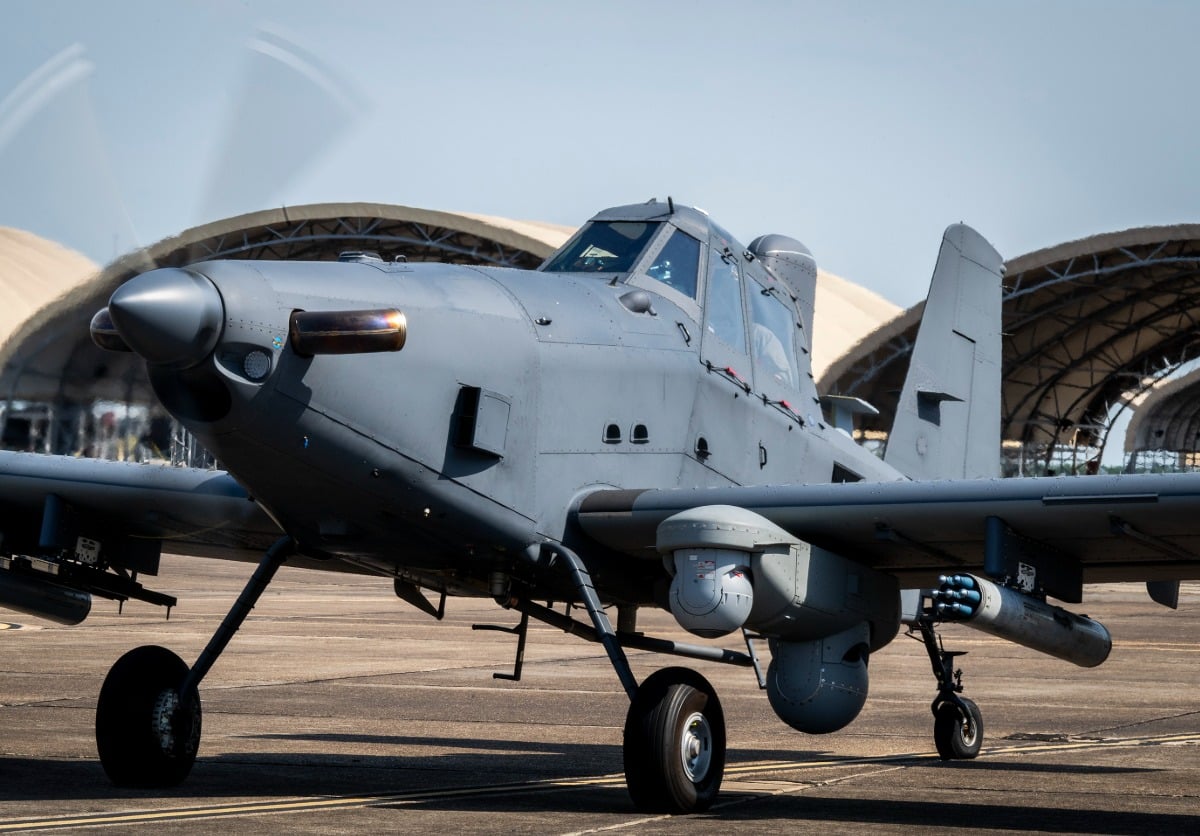
The United States Air Force is quietly hunting for a specialized cargo and baggage storage pod to outfit its brand-new OA-1K Skyraider II attack plane. This seemingly minor logistics requirement highlights a much larger, messy reality inside modern military planning. The Pentagon is trying to figure out how a heavily modified crop duster can survive and function in isolated, austere warzones when cut off from standard multi-billion-dollar supply chains.
For decades, military aviation prioritized extreme speed, radar-evading stealth, and eye-watering price tags. The OA-1K Skyraider II—a rugged, single-engine turboprop built by Air Tractor and L3Harris—is the exact opposite. Born from the Armed Overwatch program, this taildragger is designed to operate from unpaved dirt strips, loiter over targets for six to eight hours, and provide close air support for special operations teams. Yet, as the Air Force Special Operations Command (AFSOC) scales its fleet toward a planned 62 aircraft, planners have run into a distinctly unglamorous problem. If you deploy a weapon system to the middle of nowhere, where do the mechanics, the spare parts, and the pilots’ personal gear actually go? Expanding on this topic, you can also read: The Anatomy of Vietnam's T-1 Light Tank: A Brutal Breakdown of Asymmetric Armored Strategy.
The search for a dedicated storage pod exposes the structural fiction of "light, agile, and cheap" expeditionary warfare. It is a stark reminder that an aircraft is only as mobile as the gear required to keep it flying.
The Tyranny of the Unpaved Runway
The core selling point of the Skyraider II is its ability to operate where conventional fighter jets cannot. It features a steel tube roll cage, a titanium armor "bathtub" around the cockpit, and a massive Pratt & Whitney PT6A-67F turboprop engine. It is built to take a beating, land on gravel, and turn around quickly. Analysts at Gizmodo have provided expertise on this trend.
At a recent military exposition, AFSOC demonstrated a major selling point of the platform. The entire aircraft can be systematically disassembled, packed flat inside a single C-17 Globemaster III cargo jet, flown across the globe, and reassembled by a small crew in a matter of hours. This capability is explicitly aimed at overcoming vast geographic challenges, particularly the immense transit distances across the Indo-Pacific region.
But this rapid-deployment capability introduces an immediate logistical bottleneck. When a C-17 drops a Skyraider II at a remote outpost, that combat plane is immediately on the clock. It requires specialized diagnostic tools, spare tires, fuel testing kits, and essential maintenance components. The aircraft possesses 10 weapon hardpoints under its wings and fuselage, capable of carrying thousands of pounds of Hellfire missiles, laser-guided rockets, and precision bombs. What it completely lacks, however, is a trunk.
Without a dedicated, aerodynamic cargo pod fitted to one of its weapon stations, the Skyraider II cannot carry its own survival gear. If a second cargo plane has to follow the combat plane everywhere it goes just to carry luggage and spare parts, the economic and tactical argument for a cheap, independent attack aircraft completely falls apart.
The Cost Paradox of Low End Interventions
The Pentagon’s interest in propeller-driven attack planes stems from a stark financial calculation. Flying an F-35 or an F-15EX on prolonged combat air patrols over a permissive environment costs tens of thousands of dollars per flight hour. It burns through airframe life hours that are desperately needed for deterrence against peer adversaries. The Skyraider II costs a fraction of that amount to operate.
+---------------------------+-----------------------+---------------------+
| Aircraft Capability       | F-35 Lightning II     | OA-1K Skyraider II  |
+---------------------------+-----------------------+---------------------+
| Operating Cost per Hour   | $30,000+ (Estimated)  | Fractions of Jet    |
| Runway Requirement        | Paved, High-Security  | Austere Dirt Strip  |
| Loiter Time (Endurance)   | Limited without Tanker| 6 to 8 Hours        |
| Primary Weapon Focus      | High-End Stealth/Slam | Close Air Support   |
+---------------------------+-----------------------+---------------------+
However, adapting a civilian agricultural frame into a front-line military asset introduces engineering headaches. Every modification alters the weight, balance, and aerodynamic drag of the airframe. The Air Force cannot simply bolt a standard commercial cargo box to the wing of a plane that flies through active combat zones.
The sought-after storage pod must meet rigid military specifications:
- It must match the structural limits of the hardpoints without degrading flight handling.
- It must feature quick-release mechanisms compatible with standard bomb racks.
- It must withstand extreme environmental conditions, from desert dust storms to high-altitude freezing temperatures.
- It must preserve the aircraft’s low-speed handling characteristics during short-field takeoffs.
Developing or modifying a pod to meet these rigorous standards inevitably draws time and funding away from the original premise of using a cheap, off-the-shelf solution.
The Counter Argument Facing the Program
The pursuit of these auxiliary pods happens under a cloud of institutional skepticism. The Government Accountability Office (GAO) previously issued a report urging the Department of Defense to slow down procurement, questioning whether the military genuinely needs the volume of aircraft originally requested.
Critics within the defense establishment argue that the Skyraider II is a platform designed for a style of counter-insurgency warfare that the Pentagon is actively trying to move away from. In a high-intensity conflict involving advanced integrated air defense systems, a slow-moving, propeller-driven aircraft would face severe survivability challenges, regardless of its titanium armor.
Proponents push back by highlighting the realities of global military operations. Even during a large-scale theater conflict, there are secondary regions, peripheral threats, and irregular warfare missions that still require airborne surveillance and precise firepower. By utilizing a low-cost turboprop platform to handle low-threat environments, the Air Force preserves its highly sophisticated stealth fighters for the high-end missions they were exclusively built to handle.
Bridging the Operational Gap
The storage pod requirement is not a minor footnote. It is the missing link in making the Armed Overwatch concept functional in reality.
If the Air Force succeeds in procuring a ruggedized, certified cargo container that rides on a standard weapon station, the tactical flexibility of the platform changes. A pair of Skyraider IIs could deploy autonomously to a forward arming and refueling point. One aircraft would carry the necessary precision munitions, while the second carries the diagnostic tools, spare components, and mission-planning gear in its underwing pod. This self-sustainment is precisely what separate special operations units require when operating far outside the umbrella of traditional logistics hubs.
The ongoing effort to source this equipment shows that moving away from high-tech dependence is far more complicated than simply buying a simpler plane. Stripping away the luxury of advanced military infrastructure requires solving the basic, grounded problems of weight, space, and survival. The success of the Skyraider II will ultimately not be judged by how many missiles it can hang from its wings, but by whether it can carry enough tools to fix itself when the nearest maintenance depot is an ocean away.