Every August, the quiet Valencian town of Buñol transforms into a saturated red swamp of pulverized tomatoes, drawing tens of thousands of global travelers for La Tomatina. Most travel brochures frame the event as a spontaneous, anarchic explosion of joy, a chaotic street party where strangers joyfully hurl overripe produce at each other until the historic center resembles an abattoir. That romanticized narrative is a carefully maintained illusion. Behind the viral Instagram reels and the cheerful tourism board press releases lies a hyper-regulated, intensely engineered municipal operation managed with the precision of a military deployment.
The reality of La Tomatina is less about wild abandon and more about crowd containment, sanitation logistics, and damage control. Managing a transient population of twenty thousand people packed into narrow medieval alleys while dumping one hundred and twenty metric tons of acidic pulp requires months of advance bureaucratic coordination. Understanding the mechanics of this famous food fight means stripping away the festival mythology to look at how a tiny municipality survives its own manufactured spectacle.
The Economic Architecture of a Red Morning
Buñol is a working-class town historically dependent on agriculture and cement manufacturing, with a permanent resident population hovering around nine thousand people. For three hundred and sixty-four days a year, its economy ticks along at a predictable, modest pace. Then the final Wednesday of August arrives, and the town absorbs an influx of visitors that triples its headcount in a matter of hours.
The financial engine driving this madness is straightforward ticket sales and municipal fee collection. For years, the event operated as a free-for-all, drawing up to fifty thousand participants until the overcrowding became an active hazard. In 2013, the local government capped attendance at twenty thousand and instituted a ticketing system.
Ticket revenue funds the purchase of the tomatoes, the hiring of private security firms, the deployment of medical tents, and the massive post-event cleanup operation. Local merchants certainly capture a surge in revenue from morning coffee, beer sales, and parking fees, but the broader economic benefit is unevenly distributed. Many residents shutter their shops and drape their storefronts in thick plastic sheeting, effectively locking down their properties to protect against the staining, highly acidic waste splashing against building facades. The romantic notion that every local rejoices in the tomato deluge ignores the reality of property maintenance costs and structural wear in a historic quarter.
Sourcing the Ammunition
Where do all those tomatoes actually come from, and why are they thrown in the first place?
The fruit used during La Tomatina is not locally harvested table produce destined for European dinner plates. Sourcing high-grade tomatoes for a municipal battle would draw immediate, fierce criticism over food waste. Instead, the town contracts with agricultural suppliers for the perelló variety, an inexpensive, overripe strain grown specifically because it lacks commercial market value. These tomatoes are grown in Extremadura and other agricultural regions where yields occasionally outpace demand or where fruit ripens past the point of viable transport. They are essentially waste product repurposed as spectacle.
Truckloads of these discarded crops arrive on the morning of the event, backed tightly down the narrow thoroughfares of Calle del Cid and Plaza del Pueblo. Municipal workers stand atop the flatbeds, slicing open crates and hurling the initial salvos to prime the pump before the human tide surges forward.
Critics frequently argue that squandering food on this scale is indefensible, pointing to global food insecurity and inflation. The municipality defends the practice by noting that these specific tomatoes would otherwise rot in storage or be plowed back into fields as fertilizer. Still, the visual optics of tonnage being ground into the pavement remain jarring in an era of heightened ecological and economic anxiety.
Crowd Control and Municipal Engineering
The actual fight lasts precisely one hour, beginning at precisely eleven in the morning with the firing of a ceremonial water cannon and ending with a second shot that silences the chaos. That sixty-minute window is the result of exhaustive safety planning designed to prevent crush injuries and heat exhaustion.
The alleys of Buñol are ancient, narrow, and flanked by multi-story residential buildings with limited exit routes. If twenty thousand adrenaline-fueled individuals descended upon these spaces without strict perimeters, the risk of a fatal crowd surge would skyrocket. Consequently, access points are heavily gated. Private security and civil guard units check wristbands at designated checkpoints, filtering crowds into holding zones before the trucks roll through.
Participants quickly learn a set of unwritten survival rules that seasoned veterans enforce with stern authority. Tomatoes must be squashed in your hands before throwing to prevent direct impact injuries from hard, unbruised fruit. Protective goggles are mandatory equipment, not a fashion statement, because the citric acid in thousands of crushed tomatoes creates an aggressive burning sensation upon contact with unprotected eyes. Closed-toe shoes are essential unless you want your feet stepped on by combat boots or crushed beneath the weight of stumbling bodies.
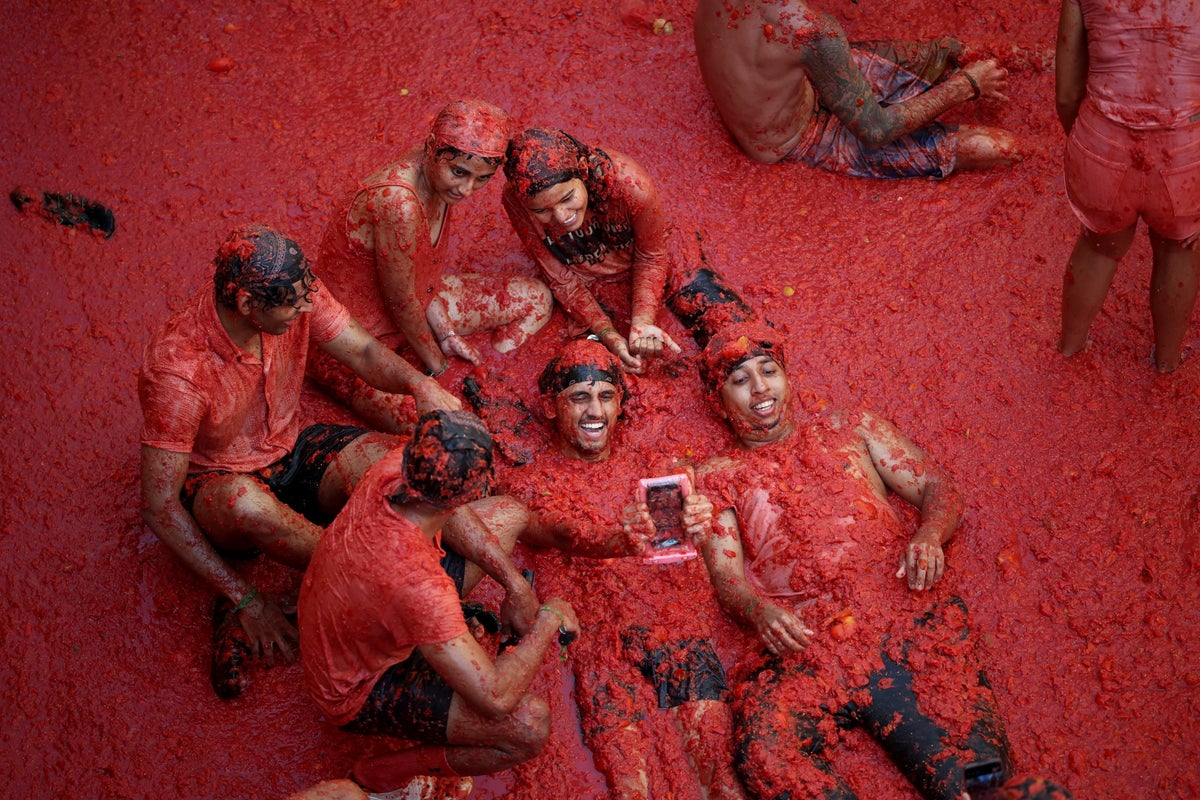
As the hour progresses, the streets fill with a deep, pulpy slurry that rises above the ankles. Walking turns into a sluggish, anaerobic slog through a sticky red morass. The air smells intensely of fermented acid and crushed seeds, a sensory assault that lingers in the nostrils for days.
The Cleanup Machine
The true marvel of La Tomatina is not the violence of the tomato barrage, but the speed of the municipal resurrection.
At twelve noon, the final horn sounds. The combatants drop their arms, wiping stinging pulp from their faces, and begin stumbling toward the Buñol River or makeshift garden hoses set up by sympathetic locals. Within minutes, the human tide begins retreating toward the train station, leaving behind a ruined urban landscape.
Then the heavy machinery moves in.
Fire trucks from the surrounding province converge on the historic center, spraying high-pressure jets of water down every alleyway and plaza. The municipal sewer grates, specially cleared beforehand, channel millions of liters of tomato-stained water out of the town center. Local sanitation crews deploy industrial scrubbing agents to neutralize the acidity before it can eat away at asphalt or seep into the foundations of historic masonry.
By mid-afternoon, the streets are clean enough to walk on in bare feet, albeit with a faint pink tint clinging to the masonry and an unmistakable metallic scent hanging in the humid Valencian air. The illusion of a permanent state of festival chaos vanishes, replaced by the quiet hum of a small Spanish town preparing for the next morning.
The Future of the Red Tide
La Tomatina survives because it satisfies a modern psychological hunger for sanctioned transgression. In an increasingly sanitized, digital, and risk-averse world, adults crave a socially approved space to regress, to get messy, and to abandon polite societal norms for sixty minutes of unbridled tribalism.
Yet the festival walks a perpetual tightrope. Climate shifts have made August temperatures in inland Spain dangerously high, turning the crowded alleys into potential heatstroke traps. Municipal authorities face continuous pressure to balance tourism revenue against the logistical strain on local infrastructure.
The spectacle persists because it is profitable, but its long-term viability depends entirely on the cold, calculated efficiency of its backstage managers. The tomato fight is an illusion of wildness built on a foundation of rigid engineering.