The raw wind off the North Sea does not care about modern art. It sweeps across the manicured lawns and wild thickets of the botanical garden, carrying the scent of damp earth, pine needles, and impending rain. On days like this, most people hurry toward the glasshouses, seeking the predictable warmth of tropical orchids and safely contained ferns.
But if you look closely near the edge of the woodland trail, something massive is changing.
A flatbed truck sits idling on the gravel path. Heavy nylon straps groan under the weight of three tons of dark, weathered bronze. Men in high-visibility jackets speak in hushed, urgent tones, their breath pluming in the crisp air as they guide a crane. The object dangling above the grass looks less like a statue and more like a bone unburied from the earth, or a boulder smoothed by ten thousand years of glacial retreat.
This is the arrival of Henry Moore.
For the next several months, a curated selection of the legendary British sculptor’s monumental works will call this botanical sanctuary home. On paper, a press release would tell you the dates, the ticket prices, and the names of the foundations involved. It would call it a "cultural collaboration."
That completely misses the point.
To understand why someone would haul millions of dollars of priceless art into the mud and rain, you have to understand what happens to us when we step inside a traditional museum.
The Gallery Paralysis
We have all felt it. You walk into a grand, white-walled gallery. The floors are polished limestone that echoes every footstep, practically shouting to the room that your shoes squeak. The lighting is clinical, pinpointed, and perfect. Guards stand in the corners with their arms crossed, watching your hands.
Everything whispers: Do not touch. Do not get too close. Do not breathe too loudly.
In those spaces, art becomes an artifact. It is isolated from the world, preserved in a sterile vacuum. You look at a sculpture, read the little white card on the wall, nod to prove you understand it, and move on. It is an intellectual exercise, not an emotional encounter.
Henry Moore hated that.
He grew up the son of a coal miner in Yorkshire. He knew the grit of the earth, the heavy density of stone, and the way Yorkshire’s rolling hills looked like sleeping giants against the sky. He didn't design his massive, abstract human figures to sit under halogen bulbs. He designed them to fight with the elements.
Consider what happens when you place a bronze sculpture outside. It ceases to be static. At 8:00 AM, the morning sun hits the crest of a bronze shoulder, turning the dark metal into a warm, glowing gold. By noon, heavy clouds roll in, and the valleys of the sculpture pool with shadow, making the piece look brooding and defensive. When the rain inevitably falls, water runs down the green-patina grooves like tears or rivers, changing the texture entirely.
The art is alive because the world around it is alive.
The Human Geometry of Stone
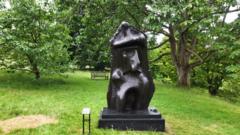
There is a specific piece being lowered onto a reinforced concrete pad near the arboretum. It is a reclining figure, a motif Moore returned to throughout his entire life. To the untrained eye, it doesn't look like a person at all. It has a tiny, featureless head, a hollowed-out torso, and limbs that blend into one another like eroded cliffs.
It is easy to feel confused by abstract art. We want things to look like what they are. We want a face to have eyes; we want a body to have fingers.
But stand twenty feet back from this bronze form and look through the massive hole pierced through its center. Through that negative space, you don't see a white museum wall. You see a centuries-old oak tree. You see the wind bending the long grass. You see the horizon.
Moore realized something profound during the air raids of World War II, when he was commissioned as an official war artist to sketch thousands of Londoners sleeping in the Underground stations. He saw humanity stripped down to its barest essentials: bodies huddled together for warmth, wrapped in blankets, morphing into collective shapes of endurance and survival.
He didn't just see people; he saw landscape. And he saw the landscape in people.
The holes in his sculptures aren't accidents, nor are they avant-garde tricks. They are invitations. They allow the world to pass through the art. A bird can fly through a Henry Moore sculpture. A child can look through it to spy on their parents. The sculpture doesn't block nature; it frames it. It forces you to look at the trees and the sky with fresh eyes, realizing that the curves of the earth match the curves of our own bodies.
The Logistics of the Impossible
Moving these titans is a quiet nightmare that the public never sees. A botanical garden is a living museum of rare, sometimes endangered flora. You cannot simply drive a massive crane over the root system of a 200-year-old Japanese maple without killing it.
The preparation begins months in advance. Engineers map out underground utility lines and test soil density to ensure the earth won't swallow a multi-ton sculpture after a heavy rainstorm. Arborists prune specific branches with surgical precision to clear a path for the crane arms without harming the canopy. Special tracking pads are laid down over lawns to distribute the weight of the transport vehicles, transforming the delicate turf into a temporary highway.
It requires an immense amount of human sweat, anxiety, and precision. One slip of a cable could chip a masterpiece or crush a collection of irreplaceable alpine plants.
Yet, when the public arrives tomorrow, all the machinery will be gone. The tracks will be lifted. The grass will be brushed back into place. The sculptures will simply exist there, looking as though they sprouted from the soil alongside the rhododendrons.
That illusion of permanence is the ultimate triumph of the exhibition. It creates a space where you can stumble upon genius by accident.
The Value of Getting Lost
We live in a culture obsessed with efficiency. We optimize our schedules, stream our entertainment on demand, and experience the world through five-inch glass screens. Even our trips to cultural institutions are often planned down to the minute, guided by audio tours and algorithms.
A exhibition like this breaks that rhythm completely.
You might enter the botanical garden with a map, looking for a specific rare orchid house. But then, through the mist or the shifting leaves, you catch a glimpse of something monumental and dark rising from the meadow. You deviate from the path. You walk across the wet grass, ruining your shoes, drawn by curiosity.
You find yourself standing before a sculpture that is cool to the touch, smelling of wet metal and moss. You notice how the green patina on the bronze perfectly mimics the lichen growing on the bark of the nearby beech trees.
You are no longer a consumer checking a cultural box. You are an explorer.
This is the invisible stake of the entire project. It isn't about selling tickets or boosting the garden’s profile, though those things keep the lights on. It is about restoring a sense of wonder to our daily existence. It is about remembering that art is not a luxury item meant solely for billionaires' vaults or silent auction houses.
Art is a baseline human necessity. It is our way of marking the earth, of saying we were here, we felt this, we survived.
The rain begins to fall now in earnest, drumming a steady, hollow rhythm against the bronze back of the reclining figure. The installation crew is packing up their tools, their faces flushed from the cold and the satisfaction of a heavy job completed.
The garden is empty now, closed to the public until morning. The great bronze shapes stand alone in the downpour, perfectly at home, waiting for the sun to change them all over again.