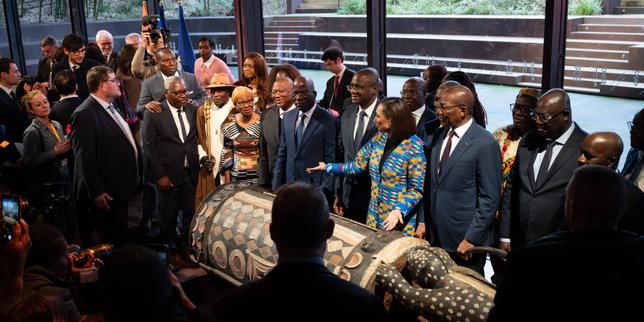
France is finally moving toward a framework law to return cultural assets looted during the colonial era, but the legislative machinery is moving with a calculated slowness that suggests preservation of the status quo rather than a radical break from the past. For decades, the Quai Branly-Jacques Chirac Museum and other state institutions held these objects behind a wall of "inalienability," a legal doctrine that made state collections permanent and untouchable. The new law aims to replace the current system of "one-off" legislative exceptions with a streamlined process. Yet, underneath the diplomatic handshakes and the talk of "cultural cooperation," a more cynical reality persists. The law creates as many hurdles as it removes, ensuring that the return of African heritage remains a grueling, case-by-case negotiation rather than a swift act of justice.
The Myth of the Clean Break
Political leaders in Paris want the public to believe this is a moral awakening. It isn't. The push for a framework law is a pragmatic response to a geopolitical nightmare. France is losing its grip on its former African colonies, and "cultural diplomacy" is one of the few soft-power tools left in the shed. By creating a standardized path for restitution, the French government hopes to manage expectations and prevent a chaotic flood of claims that could empty their national galleries.
The core of the problem lies in the definition of "looted." The French Senate has consistently tried to narrow this window, favoring a definition that requires proof of "violence" or "duress." This ignores the systemic power imbalance of the colonial period. When a colonial administrator "purchased" a sacred mask for a pittance from a village under military occupation, was that a fair market transaction or a theft? The framework law remains vague on these nuances, leaving the heavy lifting to a committee of "experts" whose composition will likely favor the established museum hierarchy.
The Inventory of Silence
We are talking about hundreds of thousands of objects. From the Benin Bronzes to the manuscripts of the Toucouleur Empire, the sheer volume of African history sitting in European basements is staggering. Most of these items are not even on display. They sit in climate-controlled crates, studied by Western academics while the descendants of those who created them are denied access.
The argument often used to stall restitution is the "conservation" defense. Curators argue that African nations lack the infrastructure to maintain these fragile artifacts. This is a patronizing deflection. It positions the thief as the rightful guardian because they have a better security system. Furthermore, it ignores the fact that many of these objects were never meant to be preserved in sterile glass boxes for eternity. They were living parts of religious and social rituals. By keeping them in Paris, the French state continues to strip them of their original purpose, maintaining a form of cultural imprisonment.
The Bureaucratic Trap
Under the proposed framework, a request for restitution must originate from a sovereign state. This sounds logical until you look at the map. Colonial borders rarely align with ethnic or cultural boundaries. If a sacred object belonged to a community that is now split across three different modern countries, who gets to ask for it? By forcing claims through the bottleneck of state-to-state diplomacy, France ensures that internal African politics will slow the process even further.
Moreover, the "scientific committee" tasked with evaluating claims will be a battleground. If the committee is dominated by French curators, the bias toward keeping collections "intact" will be overwhelming. There is no such thing as a neutral historian in this conversation. Every expert brings a perspective shaped by their training, and most European training is rooted in the belief that the "universal museum" is the highest form of cultural achievement.
Beyond the Benin Bronzes
While the 26 treasures returned to Benin in 2021 made for excellent photography, they represent a microscopic fraction of what was taken. That return was a "special law," a one-time gift that required a full vote in the French Parliament. The framework law is supposed to make this automatic, but the criteria for "restitutability" are being tightened behind closed doors.
There is a growing fear among museum directors that once the floodgates open for Africa, other regions will follow. Claims from Southeast Asia, the Pacific Islands, and South America are already gathering steam. The French establishment sees this law as a levee. They are building it not just to facilitate returns, but to control the flow and prevent a total breach of the "inalienability" principle that protects the rest of their global acquisitions.
The Economic Ghost of Colonialism
We cannot discuss the movement of statues without discussing the movement of money. The "restitution economy" is becoming a business in itself. French companies are already lining up to build the very museums in Africa that will house the returned items. In some cases, the return of an object is quietly linked to the signing of infrastructure contracts or military agreements. This isn't just about art; it's about the continued leverage of the former metropole over the periphery.
There is also the question of compensation. For over a century, European museums have generated revenue from these objects through ticket sales, merchandising, and prestige. No one is talking about returning the profits made off the back of stolen culture. The framework law focuses strictly on the physical object, neatly sidestepping the massive financial debt owed for the exploitation of these cultural assets.
The Resistance Within the Senate
The legislative path has been anything but smooth. The right-wing controlled Senate has repeatedly attempted to add clauses that would make restitution nearly impossible. They want to ensure that any return does not "significantly impoverish" the national collections. This is a subjective and dangerous metric. If a collection is built on 90% looted goods, returning them will certainly "impoverish" the museum, but that doesn't make the retention of the goods any more legal or moral.
These senators represent a segment of the French elite that still views the colonial era with a sense of "civilizing mission" nostalgia. To them, returning these objects is an admission of guilt they are not ready to make. They see the law as a surrender, while the proponents see it as a necessary evolution to save what remains of France's influence in the world.
The Role of Provenance Research
One of the most effective ways museums delay restitution is by demanding "absolute proof" of provenance. They ask for paper trails that they know do not exist because colonial looters didn't often keep meticulous receipts of their crimes. The burden of proof is placed on the victims, who must reconstruct histories that were intentionally erased by the colonial education system.
A fair framework law would shift this burden. It should be up to the museum to prove that an object was acquired through a legitimate, transparent, and voluntary transaction. If they cannot prove it was bought fairly, the assumption should be that it was taken under the coercive atmosphere of the colonial administration. This shift would change everything, but it is exactly what the French legal system is fighting to avoid.
A New Form of Cultural Colonialism
There is a danger that restitution becomes a "digital-first" initiative. Some European institutions are suggesting that they keep the physical objects but provide African nations with high-resolution 3D scans or virtual reality experiences. This is an insult. It suggests that a digital ghost is an adequate replacement for a physical ancestor. It also ensures that the physical "gold" remains in European vaults while the rest of the world gets the "paper" version.
True restitution requires the physical transfer of the object, the transfer of all legal rights, and an unconditional apology for the original theft. Anything less is just a long-term loan rebranded as a gift. The framework law, in its current draft, leans dangerously toward "deposits" and "long-term loans" rather than full sovereign returns.
The Strategy of Exhaustion
The French government is betting on the fact that African nations have limited resources to fight these legal battles. Between economic crises, security threats, and domestic politics, many governments may not have the capacity to engage in a twenty-year legal struggle for a dozen masks. By making the process bureaucratic and technical, France is using the "strategy of exhaustion."
This is why the framework law is a double-edged sword. It provides a path, but it is a path through a swamp. For every step forward, there is a committee, a report, a diplomatic review, and a parliamentary oversight meeting. It is designed to look like progress while moving at a pace that ensures most of the people currently fighting for these objects will be dead before they see them return home.
The reality is that these objects are not just "art." They are the stolen identity of entire nations, and their presence in Paris is a daily reminder of a colonial era that France refuses to fully bury. If this law is to be anything more than a PR stunt, it must strip away the protections for "national collections" and treat stolen goods for what they are, regardless of how long they have been sitting in a museum. The time for "cooperation" is over; the time for the return of property is long overdue.