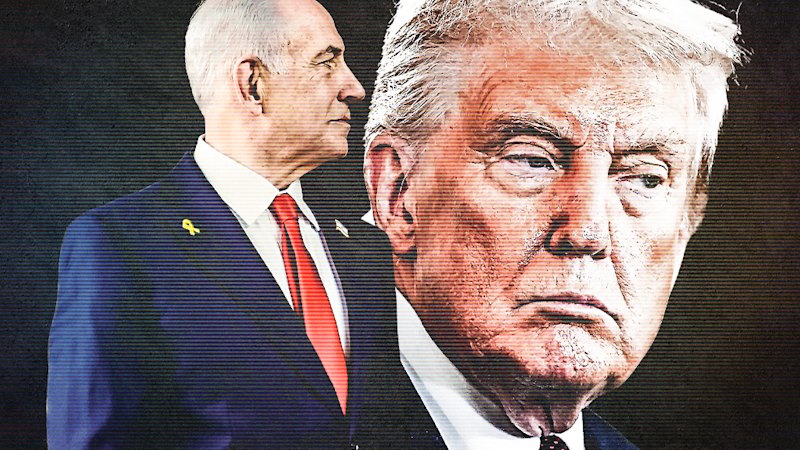
The room is always colder than you think it will be. When you step into the orbit of a truly transactional power broker, the air shifts. It is not about ideology. It is not about shared history, treaties, or the sacred bonds of international diplomacy. Those are words for speeches. In the private theater of absolute leverage, there are only two roles that ever matter: the boss and the enforcer.
For years, observers viewed the relationship between Donald Trump and Benjamin Netanyahu through the standard lens of geopolitics. They called it an alliance. They analyzed it in terms of electoral blocks, military aid, and regional stability in the Middle East. But that framework gets the entire dynamic backward. To understand the sharp, public pivots and the sudden, stinging taunts that have recently flown from Mar-a-Lago toward Jerusalem, you have to abandon the textbooks. You have to look at the raw mechanics of a corporate takeover or a family franchise.
Think of a local franchise owner who runs the most profitable store in a difficult territory. He is sharp. He is ruthless. He has survived every local competitor and outlasted every internal mutiny. He begins to believe that the territory belongs to him. He forgets that his sign, his supply line, and his ultimate protection still come from the corporate headquarters across the ocean. Then, one day, the phone rings. Or worse, the CEO goes on television and mocks him in front of the entire company.
That is the sound of the leash snapping taut.
The Illusion of the Equal Partner
Power is a mirage until it is tested against a larger mass. Throughout his record-breaking tenure as Israel’s prime minister, Netanyahu mastered the art of managing American presidents. He managed Bill Clinton with a brashness that famously left White House staffers stunned. He managed Barack Obama by bypassing him entirely, taking his grievances straight to a joint session of the United States Congress. Netanyahu operated under a specific, highly successful assumption: that the American political system was a machine he knew how to play.
Then came 2016.
The machine was replaced by an individual. Donald Trump did not view foreign policy as a grand strategy to be executed by a professional diplomatic corps. He viewed it as a portfolio of personal relationships where he held the majority share. For a time, the interests of the boss and the enforcer aligned perfectly. The embassy moved to Jerusalem. The Golan Heights were recognized. The Abraham Accords bypassed the old diplomatic logjams.
To the untrained eye, it looked like a deep partnership. But a partnership implies a shared risk. In this arrangement, the risk was entirely localized. Netanyahu was given immense latitude to run his territory, but the latitude was a loan, not a gift.
The turning point was not a policy disagreement. It was a violation of the primary code of transactional loyalty. When Netanyahu congratulated Joe Biden on his 2020 election victory, he acted like a conventional statesman following standard international protocol. To Trump, it was a defection. It was the enforcer acknowledging a new boss while the old one was still breathing.
The reaction was immediate, visceral, and laced with profanity. The public taunts that followed over the subsequent years—ranging from criticisms of Netanyahu’s intelligence failures to casual dismissals of his political strength—were not erratic outbursts. They were deliberate calibrations. They were reminders to the entire political ecosystem that in the world of transactional power, no local manager is irreplaceable.
The Middle Management Trap
Consider the psychological toll of this dynamic on a nation's leadership. When a leader relies heavily on the personal favor of a foreign patron rather than institutional guarantees, they enter a state of permanent vulnerability.
Imagine a tightrope walked in heavy boots. Every step toward domestic political survival risks alienating the patron. Every step toward pleasing the patron risks fracturing the fragile coalition at home. Netanyahu found himself trapped in this precise middle-management dilemma. He needed the American shield to maintain his projection of absolute security to his electorate. Yet, the man holding the shield had made it clear that the protection could be withdrawn the moment the enforcer became more of a liability than an asset.
This is where the standard analysis fails. Analysts often ask what a specific statement means for the future of military funding or intelligence sharing. They look at the bureaucratic machinery. They forget that the machinery is turned on and off by human whim when institutions are subordinated to personality.
The warnings issued from the stage at rallies or through late-night social media posts are designed to show the audience—both the domestic American base and the political rivals within Israel—exactly where the true authority lies. It says: I made you. I can unmake you.
The Price of Admission
There is a distinct pattern to how this type of authority operates. It requires constant public deference. It thrives on the spectacle of submission. When the enforcer attempts to project independent strength, the boss must reassert dominance, not because the policy matters, but because the hierarchy must be preserved.
We see this play out in the shifting rhetoric surrounding regional conflicts. The boss demands quick victories and clean resolutions. The enforcer, dealing with the muddy, bloody reality on the ground, stretches the timeline to ensure his own survival. The tension builds. The language turns sharp. The boss begins to musingly wonder aloud if perhaps someone else could run the shop better.
This is the hidden cost of relying on a transactional doctrine. Standard alliances are built on treaties that survive transitions of power. They are slow, boring, and predictable. Transactional alliances are fast, thrilling, and utterly terrifying because they depend entirely on the shifting moods of the individuals at the top.
When the enforcer denies the boss—whether by moving too slowly, taking too much credit, or failing to deliver a clean win that makes the boss look good—the retaliation is rarely a formal diplomatic protest. It is a public humiliation. It is a calculated leak. It is a demonstration to the rest of the world that the enforcer is just an employee.
The lesson is old, written in the history of empires and corporate boardrooms alike. You cannot use a tiger for a mount and expect to dictate the direction of the travel. The moment you try to pull the reins too hard, the rider realizes they are just a meal waiting to happen. The air in the room stays cold, the phone remains silent, and the local manager is left to face the crowded room alone, wondering if the next announcement from headquarters will be the one that replaces him entirely.